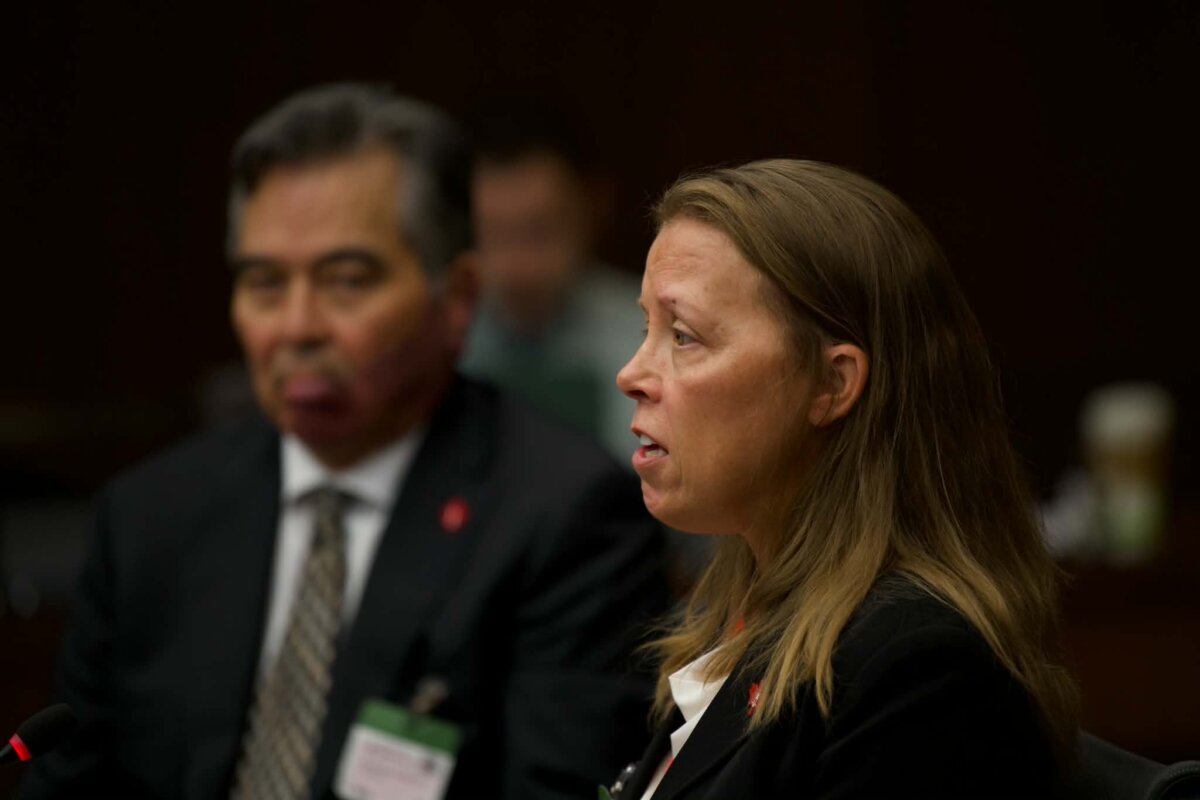

An Alberta woman injured by the COVID-19 vaccine told a public inquiry that her family was forced to sell their businesses and home in order to pay for medical treatments.
“It’s been devastating. Not only did we have to sell everything, uproot my family in a home that we always called our forever home, and had to explain to the kids that we just can’t stay here anymore,” Carrie Sakamoto testified before the Allison Inquiry on Sept. 8.
Sakamoto was one of dozens of Canadians who are testifying before the Allison Inquiry, which aims to provide a forum for Canadians who say they were injured by COVID-19 vaccines to tell their stories.
Sakamoto said she received an AstraZeneca COVID-19 vaccine and a second Pfizer dose, which led her to develop flu-like symptoms, swollen lymph nodes, and a pain that she described as “fire in my brain.” After being hospitalized, Sakamoto says she was diagnosed with Bell’s palsy, leaving half of her face paralyzed.
She said given that she still experiences vertigo, pain in her brain, and memory loss, she has been unable to continue working. She said she is one of the few who have received partial payment for her injuries through Canada’s Vaccine Injury Support Program (VISP), but she was denied coverage for medications, therapies, hearing aid, glasses, and psychology.
Sakamoto’s husband Shawn said it had been “incredibly difficult for our family,” given that they had been forced to sell their house and farm, and could not get a bank to provide them with a loan.
The federal government took over VISP in April 2026 amid criticism of the program, such as long wait times and allegations that the files of the vaccine-injured were being mismanaged. The program has since been renamed the Vaccine Impact Assistance Program (VIAP).
The Public Health Agency of Canada said in July that it had “further strengthened” the administration of VIAP, including through launching a new online portal, clarifying program rules such as eligibility criteria, providing financial support to previously approved claims, and improving training and resources for VIAP contact centre agents.
Veterans
During the hearings, Catherine Christensen, founder of Valour Law, testified that members of the Canadian Armed Forces (CAF) had developed ailments like cardiac injuries, clotting, neurological symptoms, and reproductive disruption, which they attribute to COVID-19 vaccination.
Christensen, who has been representing hundreds of CAF members who have been injured by or refused COVID-19 vaccines, said one officer who was “above the requirement for fitness in the armed forces” developed myocarditis after his first dose, was required to take a second dose, and then spent two-and-a-half years obtaining a vaccine-injury diagnosis while his release was coded as mental health.
Another CAF member collapsed while trying to start his car in the snow after receiving his second vaccine dose, and was later found to have blood clots that put his oxygen saturation under 30 percent, according to Christensen.
Michael McNair, an 11-year veteran of the CAF, testified before the inquiry that he developed severe venous thrombosis several weeks after his second Moderna vaccine dose, which resulted in his medical release from the CAF. The military denied his claim that the ailment was service-related.
While the CAF imposed COVID-19 vaccination as a condition of service in October 2021, it was lightened a year later to allow non-vaccinated individuals to serve, but it was kept in place for operational roles.
In 2023, a CAF spokesperson said the military always based its decisions around vaccination by “considering the most up-to-date medical evidence and advice, the current federal posture, and the need to be operationally ready in terms of both force health and ability to act in an environment where any vaccine-preventable illness is a hazard to individuals and the mission.”
Earlier on Sept. 8, the inquiry heard from U.S. Senator Ron Johnson, who alleged that the coronavirus was not as dangerous as it was portrayed to be, and that lockdowns and vaccines were harmful to Americans and Canadians. The inquiry will run until Sept. 11.
 Friends Read Free
Copy
Facebook
Tweet
Friends Read Free
Copy
Facebook
Tweet