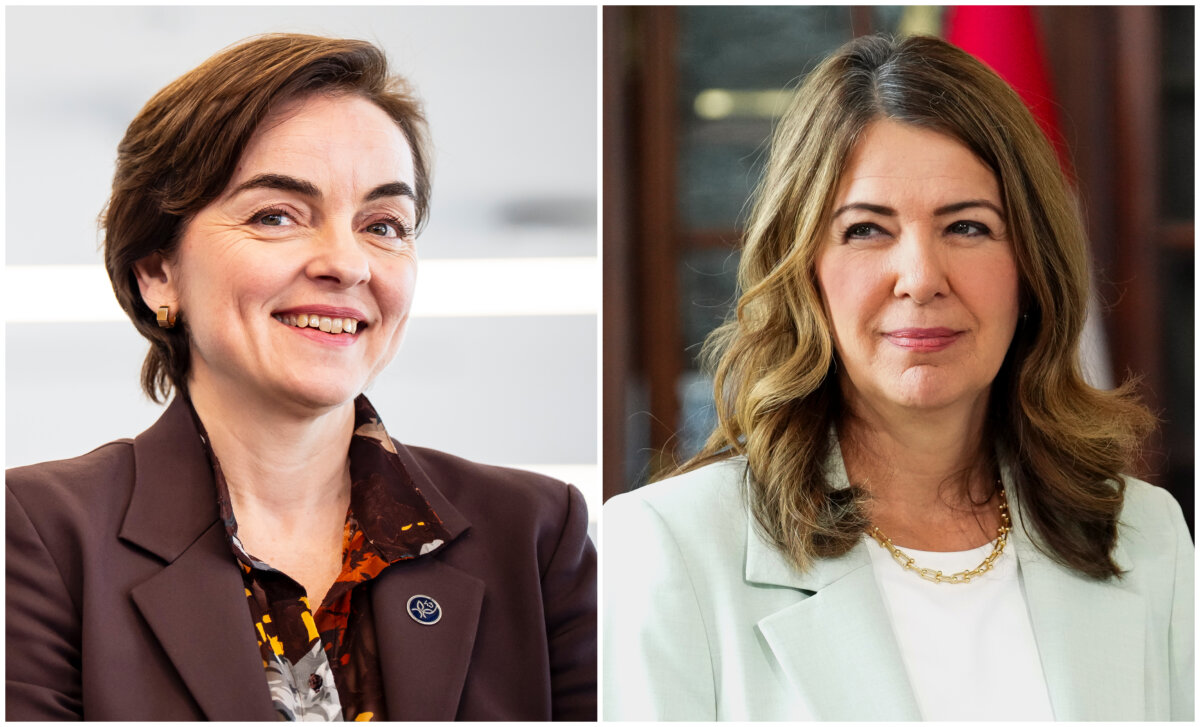

Alberta Premier Danielle Smith is scheduled to meet with her counterpart in Quebec City this week, where energy and separatism are expected to be among the main topics of discussion.
Smith told reporters on June 1 that she is optimistic about Quebec Premier Christine Frechette’s willingness to discuss an east-west energy corridor, and emphasized that she has consistently advocated for the development of a self-sufficient energy sector each time she has met with Quebec’s leadership. Frechette has discussed reopening that conversation as well, Smith added.
Smith said while both she and Frechette wish to stay in Canada as separatist sentiments rise in their provinces, they share common goals in strengthening their independence.
“I think that we can have a strong partnership between Quebec and Alberta, not only on how we repair the country so it gets back to the way it was initially intended to run, but also on an energy corridor,” Smith said during an unrelated press conference in Calgary. “So, I think it’s going to be a great couple of days talking with her.”
Smith is travelling to Quebec City on June 2, where she is scheduled to meet with government officials, according to Smith’s itinerary. The following day she will meet with the president of the National Assembly of Quebec and will speak at a fireside chat organized by the Montreal Council on Foreign Relations and the Federation of Chambers of Commerce of Quebec.
She will then have a “bilateral meeting” with Fréchette before travelling back to Alberta.
The discussions will focus on strengthening ties between Alberta and Quebec, alongside topics such as economic growth, trade, investment, and the critical nature of respecting provincial jurisdiction, according to a government press release. They will also look at ways for Alberta and Quebec to bolster collaborative partnerships and maintain ongoing provincial cooperation.
Energy
Smith said she is pleased that Frechette is interested in talking about an east-west energy corridor.
The proposed east-west corridor is a cross-country infrastructure project that is outlined in a memorandum of understanding between Ontario, Alberta, and Saskatchewan. Its objective is to connect Alberta’s energy resources to Eastern Canadian markets and tidewater ports. Quebec has traditionally been against such projects but U.S. trade threats have led to the provincial government softening its stance over the past year.
Smith has previously urged Quebec to develop its energy sector to generate additional revenue, with the goal of boosting its contribution to the nation’s equalization program.
Canada’s federal equalization program transfers funds to provinces with lower-than-average revenue-generating capacity. The government has described the program as a way to ensure all provinces can provide reasonably comparable public services at similar tax levels.
Smith called on Ottawa to overhaul the equalization program last year, saying her province is propping up other provinces while receiving nothing in return. She has advocated for Alberta to receive the same per-capita federal transfers under the equalization payment program as Canada’s other large provinces. She has also said that Quebec needs to do more.
“If Quebecers want to be strong and sovereign within a united Canada, starting by developing their own resources is number one,” Smith said before a speech in Montreal last fall. “I’d love to see Quebec develop a new revenue source so that they can reduce the amount of equalization they get.”
Equalization has become a flashpoint for Alberta separatists, who argue the program disproportionately benefits some provinces in Eastern Canada at Alberta’s expense.
Equalization payments account for 8.4 percent of provincial revenues in Quebec, 19.3 percent in Manitoba, 20.5 percent in Nova Scotia, 20.7 percent in Prince Edward Island and 23.6 percent in New Brunswick. Alberta does not receive equalization payments under the current formula.
Separatism
Quebec has a long history of sovereignty movements, including two referendums on separation in 1980 and 1995, and the issue remains present in provincial politics, with the Parti Québécois calling for a third referendum in future elections.
Alberta has held referendums on specific issues in years past, but the one planned for this fall will be the first featuring a question on separation.
Smith has said she plans to put several referendum questions to voters on Oct. 19, including one on separation. The question will ask Albertans whether they want to remain in Canada or begin the legal process for a binding referendum on leaving Confederation.
Smith told reporters during the June 1 press conference that the cost of separation for an independent Alberta would likely come in at roughly $400 billion in transitional costs and about $25 billion to $50 billion in annual costs.
“All of our trade agreements would have to be renegotiated,” she said. “You don’t get grandfathered in on those, and so that’ll have a disruption in the economy. Presumably, we’d have tariffs on all goods that are being traded immediately.”
The topic of secession may arise in conversations between Smith and Fréchette, as both premiers have residents in their provinces pushing for separation. Both provinces also seek increased provincial autonomy from the federal government.
“I’ve been inspired by Quebec on a number of different fronts in passing legislation, like the Provincial Priorities Act, and others, based on legislation that I saw Quebec had,” Smith told reporters.
She added that she doesn’t plan to meet with Parti Québécois leader Paul St-Pierre Plamondon, whose party seeks provincial secession in Quebec. The premier will, however, meet with Quebec-based companies and industry associations.
The Canadian Press contributed to this report.
 Friends Read Free
Copy
Facebook
Tweet
Friends Read Free
Copy
Facebook
Tweet