
Amazon on Thursday released a mobile robot for its warehouses that can respond to conversational prompts as part of a 10 billion euro ($11.6 billion) investment in Europe.
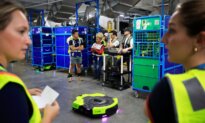
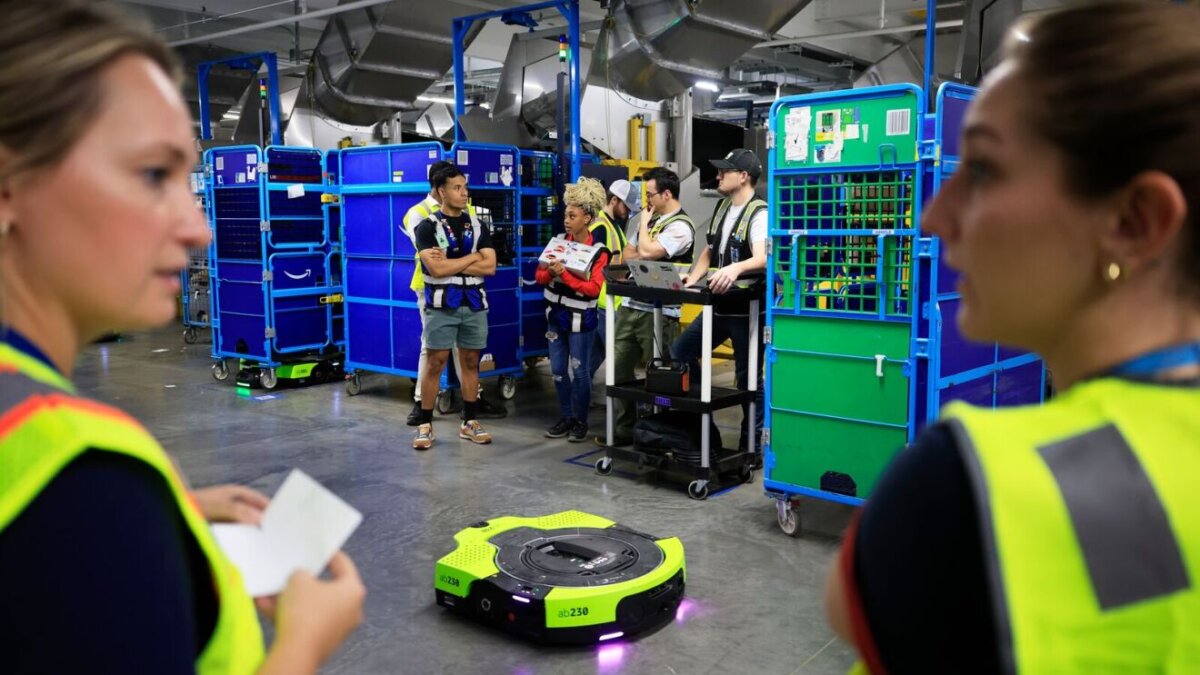
The tech giant showcased the Proteus robot at its Dartford fulfilment centre east of London on June 4.
“You tell it what needs to be done. It figures out the priority, the route, the timing,” said Scott Dresser, vice president of Amazon Robotics.
The current Proteus, deployed at 25 U.S. sites, operates only in dock areas, moving carts weighing up to nearly 400 kg (882 lbs).
The new version, due in Europe in the first half of 2027, can operate across warehouse floors.
Amazon claimed that the expansion of its European fulfilment centers will add 25,000 more jobs.
It said that in 2025, Amazon invested more than 60 billion euros ($68 billion) across Europe, the largest annual investment in the region in the company’s history.
Amazon also showcased STARK, a robotic tote-handling system first piloted in Barcelona and set to roll out to 15 European sites by 2027, and Vulcan, its first robot with a sense of touch.
Amazon said it will launch more than 25 sub-same-day delivery sites across Europe this year, including in Britain and Germany.
Europe is advanced in automation.
According to an April report by The International Federation of Robotics (IFR) in the global automation race, Western European countries reached a record 267 robots per 10,000 employees in the manufacturing industry in 2024, ahead of North America with 204 units and Asia with 131 units.
“The robot density metric provides a uniform basis for comparison by relating the total number of robots used in a country to its economic size, as measured by its workforce,” said IFR President Takayuki Ito.
The economies of South Korea, Singapore, Japan, and Taiwan are among the top 10 most automated worldwide.
China ranks 6th in Asia and 22nd worldwide. It has 166 robots for every 10,000 people employed, which is a year-on-year increase of 17 percent.
In January, GMB, one of the UK’s biggest trade unions, said that supermarket chain Asda will outsource delivery of its clothing brand George to DHL, risking up to 1,200 jobs in the process.
Asda ran distribution for its clothing label through three depots, and under the proposed plan, the work will move to a single depot run by DHL in Derby.
On June 4, ITV reported that up to 1,000 jobs are set to be lost as Asda accelerates the use of automation across its warehouse operations.
The site in Derby is being fitted with “Redline” robots, an automated system developed by Norwegian company AutoStore.
“A thousand people losing their jobs to be replaced by robots sounds like something from a dystopian sci-fi movie, but the warehouse industry is becoming increasingly automated, and it’s impossible to stand in the way of progress,” Rachelle Wilkins, a national officer for the GMB, told the publication.
“[Our] members are now very worried this is the thin end of the wedge. What if Asda does the same thing with its online food shopping network? Thousands of jobs could be lost,” she added.
Amazon’s new rollout comes as the EU seeks to cut its reliance on foreign tech suppliers.
The European Union presented a plan on June 3 to expand its domestic technology supply chains, which involves pursuing greater independence in semiconductors and AI.
EU Commission President Ursula von der Leyen said the bloc cannot afford to depend on others for technologies.
“This is about protecting our citizens, defending our interests, and making our own choices. Europe has the talent, the research excellence, the industrial base, and the Single Market,” she said on June 3.
“Together, we must turn these strengths into technological sovereignty.”
Earlier in the year, the French government said it planned to phase out U.S.-made video-conferencing tools such as Zoom and Microsoft Teams by 2027.
Starting Thursday, the European Parliament will replace Google with French search engine Qwant as the default search tool on in-house computers.
Reuters contributed to this report.
 Friends Read Free
Copy
Facebook
Tweet
Friends Read Free
Copy
Facebook
Tweet