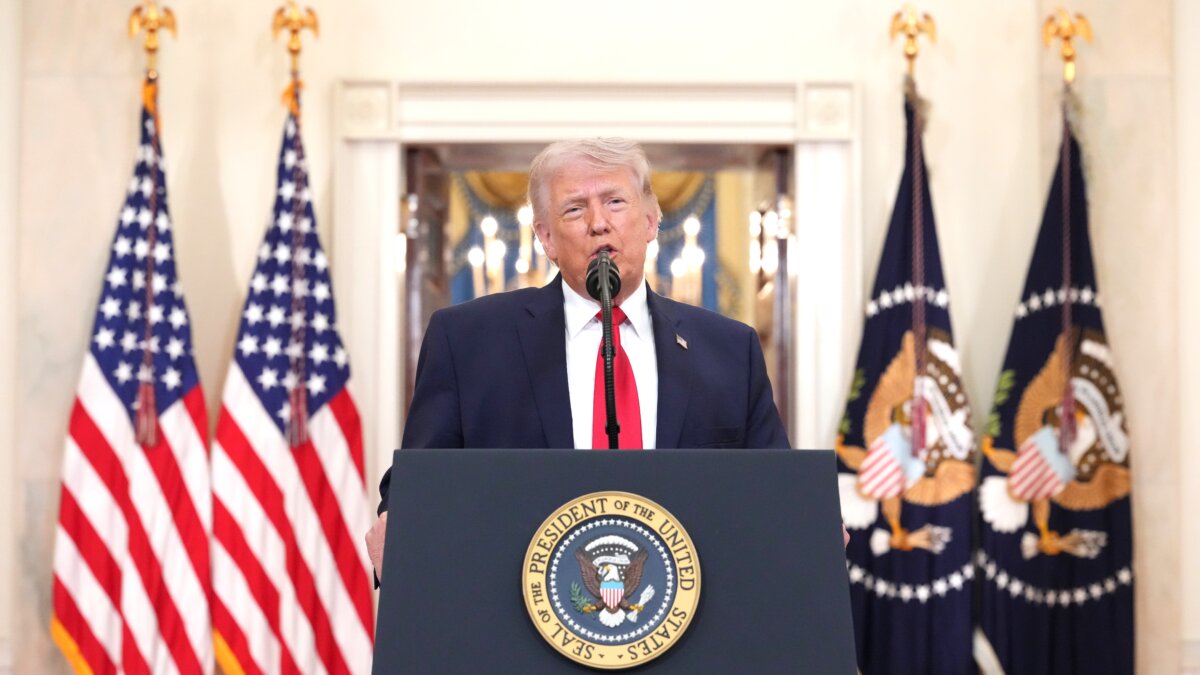

President Donald Trump delivered a speech on April 1, laying out the conditions of withdrawal from Iran, after a month of conflict that has devastated the regime and jolted the global economy, leaving many countries rationing their oil.
Giving a two or three week deadline, Trump said that the initial U.S. goal of rendering Iran incapable of being an aggressor in the Middle East was “nearing completion.”
“We’re going to hit them extremely hard over the next two to three weeks,” Trump said in his speech.
The U.S. goal has been to destroy Iran’s ballistic missile capabilities, neutralize its navy, cut off its support for terrorist proxies, and ensure they never acquire nuclear weapons.
“We’re going to bring them back to the Stone Age where they belong,” he said.
Under Operation Epic Fury, the United States, alongside Israel, began airstrikes on Iran on Feb. 28, killing Supreme Leader Ali Khamenei within hours, and over 47 top officials in the following days.
A U.S. Central Command update on April 1 stated that more than 12,300 Iranian targets had been struck since the beginning of the campaign.
Iran’s response has been to hold the Hormuz Strait hostage by attacking any commercial ships coming through.
The strait accounts for roughly 20 percent of the world’s oil supply, and the conflict has hit the global economy hard. Many countries have begun rationing oil as gas and oil prices have skyrocketed.
Saudi Arabia has been relying on its East-West Crude Oil pipeline, a 745-mile line from the Persian Gulf to the Red Sea port of Yanbu, and the United Arab Emirates has been relying on its 236-mile Habshan–Fujairah Pipeline, but both pipelines have limited capacity.
Both countries are considering more pipelines to deal with the rising demand, the Financial Times reported.
UK Foreign Secretary Yvette Cooper chaired a meeting on April 2, with representatives from more than 40 countries, including NATO allies, to discuss the global oil situation and find ways to restore shipping in the strait.
As a way of avoiding future conflicts, UK Prime Minister Keir Starmer said on April 1 that he was seeking closer ties with Europe.
Trump has repeatedly criticized Starmer for his refusal to help U.S. operations in the region by offering its bases to launch from or offering UK troops.
The United States led a 2025 campaign called Operation Midnight Hammer, striking Iranian nuclear sites. Months of failed negotiations followed in trying to convince Iran not to pursue nuclear weapons.
The Iranian Regime violently cracked down on protests that had been spurred on by the country’s economic collapse, which started in December 2025, resulting in the death of at least 7,000 civilians, according to the U.S.-based Iranian human rights organization HRANA.
Iran has been a persistent source of instability since the current regime took over in 1979.
The United States signed the Joint Comprehensive Plan of Action with Iran in 2015, alongside the UK, France, China, Russia, Germany, and the European Union, in an attempt to curb Iran’s nuclear weapons program.
The plan offered sanctions relief in exchange for Iran’s reducing its nuclear activities to a level below nuclear weapons capability.
Trump withdrew from the deal in 2018, during his first term, calling it a “horrible, one-sided deal that should have never been made.”
Soon after, Iran began violating its obligations under the agreement.
Emel Akan and Rachel Roberts contributed to this report.
 Friends Read Free
Copy
Facebook
Tweet
Friends Read Free
Copy
Facebook
Tweet