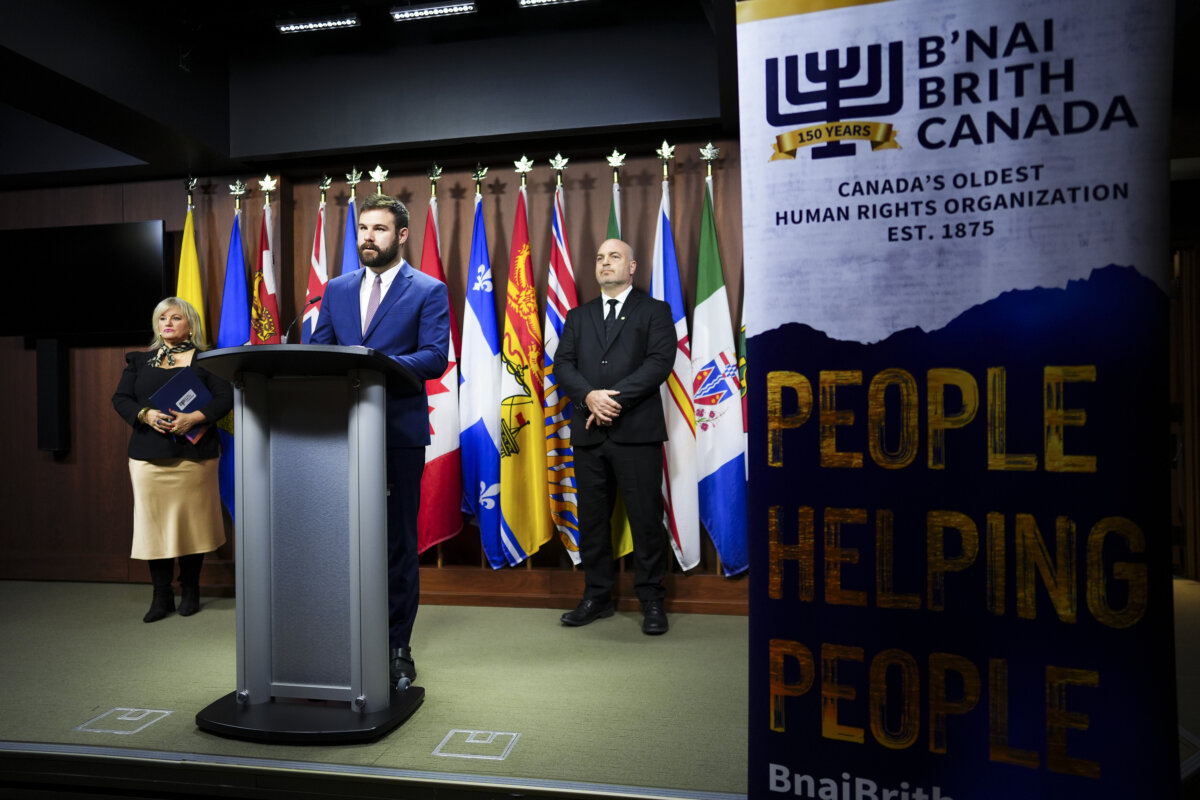

Anti-Semitic incidents in Canada, including vandalism and harassment targeting Jews, reached a record high in 2025, Jewish service organization B’nai Brith said.
At a news conference on Parliament Hill April 27, B’nai Brith said it recorded 6,800 anti-Semitic incidents across Canada in 2025, a 9.3 percent increase from the previous year and a 145.6 percent jump from 2022.
The organization described the trend as a worsening “national crisis.”
“Though the figures contained in the 2025 audit are astonishing, we cannot allow anti-Semitism to be rendered into mere statistics that we grow numb to,” said Richard Robertson, director of research and advocacy at B’nai Brith.
“A Hakenkreuz [swastika] drawn in a schoolyard is not just an incident of vandalism. It is a diabolical act of hate that leaves Jewish children afraid to go to school, and an assault on a Jewish man in a park in front of his children … is an incident that creates generational trauma and leaves an entire cohort of society questioning if they are safe to remain in this country.”
B’nai Brith said incidents of anti-Semitism in Canada have surged since Hamas’s Oct. 7, 2023, attack on Israel and the ensuing conflict in the Middle East.
It said additional spikes were recorded following Israel’s military actions in Lebanon and Iran, as well as after an ISIS-inspired terrorist attack at Bondi Beach in Sydney, Australia, on Dec. 14, 2025, during celebrations marking the Jewish holiday of Hanukkah.
Breaking down the 2025 figures by region, Robertson said Ontario recorded 3,194 incidents, the highest number in a single province or region since the organization began its annual audits in 1982.
The Prairie provinces saw an 88 percent increase from a year earlier, while the Atlantic provinces recorded a 114.5 percent rise, he said.
Although Alberta and Quebec both saw declines, incident levels in those provinces remained elevated, Robertson said.
He described the overall situation as an “unacceptable new baseline for anti-Semitism that has been established in Canada following the October 7 Hamas terror attack in Israel.”
The most common forms of anti-Semitism documented in 2025 were online and included calls for violence against Jews, dehumanizing allegations about Jews, Holocaust denial, the display of anti-Semitic symbols, and holding Jews collectively responsible for the actions of the state of Israel, he said.
Robertson said anti-Semitism has become so widespread that the word “Jew” is now commonly used as a slur to disparage non-Jews.
“In contemporary Canada, Jewishness itself has become derogatory,” he said.
Asked by a reporter what should be done to address the problem, Robertson called for coordinated action at all levels of government and society.
“What we need in Canada is a multi-level approach … We need a task force. We need consolidated efforts to provide both the immediate relief that is required, such as security infrastructure funding and policing,” he said. “But we also need legislative change. And this is something that no government in this country can do alone. So what we need … [is] a whole of society approach. But it must start now and it must start at the federal level and be replicated across the country.”
“It is okay to hold political views. It is okay to challenge a nation’s response to issues. It is not okay to subject a minority in this country to unprecedented levels of hate because of the actions of a foreign government,” he added.
 Friends Read Free
Copy
Facebook
Tweet
Friends Read Free
Copy
Facebook
Tweet