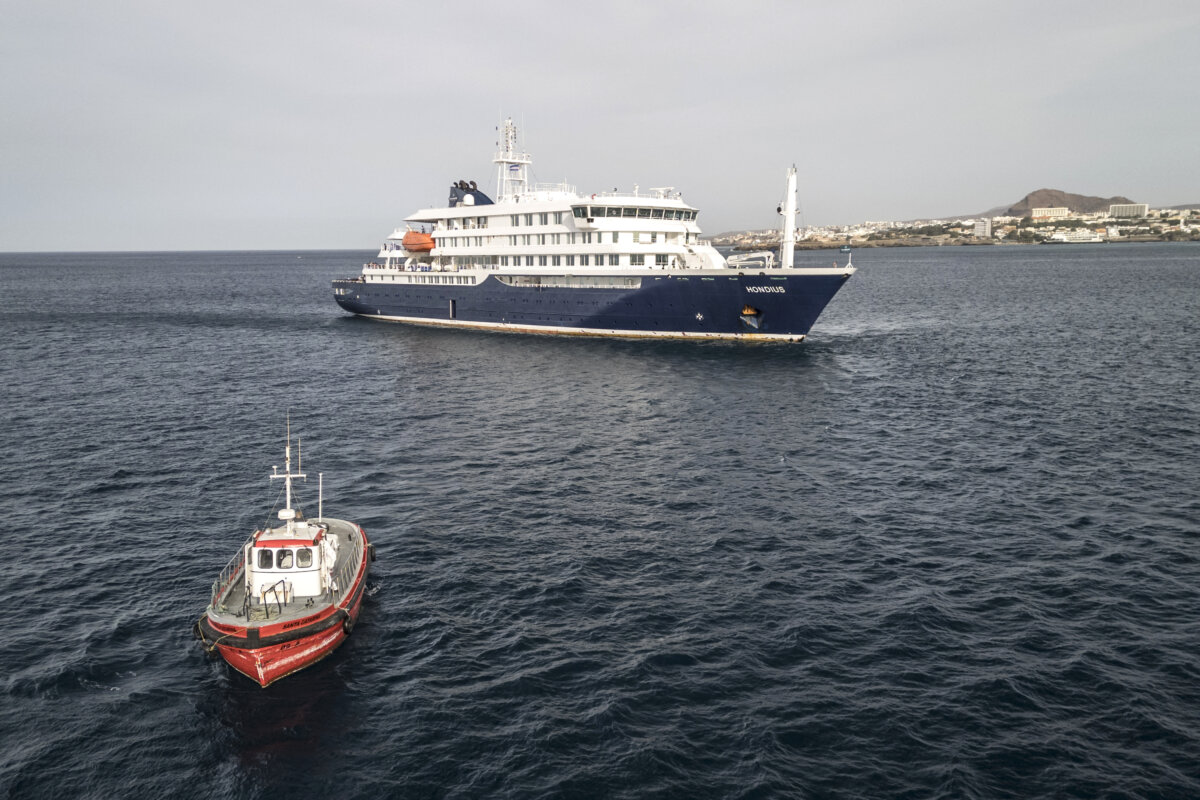

Argentina is investigating whether a hantavirus outbreak aboard the MV Hondius cruise ship may be linked to exposure before passengers boarded in Ushuaia, in the south of the Latin American country.
Argentina’s Health Ministry announced the launch of the investigation in its May 6 update.
The outbreak occurred on the cruise ship, run by Dutch operator Oceanwide Expeditions, on April 1, after several passengers and crew members reported symptoms of the disease. The ship, which departed from Ushuaia, Tierra del Fuego, followed an itinerary through the South Atlantic, with multiple stops.
Argentina said eight cases had been confirmed among passengers and crew of the MV Hondius, and three people have died, according to the update. The ministry said the variant had been confirmed as the Andes strain.
Authorities said this strain has a history of circulation in only Chubut, Río Negro, and Neuquén, Argentina, and in southern Chile.
Hantavirus is primarily spread from infected rodents; the Andes strain can spread between people but rarely does.
According to the UK Health Security Agency, humans can acquire Andes virus (ANDV) infection, a type of hantavirus, by contact with infected rodents or their excreta in South America, principally in Argentina and Chile, and rarely through contact with an infected person.
Wild rodents of the family Cricetidae are the natural animal reservoir of ANDV, particularly the long-tailed pygmy rice rat. People usually catch the Andes virus by inhaling dust contaminated with infected rodent droppings, urine, or saliva. It is unclear how human-to-human transmission of ANDV occurs, but rare person-to-person spread appears to require close contact.
UKHSA says that hantavirus cardiopulmonary syndrome is the most important complication of ANDV infection and is associated with a high mortality rate, typically 35–50 percent.
Argentina’s Health Ministry said in a May 4 bulletin that it had recorded 101 confirmed hantavirus cases since the start of the 2025–2026 season.
In a May 4 statement, Oceanwide said two Dutch nationals had been passengers: a passenger who died on board and his wife, who died later after becoming unwell during repatriation. However, the company noted that their deaths had not been confirmed to have been connected to the current medical situation on board.
Argentina has identified the Dutch citizens as the cases who first showed symptoms.
In a May 6 update, Argentina’s Health Ministry said it is reconstructing the travel history of the Dutch index cases in the MV Hondius hantavirus cluster, saying the pair had traveled through Argentina, Chile, and Uruguay before boarding the vessel in Ushuaia on April 1.
The ministry said infection in Argentina has not been confirmed and noted that Tierra del Fuego has reported no hantavirus cases since mandatory notification began in 1996.
It said that its teams will test rodents in areas linked to the passengers’ route as part of intensified surveillance.
World Health Organization Director-General Tedros Adhanom Ghebreyesus said in a May 6 post on X that as of that time, there were eight cases, three of whom were confirmed by laboratory testing as infected with hantavirus.
Ghebreyesus also said that Swiss authorities had confirmed a case of hantavirus identified in a passenger from the MV Hondius cruise ship who presented to a hospital in Zurich, where the patient is currently receiving medical care.
The third death was of a German woman who died on the ship on May 2, after developing symptoms five days earlier.
A British man fell ill on board the ship after it left Saint Helena and disembarked at Ascension Island, where he received treatment and was medically evacuated to South Africa on April 27.
He was hospitalized in isolation in an intensive care unit in Johannesburg.
The Spanish Ministry of Health said on the evening of May 5 that it would allow the luxury ship to dock in the Canary Islands “in accordance with international law and humanitarian principles.”
According to VesselFinder, the ship is expected to arrive there on May 10.
 Friends Read Free
Copy
Facebook
Tweet
Friends Read Free
Copy
Facebook
Tweet