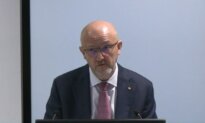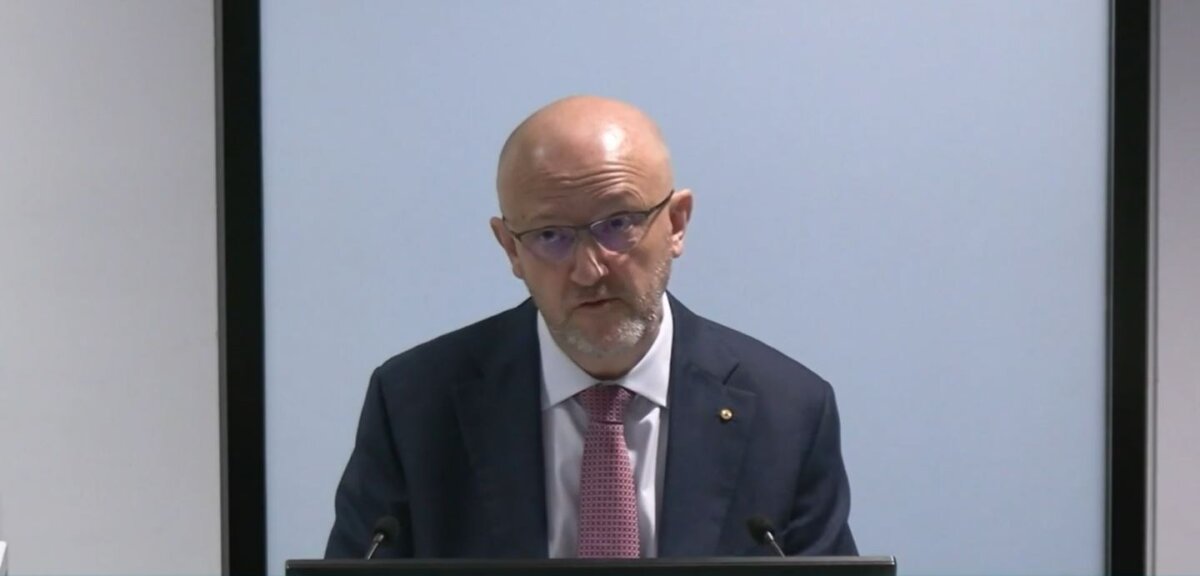
The main focus of the Australian Security Intelligence Service (ASIO) prior to the Bondi terrorist attack on Dec. 14, 2025, was on foreign espionage and foreign interference in the community and in politics, the organisation’s chief told the Royal Commission on Anti-Semitism and Social Cohesion.
Director-General Mike Burgess admitted that, because those issues were “not connected” to the threat of terrorism, security agencies and police had no indication an attack was imminent.
“At the same time, every rock we lifted up, we found espionage or foreign interference that needed to be inquired [into] and investigated,” he said. “And so resources were moved over there. Of course, I reiterate that at no time do I believe we had any serious inquiries that were left un-inquired or investigated.
“So yes, we were pivoting resources across because that’s where the leads took us and where we were required to put effort,” he told the commission.
By February 2023, “espionage and foreign interference was our nation’s principal security concern,” Burgess said, “but at the same time, terrorism was still an enduring threat. Because terrorism actually has the potential to cause people to lose their lives or get harmed, it has always remained a priority for us.
“There was just less activity that we were investigating, because the nature of the environment had changed and the number of tasks we were looking at had reduced.”
Spike in Anti-Semitism, ASIO Adequately Resourced?
Burgess said since the attack by Hamas on Israel on Oct. 7, 2023, ASIO had more frequent contact with the local Community Security Group (CSG), which provides security to the Jewish community.
The subsequent war in the Middle East involving Iran, Israel, and the United States had driven more incidents of anti-Semitism in Australia and “invoked a range of emotions” in Australia.
“And those strong reactions, and some of those violent aspects of that, and those behaviours including anti-Semitism that, in our view, were left unchecked, [and] were therefore normalised and gave more permission for violence through 2023 and through to August [2024] when we raised it.”
The federal government had set the threat level to “possible” in 2022, but raised it to “probable” in August 2024.
The director general said he recognised that the problem of anti-Semitism “is broader than ASIO.”
“Our interest is identifying and understanding threats to security, insofar as individuals who have an ideology where they think violence is the answer … but of course I recognise that an act of anti-Semitism can be something that is not of interest to the security service in itself.”
Burgess said he believed ASIO was adequately resourced to deal with the threats faced by Australia when Sajid Akram (50) and Naveed Akram (24) opened fire on the “Chanukah by the Sea” gathering, killing 15 people and injuring over 40 more.
“In retrospect, I still think that our resourcing was sufficient for the problems we face,” he said. “Of course, we are stretched, and I do have a means by which I can ask for additional resources if we need to.”
He said the pivot to foreign interference was “not to the detriment of our counter terrorism [CT] mission; rather, it coincided with a reduction in our CT workload that was naturally emerging. It did not leave CT under-resourced.”
What Type of Foreign Interference Threats Out There?
Burgess described the type of foreign interference threat that ASIO had focused on prior to the attack as including some nations that want to silence dissidents in an Australian community who might be seen as a threat.
“[The country] undertakes spying and threatening, intimidating behaviours against those individuals, and we’ve seen that in this country, including up to the threatening of their lives,” he said.
“Another example would be where a foreign government cultivates relationships with individuals and looks to generate favour and actually get inside the political system, so they’re fully informed on what our political masters at the local council, state level, and federal level are doing.
“And they work to shape that environment, so [politicians and officials] are making decisions in that country’s favour. And all of that is being done in a way where the dark hand of the foreign state is not declared,” Burgess said.
 Friends Read Free
Copy
Facebook
Tweet
Friends Read Free
Copy
Facebook
Tweet