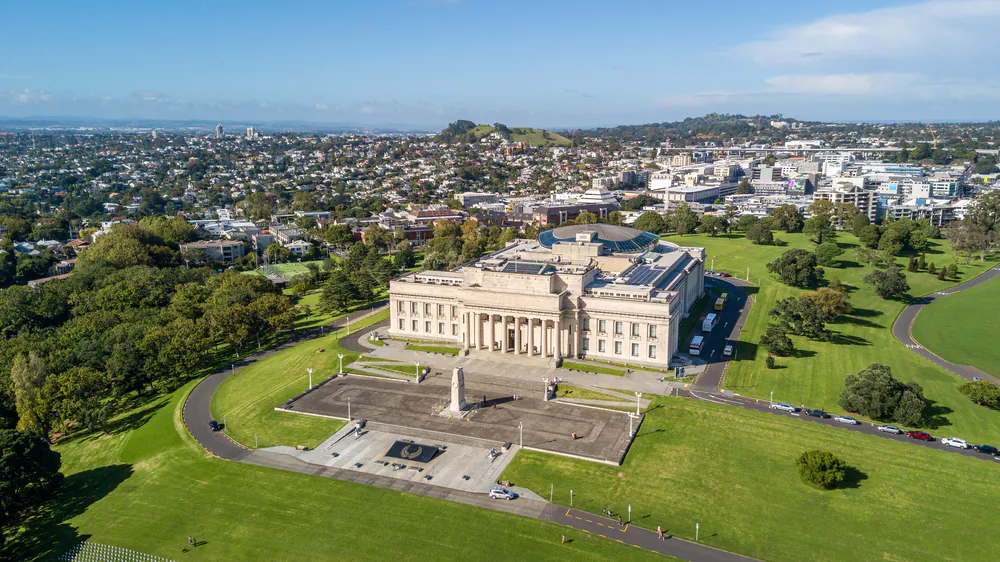
The Auckland War Memorial Museum—visited by almost 900,000 people in 2022/23—says it intends to move from being “a colonial museum” to one which focuses on the Treaty of Waitangi, New Zealand’s founding document.
“This builds upon our bicultural foundation, which in our context recognises Māori as Tangata Whenua [indigenous people],” it says in its 2024/25 draft annual plan.
“The other strand is Tangata Tiriti—the people of the Treaty—which includes all other cultures and communities that now call Aotearoa New Zealand home by virtue of the Treaty. This approach includes everyone.”
It says it will no longer see itself as “primarily an expert and keeper of knowledge and collections,” but will transition to “working in partnership with communities, recognising and valuing … cultural knowledge.”
To Be Led by Māori Lore
The draft document says the institution will “evolve [in]to a tikanga [Māori custom and lore]-led Museum, where Māori culture, values and knowledge systems are inherent in our unique identity and focus our celebration of te ao Māori” (broadly, “everything Māori”).
“In addressing our shared past, we will disrupt the colonial narratives and structures that have shaped our understanding of history,” it says, committing itself to “develop programmes that authentically represent Māori culture, history, and contemporary issues.”
The draft indicates that some of the items in the museum’s collection may be returned to Māori tribes.
“We will also develop a proactive repatriation policy to demonstrate our commitment to Te Tiriti o Waitangi and begin reconnecting communities with taonga and kōiwi [treasures and human remains],” the document says.
Online Cenotaph
Despite its full name remaining the Auckland War Memorial Museum, the organisation refers to itself by the initials “AM” and its web address is simply “aucklandmuseum.com.” It is run as a general museum rather than a military one and last year featured “Ancient Greeks: Athletes, Warriors and Heroes” from the British Museum, followed by another international touring exhibition, “Secrets of Stonehenge,” ending with “Egypt: In the Time of Pharaohs.”
However, it remains the site of Auckland’s largest ANZAC Day commemoration each year. It also features an “online cenotaph” on its website.
Last year alone, 16,934 images and 8,754 pieces of data were uploaded to the online cenotaph by members of the public.
In December last year, it was the subject of controversy when it was illuminated in the colours of Israel, after pro-Palestinian supporters lit it up in red and green a month earlier. The Museum later apologised.
Its decision to reject the “Fantastic Beasts” exhibition because of its links to J.K. Rowling also caused a furore.
The museum received just over $52 million (US$32 million) in funding last year. Its largest source of income is the Auckland City Council, from whom it received $32.3 million in 2023, along with almost $6 million in donations and operating grants, $1.1 million in capital grants and $440,000 from trusts and bequests. Commercial operations, including memberships and entry fees, brought in a further $12.3 million.
However it spent $54.4 million on operating costs, leaving it with a $2.3 million deficit—less than the budgeted loss of $7.9 million.
 Friends Read Free
Copy
Facebook
Tweet
Friends Read Free
Copy
Facebook
Tweet