
An academic has urged the Albanese government to develop a clear vision for managing its relationship with the United States under the Trump administration.
This comes amid a lack of progress in several key areas of cooperation.
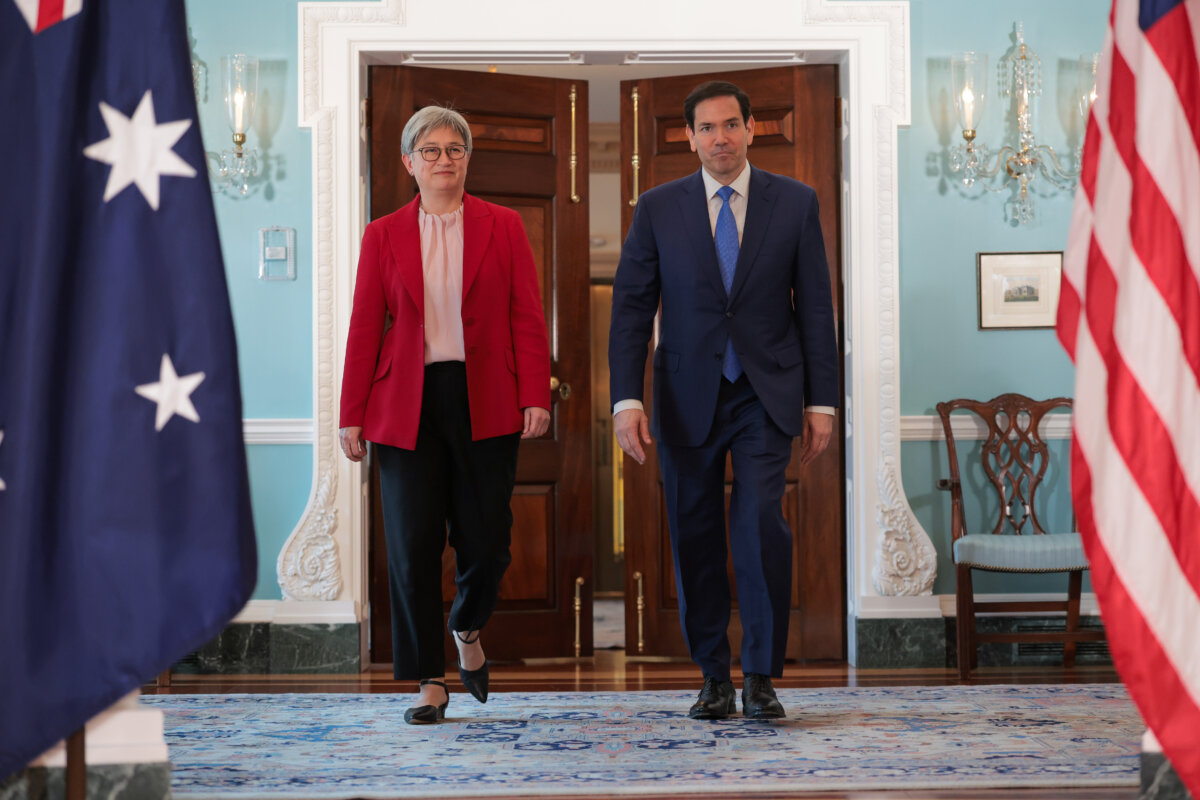
On July 2, Foreign Minister Penny Wong had a meeting with U.S. Secretary of State Marco Rubio on the sidelines of the Quad summit in Washington D.C.
During the meeting, Wong made the case for a tariff exemption for Australia, delving into the country’s free trade agreement with the United States.
The two ministers also discussed the AUKUS submarine agreement, the future of which remains uncertain as it is currently under review by the Trump administration.
Surprisingly, there was no discussion of Australia’s military budget, even though U.S. Defense Secretary Pete Hegseth had previously urged the Labor government to increase its defence spending to 3.5 percent of GDP to address the challenges in the Pacific region.
Despite Wong’s efforts, it appears that little progress has been made in negotiations between the two sides, as the minister declined to comment on how her U.S. counterpart responded to the matters.
A Clearer Vision
Joseph Camilleri, an international relations emeritus professor at La Trobe University, pointed out that the Labor government needed to have a clearer U.S. policy.
“What Australian governments—this one included—struggle with is a lack of coherent foreign policy, and that then shows itself in these meetings,” he said.
According to the professor, Australia should clarify its relationship with the United States in relation to its other partnerships, including those with Southeast Asia and China.
This involves taking specific stances that align with the United States on international issues such as the war in Ukraine and the recent Israel-Iran conflict.
However, judging by the Labor government’s performance so far, Camilleri said it has become stuck in the status quo due to significant internal differences in perspectives and views.
“It just tries to deal with foreign policy as best it can in small pieces,” he said.
“They are hemmed in by powerful pressures on different sides, and to think through a coherent alternative would require a very bold initiative.
“Most governments, this one included, are not taken to bold initiatives.”
Australia Gets Caught in US-China Tensions
At present, Australia appears to have been caught in the middle of the growing tensions between the United States and the Chinese Communist Party (CCP).
While the United States is arguably Australia’s most important ally in terms of security and strategic cooperation, China is the country’s number one trade partner.
Most recently, the Trump administration has urged the Albanese government to increase its military budget, while the CCP has pressured Australia not to boost its defence spending.
Amid pressure from both sides, the Albanese government stated that it would stick with the current plan, which is to increase defence spending from 2 percent to 2.3 percent by 2033-34.
 Friends Read Free
Copy
Facebook
Tweet
Friends Read Free
Copy
Facebook
Tweet