
OTTAWA—The Bank of Canada announced it has lowered its policy interest rate to 2.25 percent, warning that the trade war with the United States has diminished Canada’s economic prospects.
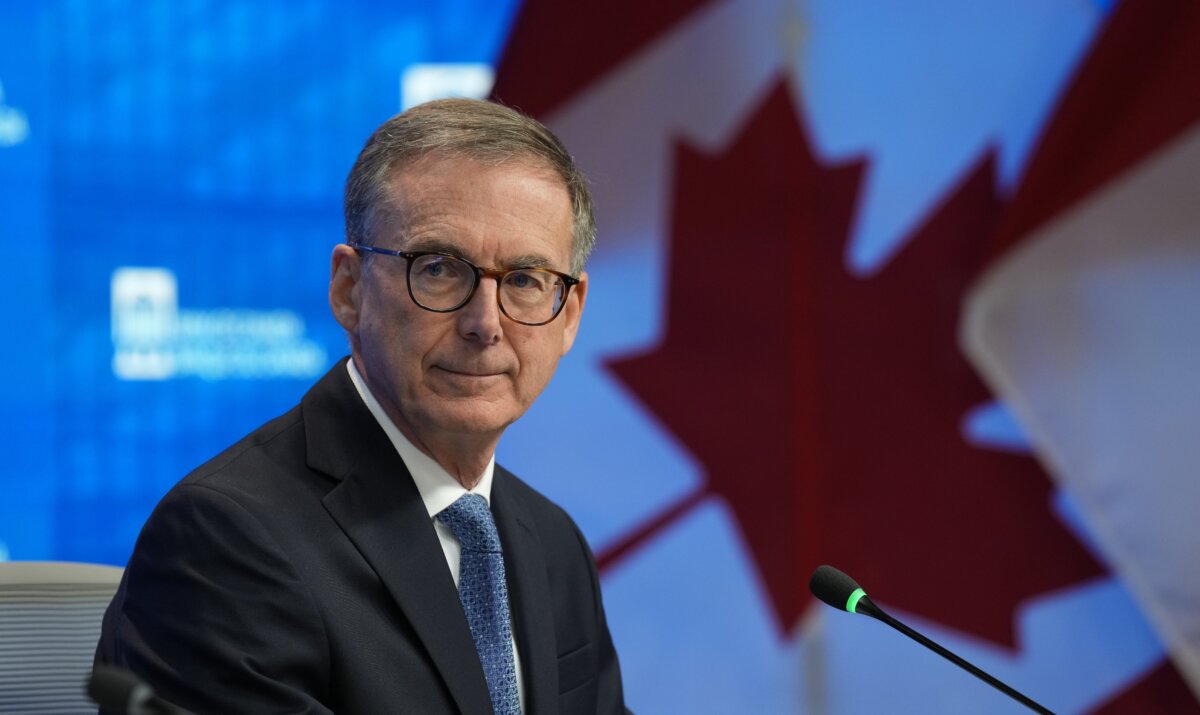
“The structural damage caused by tariffs is reducing our productive capacity and adding costs. This limits the ability of monetary policy to boost demand while maintaining low inflation,” Bank of Canada Governor Tiff Macklem said on Oct. 29.
Macklem said that if the economy were to grow in line with its projections outlined in the Bank’s October Monetary Policy Report, the current interest rate would be “at about the right level to keep inflation close to 2 percent while helping the economy through this period of structural adjustment.” He said the governing council will continue assessing economic data to make its decisions, and will be prepared to respond if their forecast changes.
This marks the second time in a row the Bank has lowered interest rates by 25 basis points, as it had held its interest rate steady at 2.75 percent since March before lowering it in September.
The governor said the Bank of Canada has previously warned that monetary policy could not undo the economic damage done by U.S. tariffs, and now the economy will “work less efficiently,” with higher costs and less income. “Monetary policy can help the economy adjust as long as inflation is well-controlled, but it cannot restore the economy to its pre-tariff path,” Macklem said.
Macklem said the Bank expects to see “very modest growth” throughout the rest of 2025, with growth accelerating in the beginning of 2026. Macklem said the weakness of the Canadian economy is putting downward pressure on inflation, while the trade war is adding costs for businesses and putting upward pressure on inflation, keeping it close to the Bank’s 2 percent target.
The governor said Canada’s economy contracted by 1.6 percent in the second quarter of 2025, with U.S. tariffs having “severe” effects on sectors like automobiles, steel, aluminum, and lumber. Canada is impacted by different U.S. tariffs, including a general 35 percent tariff on Canadian goods not covered under the United States-Mexico-Canada Agreement (USMCA), 50 percent tariffs on steel, aluminum, and copper, 25 percent tariffs on vehicles and auto parts, and 10 percent tariffs on oil and potash.
U.S. President Donald Trump recently said he would raise unspecified tariffs by 10 percent in response to Ontario’s anti-tariff TV ad broadcasted in the United States.
Macklem said household spending was “resilient” in the second quarter of the year, with strong consumer spending and an uptick in residential investment. He said the employment gains seen in September had followed two consecutive months of “sizeable” losses concentrated in sectors sensitive to the trade war, and Canada’s unemployment rate currently sits at 7.1 percent.
The Consumer Price Index inflation was 2.4 percent in September, which was slightly higher than the Bank had anticipated. Macklem said the Bank expects inflationary pressure will ease in the coming months and inflation will remain at around 2 percent over the projection horizon.
The Bank said the United States has seen “strong” economic activity boosted by AI investment, while employment growth has slowed and tariffs have begun to raise prices. The European Union has seen “decelerating” growth due to falling exports and domestic demand, while China has increased exports to other countries to make up for lower exports to United States and has seen weakening business investment.
Monetary Policy Report
The Bank’s Monetary Policy Report for October includes one baseline outlook for economic growth and inflation, rather than a series of potential scenarios that it has shared since the beginning of the trade war.
The report states that Canada’s economy has been put on the “lower path” due to U.S. tariffs, which is leading to a fall in demand for Canadian exports and higher costs for Canadians. The report says there remains “considerable uncertainty” around how U.S. tariffs will change global trade relationships and how the 2026 review of the USMCA will play out.
The report expects there will be weak GDP growth of around 0.75 percent in the second half of 2025, with new U.S. tariffs on copper, furniture, and softwood lumber and Chinese tariffs on canola, peas, pork and seafood putting further strain on the economy. Additionally, U.S. tourism to Canada remains below 2024 levels.
The Bank projects Canada’s GDP growth in 2025 will be 1.2 percent, while in 2026 it will grow by just 1.1 percent, and in 2027 it will grow by 1.6 percent.
While layoffs have been reported in sectors reliant on trade with the United States, most Canadian businesses surveyed for the report expect their workforce numbers will remain unchanged over the next 12 months due to soft demand and tariff uncertainty. The federal government’s lowering of immigration rates has also put downward pressure on the unemployment rate.
The report said the average U.S. tariff rate on Canada rose from 4.8 percent in July to 5.9 percent in October, while Canada’s average tariff rate on the United States fell from 2.1 percent to 1 percent over the same period. Due to tariff exemptions under the USMCA, around 90 percent of Canadian exports to the United States were tariff-free in July, according to the report.
The report expects inflation to fall from 2.4 percent in September to around 2 percent in early 2026, as the removal of Canadian counter-tariffs on the United States will put downward pressure on the metric. The report expects there to be an easing of inflation for services, excluding shelter, over its projection horizon.
The report noted that since there is “considerable uncertainty” around Canada’s trade relationship with the United States, there is also uncertainty around the Bank’s economic projections. U.S. tariffs could depreciate the value of the Canadian dollar and raise inflation in Canada more than expected, while a global economic slowdown could lower inflation.
 Friends Read Free
Copy
Facebook
Tweet
Friends Read Free
Copy
Facebook
Tweet