There isn’t one particular risk on the horizon that’s keeping Bank of Canada officials up at night—it’s the range of vulnerabilities all cropping up at the same time that could test the resilience of the Canadian financial system.
The central bank released its annual financial stability report Thursday, outlining where it sees the biggest risks to markets, households and the broader financial system.
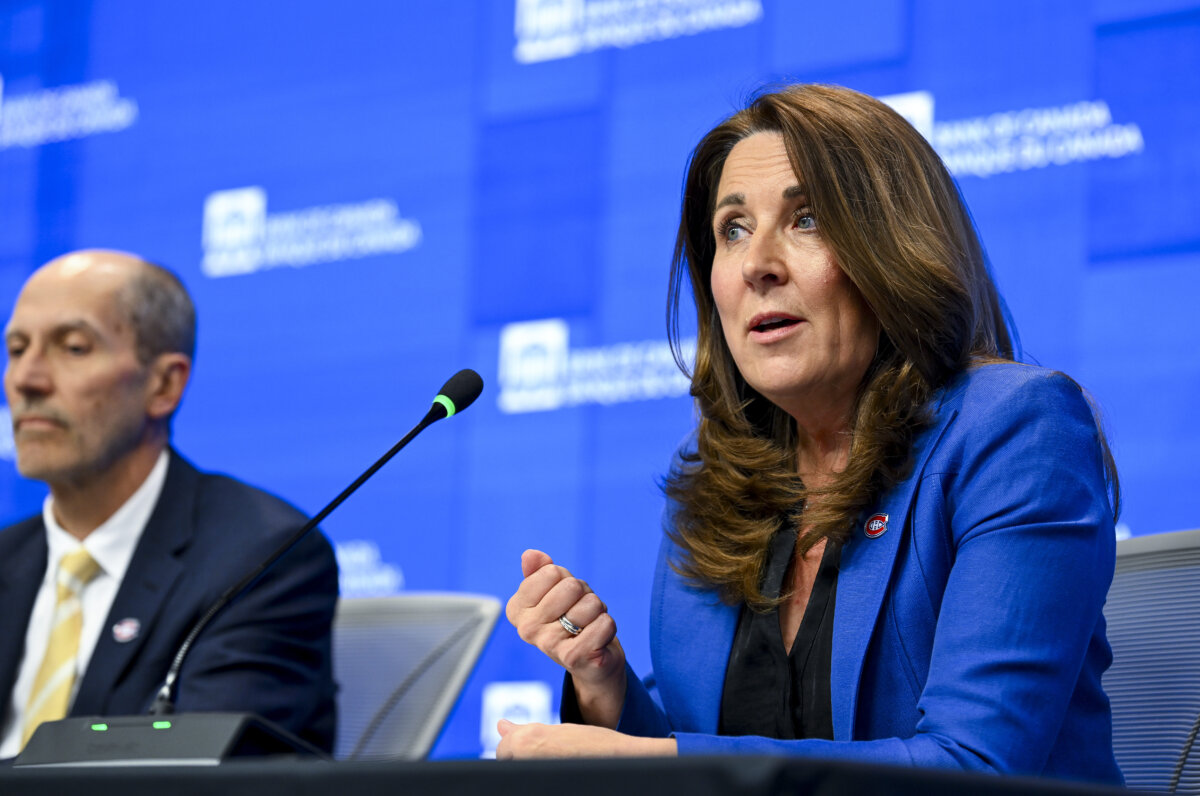
Senior deputy governor Carolyn Rogers stressed in a press conference with media that the report is not a forecast and does not guide interest rate decisions.
The report lays out a series of risks related to geopolitics, artificial intelligence and global sovereign debt activity.
Rogers said that, taken one by one, those vulnerabilities look “manageable.”
But she warned that a significant shock to the economy could trigger multiple risks simultaneously. That could create a cascading effect that tests Canada’s financial resilience.
“The economic and geopolitical environment has become more volatile. And this has made it more likely that a new shock or combination of shocks could cause several vulnerabilities to crystalize at once,” Rogers said.
Compared with the 2025 outlook, Rogers said risks for households and businesses have largely stabilized.
A year ago, much of the financial stability report focused on risks from the United States’ tariffs.
So far, the consequences of those disruptions have not been as bad as the Bank of Canada first feared.
But if the upcoming renewal of the Canada-U.S.-Mexico agreement results in tighter trade restrictions, then a weaker economy and wider job losses could have negative implications for financial stability.
One area where risks seem to be ratcheting up, however, is hedge fund participation in global sovereign debt markets. Hedge fund activity is part of the normal functioning of government bond markets, but the Bank of Canada flagged concerns that any disruptions to their funding access could lead to a sudden sell-off in government bonds.
That, too, would have knock-on effects for the financial system, Rogers warned.
“There continues to be high levels of leverage, and that, with the backdrop of a more volatile geopolitical environment, makes it more likely that the trigger event could happen and disrupt those markets,” she said.
The Bank of Canada indicated the financial system is so far holding up well through the Iran war uncertainty, but a lack of clarity around the length of the conflict and how it might resolve remain a risk.
Persistently high global oil prices tied to the Iran war, if accompanied by stress in financial markets, could test Canadian resilience, the report warned. Such a scenario could see inflation rise and monetary policy hold tight, while unemployment ticks higher and home prices fall.
Artificial intelligence is, meanwhile, sparking concern about disruption in certain industries, the prospect of overinvestment and risks of increasingly sophisticated cyberattacks.
Climbing stock market valuations have increasingly been concentrated in the AI sector, the report noted, meaning a potential correction here could have an outsized impact across markets.
Despite those headwinds, the Bank of Canada sees households and businesses as broadly financially healthy.
Past financial stability reports have also highlighted risks tied to a looming wave of mortgage renewals, as homeowners who bought during the pandemic-era peak saw their loans turn over at higher rates of interest.
But officials now expect that pressure will mostly alleviate a year from now as the final wave of mortgage renewals passes over the next 12 months.
Rogers said many Canadians bracing for those renewals saved prudently, while others got pay raises or were able to re-amortize their homes to lengthen the payment schedule, softening the blow of higher payments. After a series of interest rate hikes to tame inflation in the post-pandemic era, the Bank of Canada’s own policy rate also came back down quickly, limiting the shock for renewing households.
Rogers gave credit to the Office of the Superintendent of Financial Institutions’ minimum qualifying rate—the mortgage stress test—for making sure borrowers could handle the rapid run-up in rates.
Canadian banks have enjoyed strong profitability and are setting aside more funds to cover bad loans, the financial stability report noted, insulating them from the risks of a severe downturn.
While Canada has faced some strains over the past year, deputy governor Toni Gravelle said Thursday that those episodes have not led to broad-based financial stress.
Gravelle noted that the aggregate figures can mask vulnerabilities, and households with the highest debt burden are least able to absorb financial shocks like a sudden job loss.
The Bank of Canada’s typical approach to stress testing the financial system is to take a scenario with a low probability but high impact and see how markets, households and other elements would react—like the case of persistent oil prices tied to the war in Iran.
But Rogers said the risks the central bank isn’t expecting are the ones that could cause the most damage.
“The shocks that are really dangerous are the things you never thought of happening, because those are the things you haven’t planned for,” she said.
“That’s really what keeps me awake, is, ‘What have I not thought of?'”
 Friends Read Free
Copy
Facebook
Tweet
Friends Read Free
Copy
Facebook
Tweet