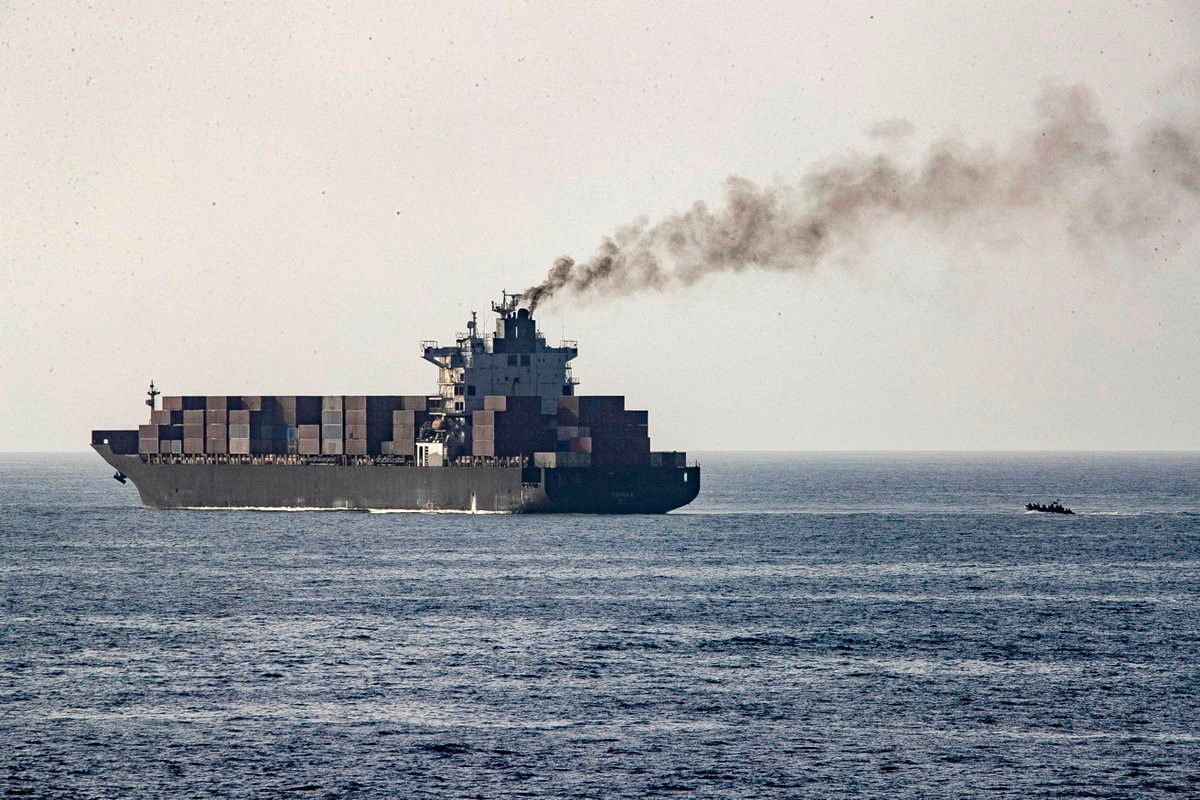

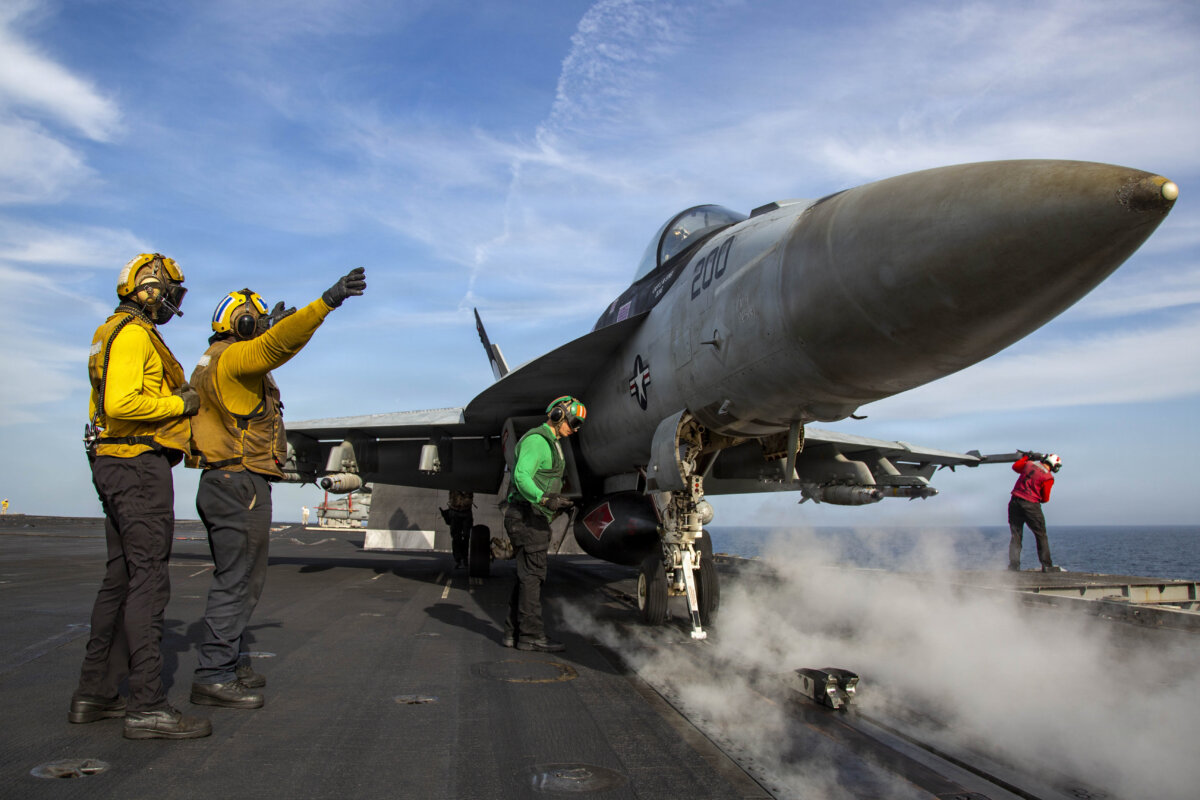
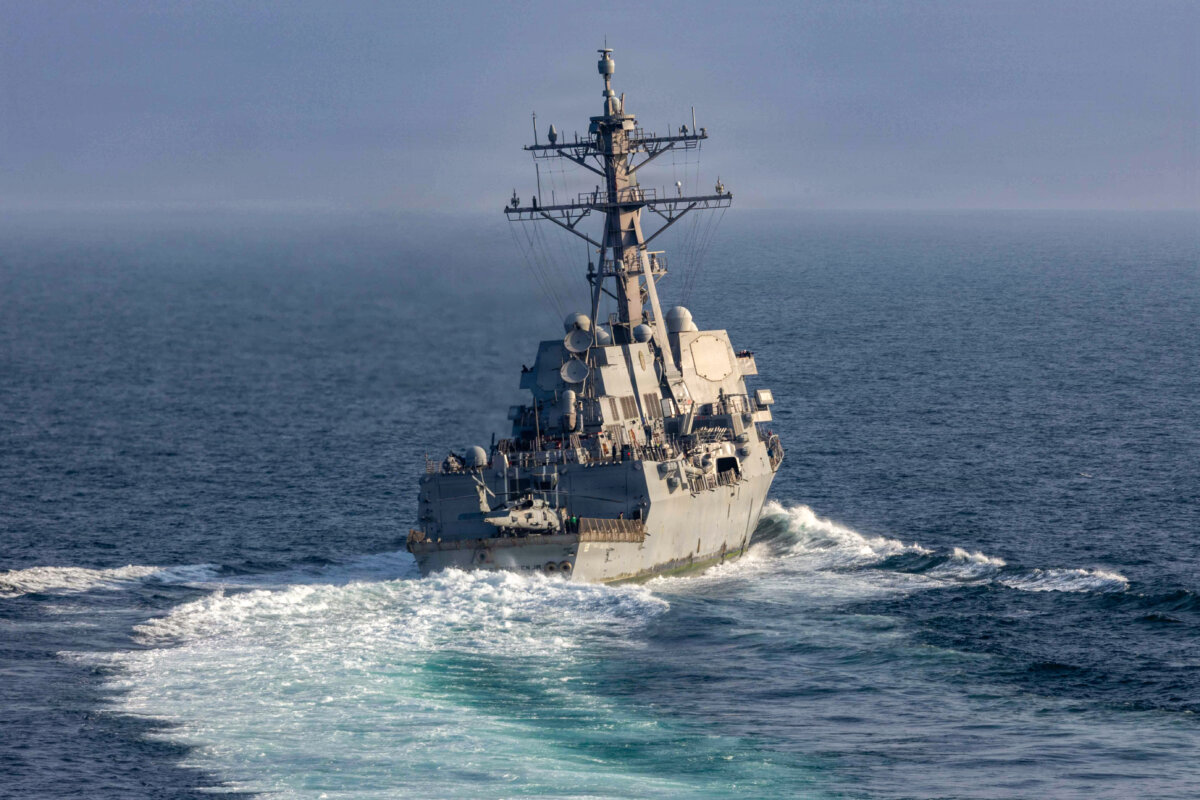
With the arrival of USS George H.W. Bush, there are now three carrier battlegroups, more than 240 jets, and at least 16 destroyers in the Arabian and Red seas hunting for Iranian ships and “shadow fleet” tankers.
But one thing the 20,000 sailors and Marines involved in the 20-plus ship operation—including more than 2,500 assault infantry on the amphibious assault ship USS Tripoli—aren’t doing is blockading the Strait of Hormuz.
Iran’s Iranian Revolutionary Guard Corps (IRGC) is controlling which ships come and go through the narrow 21-mile pass linking the Persian Gulf to the Gulf of Oman.
Iranian ships are transiting the corridor and moving in and out of Persian Gulf ports, or what remains of them after 38 days of bombing, because the U.S. Navy has few, if any, warships in the basin-like sea. Under the ceasefire, the Iranian ships are not being fired on by U.S. or Israeli forces.
This naval force—the largest assembly of U.S. Navy might in the region since 2003’s invasion of Iraq and 1979–1981 Iranian hostage crisis—is enforcing a 190-mile “you shall not pass” line stretching from Ras al-Hadd in Oman east to Kaij-e-Gavater Bay at the Iran–Pakistan border, more than 220 miles south of the strait.
While Iran controls the strait and its Persian Gulf ports are not being “blockaded” under the ceasefire, its shipping has no access to sea lanes beyond the U.S. Navy’s GONZO (Gulf of Oman Naval Zone of Operations) Station.
It’s a standoff, with IRGC using its geographic advantage to implement an economic tourniquet on a waterway vital to international commerce, and the United States using its global reach to selectively suspend maritime trade vital to Iran worldwide.
It is, in essence, a blockade of a blockade.
“We’re not blockading the strait. We’re blockading Iranian ships transiting into the Gulf of Oman,” said Salvatore Mercogliano, a professor who analyzes maritime commerce at Campbell University in Buies Creek, North Carolina. “We’re not anywhere close to the Strait of Hormuz. What we’re doing is what’s called a ‘distant blockade.’”
The GONZO Line
As of April 27, U.S. Central Command reports that since April 13, the U.S. Navy has intercepted 38 vessels after transiting the strait and “redirected” them back to Persian Gulf ports.
On April 19, USS Spruance sailors and USS Tripoli Marines seized Iranian-flagged M/V Touska attempting to run the GONZO line. On April 22, U.S. forces impounded Palau-flagged tanker Tifani, carrying 1.9 million barrels of Iranian crude, in the Bay of Bengal off Malaysia. On April 23, U.S. forces captured sanctioned tanker Majestic X between Sri Lanka and Indonesia. On April 25, the U.S. Navy intercepted Botswana-flagged M/V Sevan in the Arabian Sea and “escorted” the liquefied natural gas carrier back to the strait.
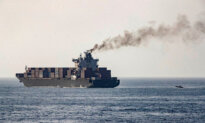
Touska and Tifani were seized thousands of miles from the Strait of Hormuz in an eastern Indian Ocean area known as a “floating gas station,” where oil from sanctioned nations, such as Iran and Russia, is bought by “shadow fleet” tankers operating under false flags and sold in Asia, primarily to Chinese buyers.
Sevan is among 19 vessels the U.S. Treasury Department sanctioned on April 24 for transporting Iranian goods. The International Maritime Organization maintains that at least 17 of these 19—and perhaps more than 60 worldwide—are operating under the flag of Botswana—a surprise to the land-locked African nation because it doesn’t have a ship registry.
What is unfolding in the operation against Iran is similar to the Pentagon’s December 2025–February 2026 seizures of at least five “shadow fleet” ships transporting sanctioned crude from Venezuela in the Caribbean Sea, the North Atlantic, and Indian Ocean.
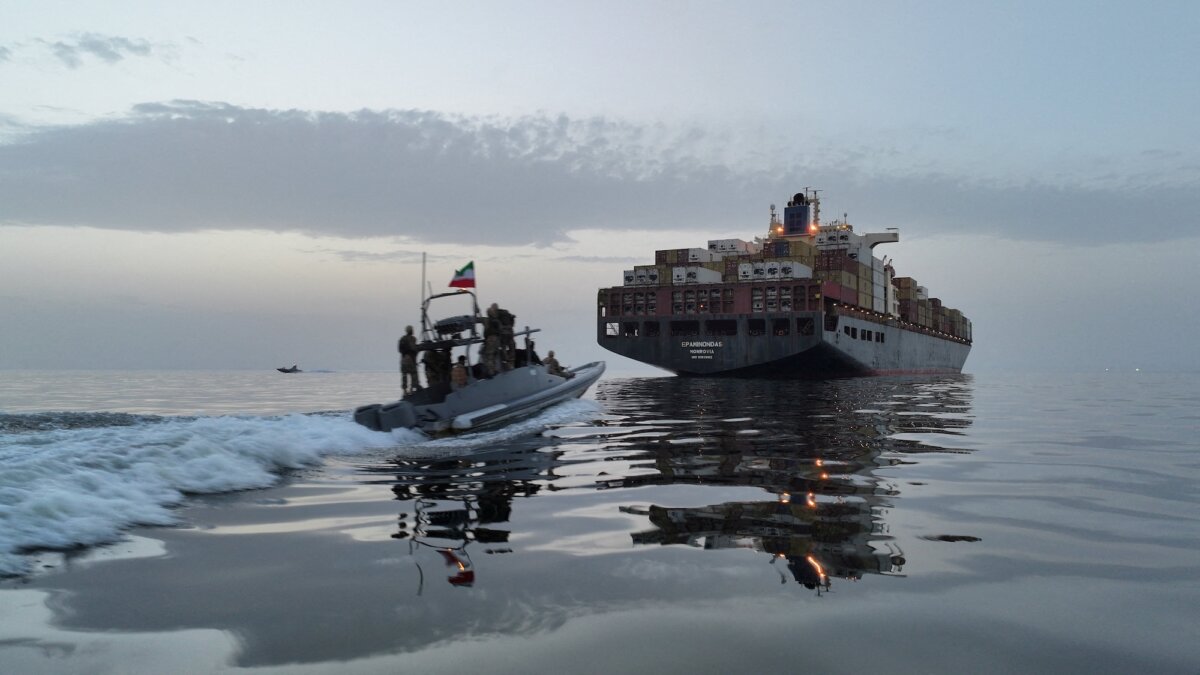
While the United States is enforcing its global hunt for Iranian shipping beyond the GONZO line, the IRGC in a “tit-for-tat” response on April 22 seized Panamanian-flagged Francesca and Greek-flagged Epaminondas for “operating without the necessary permits” Iran now requires for transiting the strait.
The distinction is that while the United States is acting selectively, targeting Iranian ships and “shadow fleet” tankers, the IRGC is imposing its will on global commerce, said Gregory Copley, president of Washington-based International Strategic Studies Association and editor-in-chief of Defense & Foreign Affairs.
“What we’re seeing is a competition of words and images between the Iranians and the United States,” he told The Epoch Times. “The Iranians are saying, ‘We’re blockading the strait,’ and the Americans saying, ‘You can’t blockade the strait.’”
When President Donald Trump and Secretary of War Pete Hegseth, among others, say the United States is blockading Iranian ports and Iranian shipping in the strait, they mean by extension beyond the GONZO Line; but Iran is using that blockade claim “to seek the psychological upper hand,” Copley said.
“When the Iranians said they were blockading the strait or restricting trade through the strait, they took a lot of heat for that, and were being blamed by their neighbors for interrupting their trade,” he said. “When President Trump says he’s the one who’s imposing the blockade, then the United States gets blamed for the impact on other countries’ economies.”
No Military Solution
A blockade is generally a long-term strategy, a sea siege to slowly strangle an adversary. But with more than 20 percent of the world’s oil and gas, among other vital exports, locked in the Persian Gulf along with hundreds of idling ships and 20,000 marooned merchant sailors, the impasse is fostering impatience.
While the ceasefire holds and there are back-channel talks via Pakistan between the Trump administration and Tehran, it’s uncertain if the IRGC will lift its blockade of the strait without U.S. concessions, or if the U.S. will back down from demands that Iran abandon its nuclear ambitions, end supporting terrorist groups, and relinquish its illegal annexation of the strait.
The Pentagon is refining plans for a massive naval and air assault on IRGC installations along the Hormuz coast and dug into the Shanin Kuh Heights towering above.
But, ultimately, Mercogliano told The Epoch Times, there really isn’t a military solution when “all it takes is a speedboat to come out and shoot a couple of machine guns into the windows of a bridge and they can get an 11,000-TEU [20-foot equivalent units] MSC ship [Mediterranean Shipping Co., the world’s largest container shipping line] to stop and be boarded and staged for an Iranian video.”
He cited unconfirmed claims the IRGC is, or has, mined the strait to ensure ships use a channel closest to its shores as an example of how commercial shipping corporations are not going to risk crews’ lives or tankers worth millions in a confined contested waterway.
“It takes zero mines to create a minefield. Just a threat of mines is always enough,” Mercogliano said.
In the end, whether it is in the Strait of Hormuz, the Bab-el-Mandeb Strait linking the Red Sea to the Gulf of Adeno, the Malacca Strait between the South China Sea and the Indian Ocean, the Dardanelles Strait between the Black and Mediterranean seas, the Danish Straits connecting the Baltic and North seas, the Strait of Gibraltar, or in the Suez and Panama canals, commercial shipping traffic moves by mutual consent for mutual benefit.
Until there’s mutual consent with Iran allowing international traffic to resume in the Strait of Hormuz and the United States permitting Iranian shipping to access sea lanes, it’s a painful standoff, but one Copley believes will force Tehran to blink first as the U.S. Navy tightens its global vise.
“What you call it—a blockade, not a blockade—is immaterial,” he said. “The point is to cut off Iran’s maritime trade, not necessarily shut down trade in the Strait of Hormuz. You’re looking to achieve a certain outcome. It’s about outcomes, not process.”
 Friends Read Free
Copy
Facebook
Tweet
Friends Read Free
Copy
Facebook
Tweet