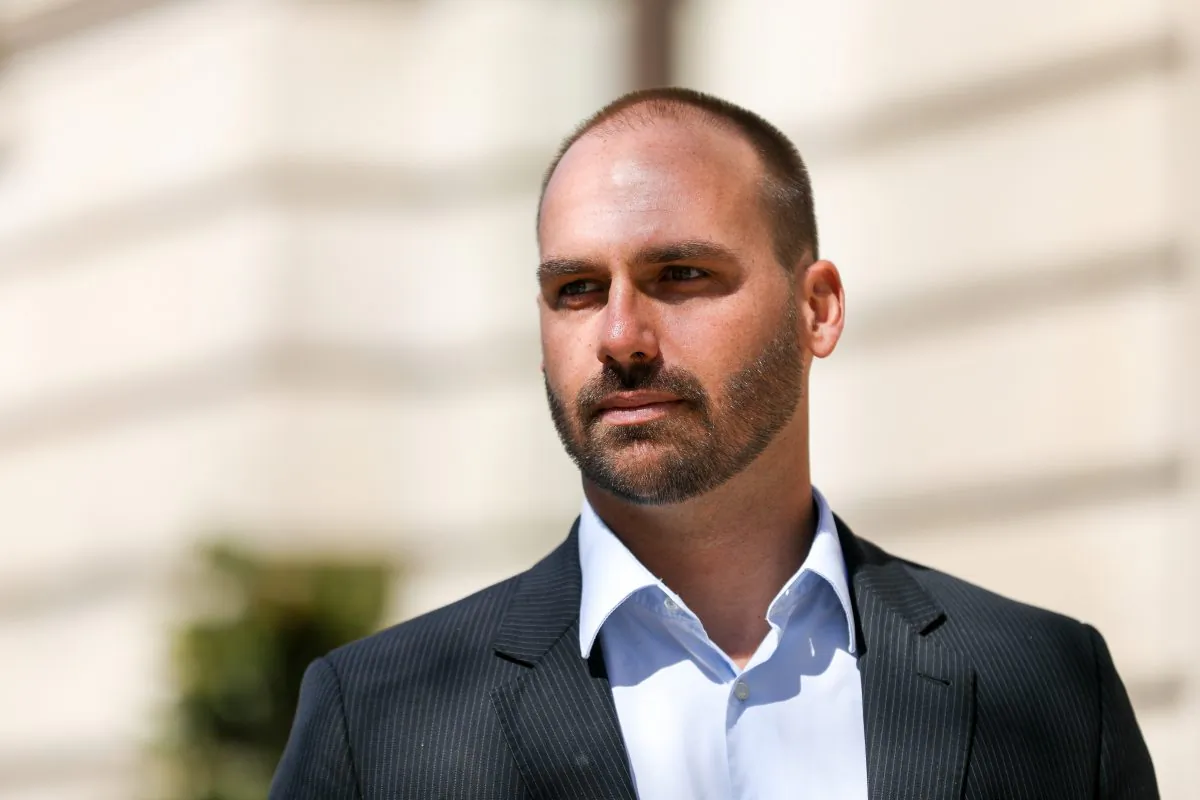

Former Brazilian President Jair Bolsonaro’s son Eduardo Bolsonaro has been charged with coercion, according to a statement released by the country’s prosecutor general, Paulo Gonet Branco, on Sept. 22.
The case is linked to the one that saw the former president convicted of plotting a coup and sentenced to 27 years in prison on Sept. 11.
According to the statement from the prosecutor general’s office, Eduardo Bolsonaro, who is a sitting member of Brazil’s Chamber of Deputies, “repeatedly sought to subordinate the interests of Brazil and the entire society to his own personal and family agenda.”
Prosecutors also charged Brazilian journalist and commentator Paulo Figueiredo, grandson of former Brazilian President João Figueiredo, with the same crime.
Both Eduardo Bolsonaro and Paulo Figueiredo live in the United States, with the former moving there earlier this year to seek support from U.S. President Donald Trump—a longtime ally of the now-incarcerated former Brazilian leader—to stop criminal proceedings against his father.
Eduardo Bolsonaro has also claimed credit for pushing the White House to impose 50 percent tariffs on most Brazilian goods.
The pair connected the charges laid against them to fresh sanctions imposed by the United States on the wife of Brazilian Supreme Court Justice Alexandre de Moraes, who presided over Jair Bolsonaro’s trial.
“We live in the United States, and therefore under the jurisdiction of the American Constitution, which in its First Amendment guarantees the right to ‘petition the Government for a redress of grievances,'” they wrote in a statement posted on X. “And that is exactly what we are doing, and we will continue to do.”
The U.S. State Department stated on Sept. 22 that its Office of Foreign Assets Control was sanctioning Viviane Barci de Moraes and the couple’s holding company, the Lex Institute, for enabling Alexandre de Moraes to use his justice position to “weaponize courts, authorize arbitrary pre-trial detentions, and suppress freedom of expression.”
“These sanctions build on a series of actions taken by the Trump Administration to hold [Alexandre de] Moraes accountable for abusing his authority, creating a censorship complex, blatantly targeting political opponents, and committing serious human rights abuse,” Secretary of State Marco Rubio said in a statement.
The Brazilian Supreme Court judge was sanctioned by the United States on July 30.
On Sept. 11, a panel of the Brazilian Supreme Court, including Moraes, sentenced Jair Bolsonaro to 27 years in prison after convicting him of attempting to overthrow the government following his loss in the country’s 2022 election.
The five-justice court finalized the conviction on the same day, finding him guilty on five counts: attempted coup, participation in an armed criminal organization, attempted violent abolition of the democratic rule of law, violence-related damage, and serious threats against state assets and protected heritage.
The panel then quickly moved to the sentencing phase, sentencing the former Brazilian president to 27 years and three months in prison. This makes Bolsonaro the first former Brazilian president to be convicted of attempting a coup.
The conviction stems from the aftermath of the 2022 Brazilian presidential election, during which Bolsonaro’s supporters allegedly attacked government buildings.
Bolsonaro has denied any involvement and claims that he is the target of political persecution under the administration of his former rival, Brazilian President Luiz Inácio Lula da Silva, commonly known as Lula.
At the time, Trump said he was unhappy with the conviction and said it was “very bad for Brazil.”
Joseph Lord contributed to this report.
Correction: A previous version of this article misstated the relationship between Brazilian journalist and commentator Paulo Figueiredo and former Brazilian President João Figueiredo. The Epoch Times regrets the error.
 Friends Read Free
Copy
Facebook
Tweet
Friends Read Free
Copy
Facebook
Tweet