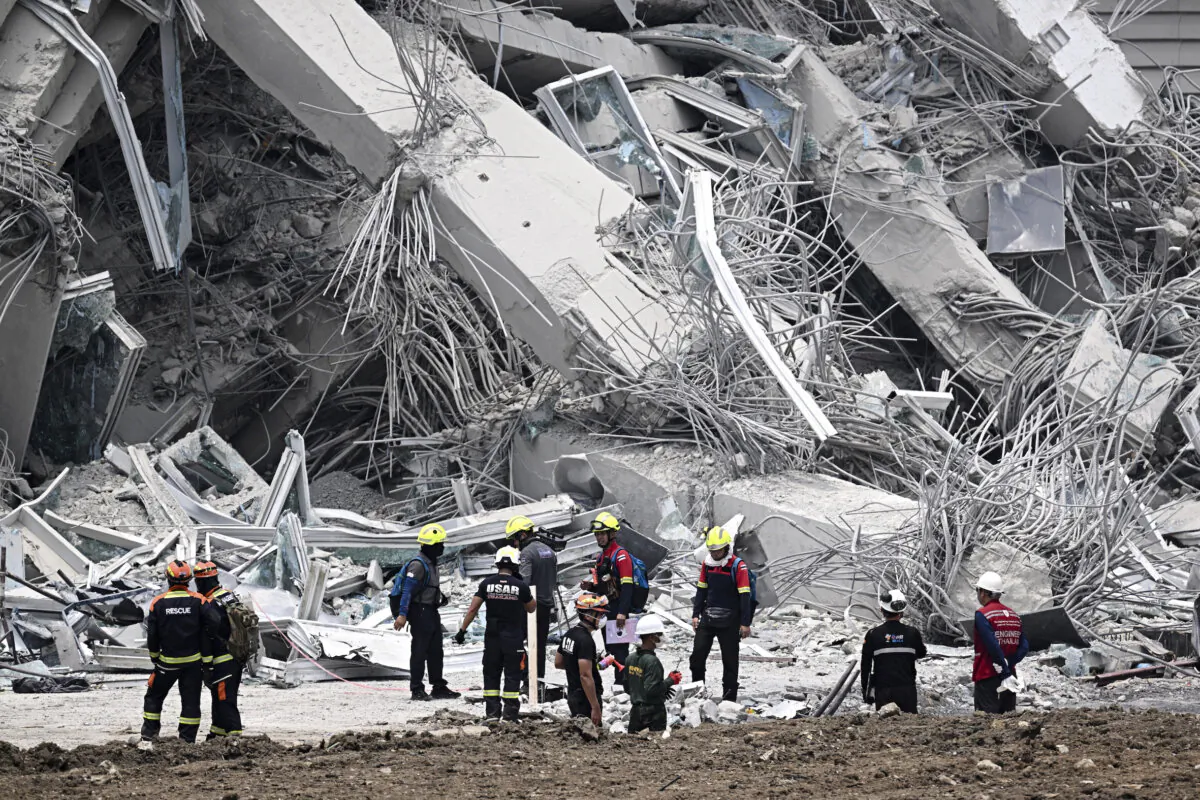

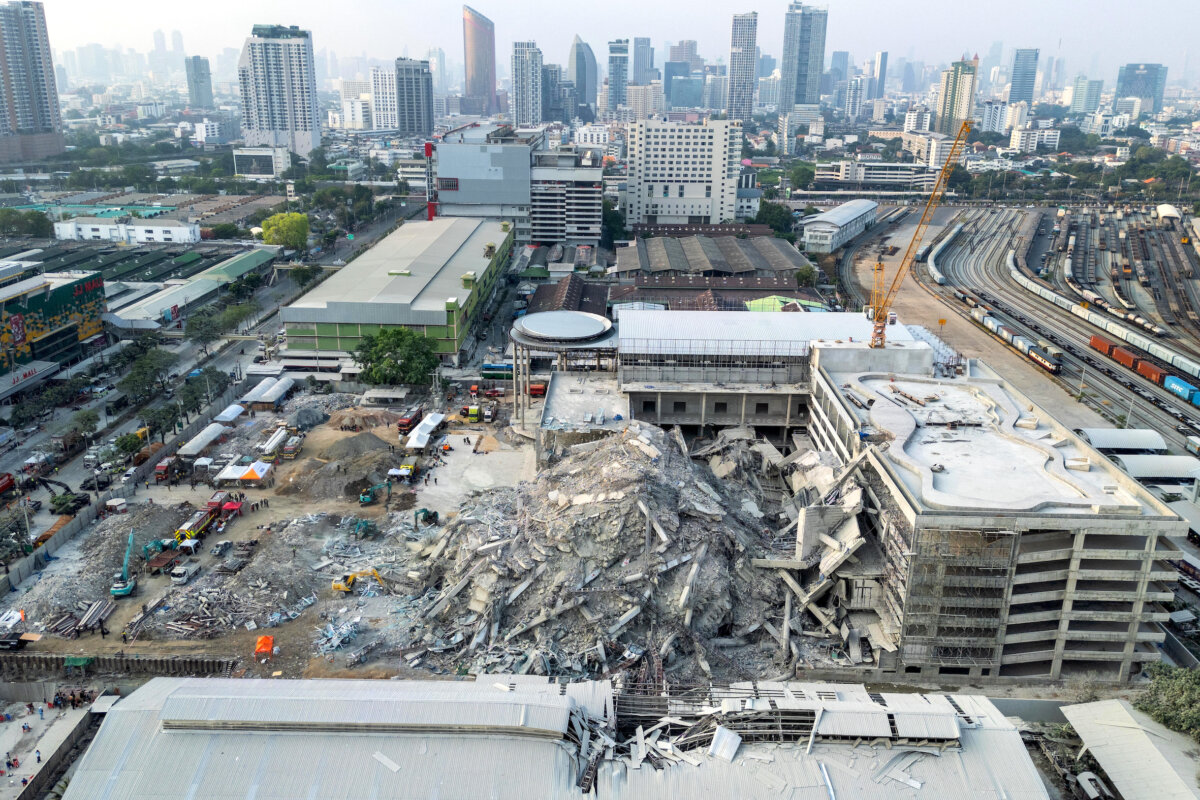
The Thai government announced a probe on March 29 of a 33-story building that collapsed during neighboring Burma’s recent 7.7-magnitude earthquake, with nine workers confirmed killed and about 100 missing. The building was a joint Thai–China construction project.
Some glass windows installed as cladding on the building could be seen falling off as the entire structure collapsed within seconds. The cloud of dust that rose as the building collapsed into a mound was caught by witnesses in videos shared on social media.
The building, some 800 miles from the earthquake’s epicenter, was the only high-rise in Thailand to collapse from the March 28 quake. The death toll in Burma, also known as Myanmar, has reached more than 1,700, with many still missing.
At a March 29 news conference, Thai Prime Minister Paetongtarn Shinawatra acknowledged public concerns regarding why only this one building collapsed in Bangkok while similar nearby structures remained intact. She said that the government has ordered the Department of Public Works and Town and Country Planning to investigate what caused the structural failure of the high-rise structure, with a reporting deadline in a week.
Shinawatra said the department has also been asked to investigate those responsible for the building design and how the design, which was said to be a unique “core tube + flat slab” structure, was approved.
“I watched multiple clips of the building collapse from different angles. From my experience in the construction industry, I have never seen an issue like this,” the prime minister said. “We must investigate thoroughly because a significant portion of the budget was allocated, and the deadline for completion had been extended.”
The building, which had a scheduled completion date of Dec. 31, 2023, was to be used as Thailand’s new Office of the Auditor General.
The building was a $63 million joint venture between leading Thai construction company Italian-Thai Development Co. (ITD) and China Railway No. 10 Bureau Group Co.
ITD has been facing a liquidity crisis because of significant debt obligations from delayed or problematic projects, many in war-torn Burma.
Local Thai media reported that a Chinese state-owned railway group, the China Railway Engineering Corp. (CREC), is the largest shareholder, with 49 percent of the shares in the China Railway No. 10 Bureau Group Co.—the maximum stake that foreign companies can hold in a Thai company under Thai law.
CREC is heavily involved in China’s controversial Belt and Road Initiative (BRI), and China Railway No. 10 Bureau Group Co. is a primary contractor of the BRI Thai–China high-speed rail project connecting Bangkok to Laos and China, according to Chinese state-run media. Beijing hopes that the new trade route will facilitate greater economic opportunities between the trading partners.
However, nations involved in other BRI projects have warned of unsustainable debts incurred as a result of the projects, which have not delivered the advertised economic stimulation and growth but instead resulted in national security risks for host countries.
Structural Build Said to Be Finished
Construction on the building in Bangkok’s Chatuchak Weekend Market commercial area began in 2020 and was put on hold during the COVID-19 pandemic. Completion of the building’s structural components was announced by the China Railway No. 10 Bureau Group on April 3, 2024.
The group posted photos of the topping out of the building, with one photo showing workers holding a Chinese banner that read, “Warm congratulations on the successful topping-out of the main structure of the Thailand Audit Office project undertaken by China Railway 10th Bureau.”
Topping out represents the completion of the structural phase of construction, with the highest point of the building having been put in place.
Following the building collapse, that news was quickly deleted from the group’s official website and social media channels on state-controlled WeChat.
According to Taiwan’s CNA, except for one report by Chinese financial outlet Caixin, Chinese media reports mostly avoided mention of the involvement of the China Railway 10th Bureau with the building’s construction. The Caixin report has since been removed, along with other reports including initial reports by state media outlet Xinhua. Internet search results have been limited for keywords like “Bangkok” and “tower.”
China’s media reports of the collapse had mentioned only that construction was 30 percent complete.
CNA also noted that a now-censored Phoenix.com report had said that the main structure of the building was successfully topped out and that the project had entered the decoration and renovation stage of construction.
Phoenix reported that after completion, the building would “be a business card for China Railway 10th Bureau’s development in Thailand.”
Anutin Charnvirakul, Thai deputy prime minister and interior minister, told reporters while visiting the site on the evening of the earthquake that some things seen in the collapse were highly unusual.
“I am not a structural engineer, but I looked at it. … It shows that it did not collapse from above. It was a tear, a tear in the columns that support the weight of the entire building below. We have to look at how it was designed, but I believe they made allowances,” he said.
However, Charnvirakul encouraged people not to jump to conclusions to avoid panic about the cause of the collapse.
“Engineers have to set up models,” he said. “We shouldn’t speculate on this because it’s all based on science. If they design inadequately, it will say that the design is inadequate.”
“If they design adequately, we will look at the new cause,” Charnvirakul said, pointing to building standards for earthquakes that “may have to be increased in the future.”
Sub-Standard Steel Found
On March 31, the director of the Thai Industrial Standards Institute, Nonthichai Likitaporn, announced that results of initial testing on 28 steel samples recovered from the wreckage indicated that two samples—32mm and 20mm steel bars belonging to Chinese company Xin Ke Yuan Steel Co., Ltd.—failed national materials standards. He said that more samples would be tested for a “more comprehensive analysis” as the investigation continues.
Thai Industry Minister Akanat Promphan told reporters on March 30 the ministry had been cracking down on companies that have produced sub-standard steel over the past six months, and had shut down seven factories and seized 360 million baht (about $10 million) of their assets.
“Many of these factories used an old production process and equipment relocated from China,” he said. “This has led to sub-standard steel.”
Xin Ke Yuan Steel Co., Ltd., was ordered to shut down in December 2024 after an inspection uncovered safety and environmental issues. The Industry Ministry instructed the company to provide sales records for its steel since the factory’s closure, saying it would face charges if it moved or sold any of its product that was confiscated.
Chinese Workers Arrested, Charged
On March 30, Police Major Gen. Noppasin Poonsawat, deputy commissioner of the Metropolitan Police Bureau, said that four Chinese workers were seen removing documents from containers behind the collapsed building a day earlier and had fled the scene. They were later arrested by police for questioning over 32 files they had retrieved from the restricted disaster zone.
The deputy Bangkok police chief said the documents, which police seized, contained information such as project contractors and sub-contractors, requests for information, and electrical and transportation engineering documents.
The Chinese workers, who were employees of CREC and had work permits, told police they were collecting the documents for insurance compensation claims. They were released after questioning, local media reported.
The Bangkok Chatuchak District Office also filed charges, resulting in the men pleading guilty and receiving reduced sentences of one month’s jail and a 3,000-baht ($91) fine for violating disaster zone laws, according to local reports. The court also suspended their jail terms for a year probation.
Workers Trapped and Killed
As of May, 92 people, mostly construction workers, have been confirmed killed in the collapse, with four workers still missing. Nine others were injured.
Bangkok-based Khaosod English reported that a foreman with TTSW Engineering Ltd. working at a lower floor of the construction site told the outlet that he heard the concrete floor make cracking sounds about 10 minutes before the building collapsed. He said he was not able to identify which floor the cracking sound was originating from, according to the outlet.
The foreman told the outlet that the timing of the quake was fortunate, as an upcoming shift change at 4 p.m. local time would have seen double the number of people on the site.
Bangkok Gov. Chadchart Sittipunt said on March 29 that city authorities have received 6,000 reports of cracks in buildings across the capital. They are being investigated and the appropriate safety measures taken, he said.
Reuters contributed to this report.
 Friends Read Free
Copy
Facebook
Tweet
Friends Read Free
Copy
Facebook
Tweet