
Canada and South Korea have entered into a new agreement to bolster cooperation on defence procurement, industrial security, and research, officials have announced.
The agreement comes several months after Prime Minister Mark Carney’s October meeting with President Lee Jae Myung in South Korea to finalize the Canada-Republic of Korea Security and Defence Cooperation Partnership (SDCP).
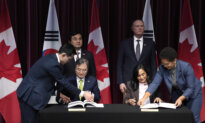
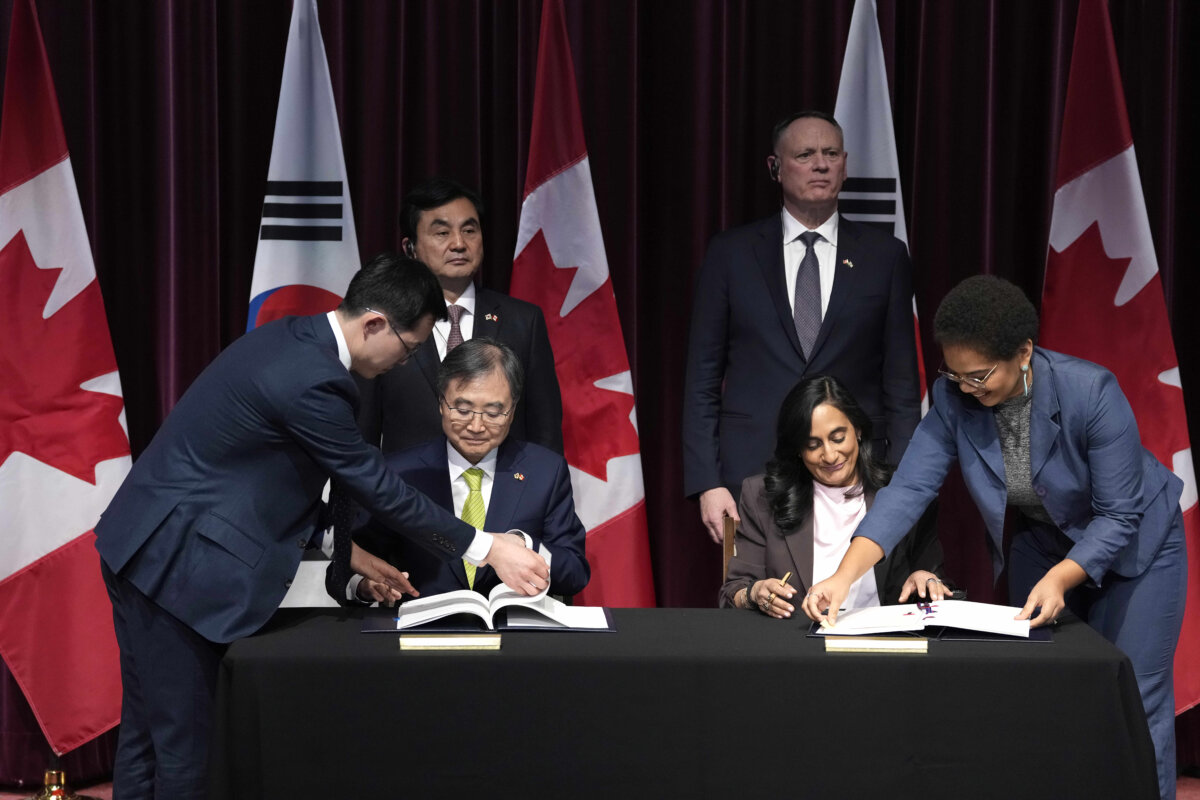
The new deal builds on that partnership with the creation of a SDCP Action Plan. It was finalized on Feb. 25 with an official signing ceremony in Ottawa, where Defence Minister David McGuinty and Foreign Affairs Minister Anita Anand hosted their South Korean counterparts, Foreign Affairs Minister Cho Hyun and Defence Minister Ahn Gyuback.
McGuinty told reporters after the ceremony that the deal represents “an important step for our two countries.”
“It’s critical that Canada expands its defence industry, but it’s equally important that we enhance our defence relations around the world, and that’s what today is really all about,” he said.
Ottawa said in a statement that the action plan serves as a guide to strengthen, expand, and guide defence cooperation between the two countries to address traditional and emerging threats in the Indo-Pacific. It will also encompass a legal framework for the collaboration of their military forces.
Key initiatives under the SDCP action plan include enhancing industry competitiveness via information protection agreements and expanding joint military exercises, including new Air Force Staff Talks.
The plan also calls for a biennial meeting between the two countries to oversee progress. The next meeting is set for 2028.
Hyun said the deal means South Korea and Canada will be able to engage in deeper defence and security cooperation at a time of geopolitical uncertainties.
“We believe that security and economy are very closely linked so our two countries will continue to deepen our economic cooperation,” he said, noting that the countries will work to increase trade and investments. “In defence, industry and other areas, I hope that we become the closest partners out there.”
Ottawa is aiming to double non-U.S. exports over the next 10 years, after U.S. President Donald Trump implemented tariffs against Canada and other countries.
Anand told reporters the trade diversification strategy is part of the government’s foreign policy strategy.
“What Canada is doing in this era is coalescing around like-minded countries on initiatives that will grow the domestic economy and advance our security and defence overall,” Anand said. “This is an era where one cannot separate defense and security, on the one hand, from economic results on the other.”
Submarine Deal
The deal also comes as South Korean company Hanwha Oceans is competing with the German submarine producer TKMS for a multi-billion-dollar contract to provide Canada with up to 12 new submarines.
Neither McGuinty nor Anand would say when the new submarines would hit Canadian waters.
“The good news is we’re procuring submarines for the first time in a very long time,” McGuinty said. “This is likely the largest procurement in Canadian history in the defence space, so we’re going to take the time that we need to get this right.”
Anand added that the procurement process doesn’t involve “intervention at the political level.” She said manufacturers are currently in the process of compiling their bids to meet Canada’s technical and design requirements.
The South Korean ministers said they advocated for their country’s submarines at the Feb. 25 meeting.
Industry Minister Mélanie Joly recently told reporters that Canada is seeking industrial advantages that extend beyond the submarines, emphasizing that Ottawa’s intention is to increase vehicle manufacturing from South Korean, German, and Chinese automakers.
Joly and her German counterpart signed a joint declaration of intent on Feb. 24 to promote increased cooperation in the sectors of automobile and battery manufacturing, as well as critical minerals.
She also signed a deal with South Korean Trade Minister Jung-Kwan Kim last month with the goal of establishing South Korean automobile manufacturing in Canada.
Conservative critic for national defence James Bezan said in a statement that signing non-binding agreements doesn’t mean the operational strength and capabilities of the Canadian Armed Forces will be increased.
“What we need is for the Liberal government to listen to our service men and women and buy much-needed equipment quickly, based on what we need to defend ourselves,” said Bezan. “Nearly a year into his term, and Carney has changed the rhetoric, but not the reality of what kit our armed forces have to do their jobs.”
The Canadian Press contributed to this report.
 Friends Read Free
Copy
Facebook
Tweet
Friends Read Free
Copy
Facebook
Tweet