
Canada will be able to join Europe’s massive rearmament program following months of negotiations, but Ottawa has not indicated the cost of reaching such an agreement.
Prime Minister Mark Carney has concluded negotiations for Canada’s participation in the Security Action for Europe (SAFE) program, as part of Canada’s Security and Defence Partnership with the European Union, the Prime Minister’s Office (PMO) said in a Dec. 1 news release.
So far, details about the cost of Canada’s membership in the SAFE program have not been released.
“The details in terms of costs, percentages are being ironed out,” Defence Minister David McGuinty told reporters on Dec. 1 when asked about the entrance fee Canada will have to pay to participate in the program.
“We’re still negotiating on fine-tuning the terms of all the final inked deal that’s coming. It won’t be long,” he added.
McGuinty said Canada will be able to participate in the program by supplying equipment and capabilities such as ammunition, missiles, drones, artillery systems, and infantry weapons. This will give Canadian defence companies expanded access to the European market as EU countries look to increase defence spending as part of the EU’s Readiness 2030 plan, the PMO said.
Canada is the first country outside of the EU to gain access to the SAFE program.
The PMO says Canada joining the program will unlock “billions of dollars in potential defence opportunities for Canadian businesses.” The program provides up to $244 billion in loans to EU member countries to support large-scale defence projects like acquiring capabilities.
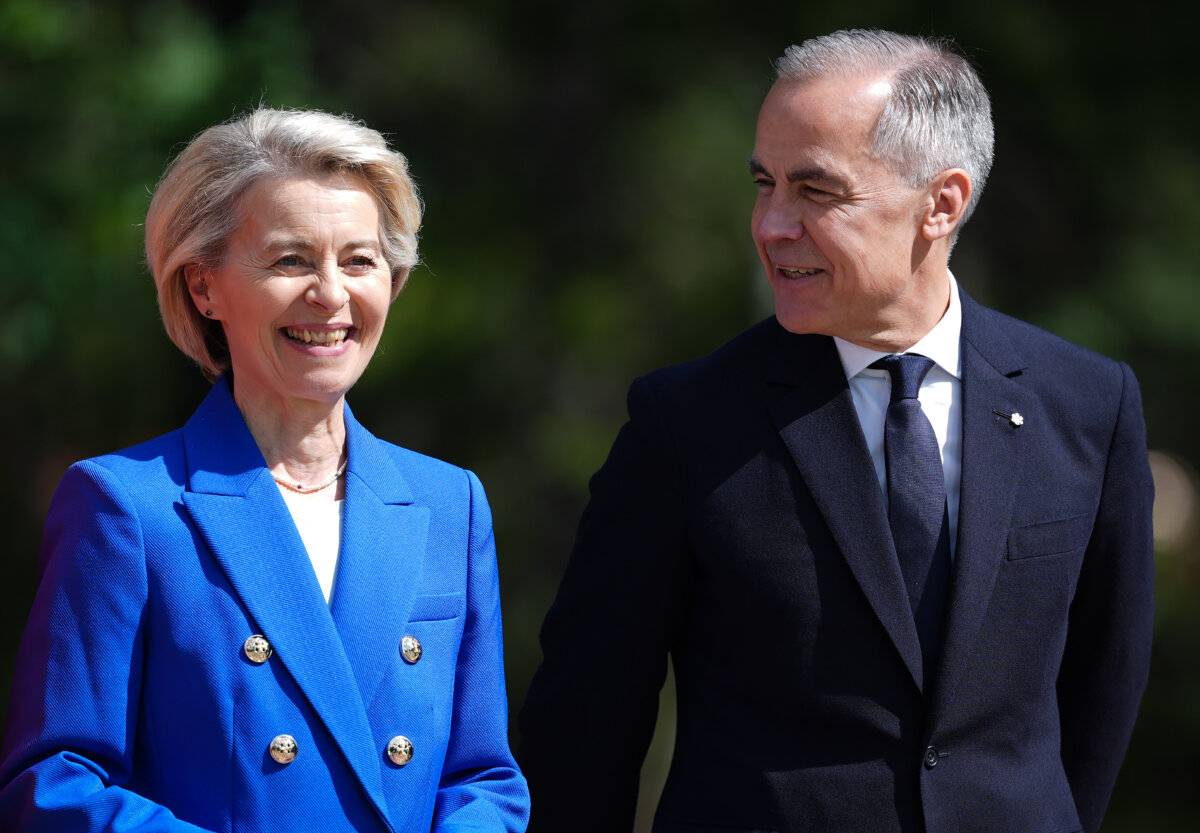
In a Dec. 1 joint statement, Carney and President of the European Commission Ursula von der Leyen said Canada joining the SAFE program represents the next step in deepening cooperation and is “symbolic of the shared priorities” of the EU and Canada.
The two leaders also said the program will provide support to Ukraine and “increase the resiliency of the Ukrainian defence industry.”
Canada–EU Ties Amid US Tensions
Canada and the EU signed a defence security pact while Carney was visiting Brussels in June. The deal allowed Canada to begin talks to join the EU’s rearmament plan. Canada and NATO ally countries also committed in June to meeting NATO’s defence spending target of 5 percent of GDP by 2035.
The new defence pact came as Carney had been seeking closer ties with Europe amid trade tensions with the United States that have led to efforts to diversify Canada’s defence partnerships.
As Canada continues to have ongoing tensions with the United States, Swedish defence company Saab has floated the possibility of 10,000 aerospace manufacturing jobs coming to Canada if the government puts in an order for a fleet of its Gripen fighter jets, as Canada looks to replace its aging fleet.
Canada currently has a contract for American-made F-35 stealth fighter jets, but Industry Minister Mélanie Joly has said the contract doesn’t deliver enough economic benefits. She said on Nov. 18 that Ottawa is continuing to look at what U.S. firm Lockheed Martin can offer, but noted she also wants to see if Saab can provide a better deal.
McGuinty said on Nov. 21 that despite the review of Canada’s F-35 fighter jet purchase, “Canada and the United States continue to cooperate on defence, security, and intelligence.”
Jennifer Cowan and Noé Chartier contributed to this report.
 Friends Read Free
Copy
Facebook
Tweet
Friends Read Free
Copy
Facebook
Tweet