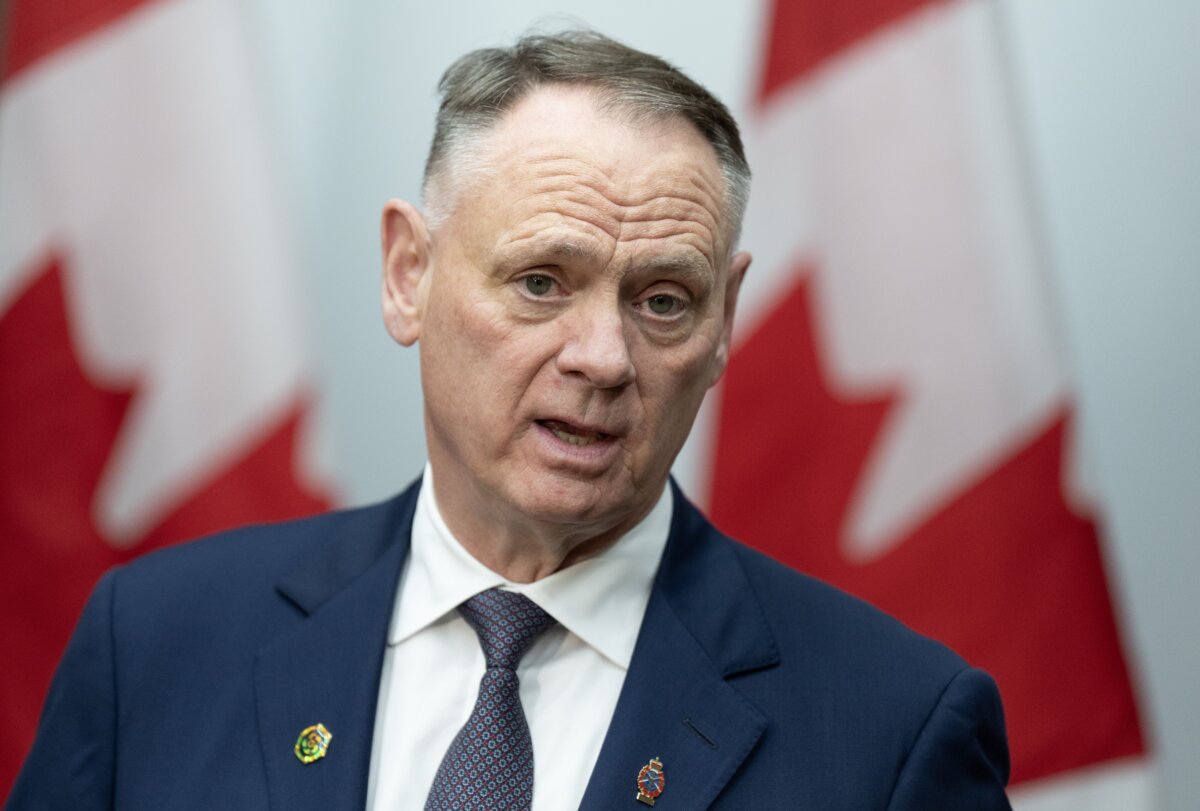

Though Canada’s purchase of F-35 fighter jets is still under review, causing concerns in the United States, Defence Minister David McGuinty said cooperation between the two countries remains robust.
“It is important to remember that Canada and the United States continue to cooperate on defence, security, and intelligence,” McGuinty said during an unrelated defence announcement in Halifax on Nov. 21.
McGuinty was asked by reporters to comment on the status of the review, which was ordered after Prime Minister Mark Carney took office in the spring amid trade tensions with the United States.
McGuinty said the “deep” review remains underway and didn’t offer a timeline for its completion.
The subject is surfacing as Swedish manufacturer Saab has launched a campaign to convince Ottawa to purchase its Gripen fighter jet.
Canada is aiming to replace its aging fleet of CF-18 Hornets, which were put into service in the 1980s.
The Canadian government has already finalized the purchase of 16 F-35s from U.S. defence firm Lockheed Martin out of an initial commitment to acquire 88.
Meanwhile, U.S. Ambassador to Canada Pete Hoekstra this week mentioned Canada’s decision on the F-35 in the context of the evolution of trade talks with his country.
Trade talks on U.S. sectoral tariffs and energy were cancelled by U.S. President Donald Trump last month, citing Ontario’s anti-tariff TV ad broadcasted in the United States.
The trade tensions between Canada and the United States have not impacted defence cooperation, according to McGuinty.
“In fact, in my six or seven months in this job, what I’ve concluded is that there is no daylight between us,” he said.
“We’re sharing information intelligence, we’re sharing equipment, we’re purchasing equipment, we have integrated supply chains, we’re working together on different equipment, we’re in lockstep on so many fronts, that’s a positive and an important thing for us going forward.”
At the same time, the Carney government has worked towards increasing defence cooperation with Europe, including by starting talks to join its massive re-armament plan.
There was additional activity regarding Sweden this week as its royal family visited Ottawa. Ottawa announced a new “strategic partnership” with the Scandinavian country, which includes defence industrial cooperation.
Accompanying the Swedish royals on the visit were Saab executives, who met with Canadian officials.
Industry Minister Mélanie Joly said the company proposed establishing manufacturing in Canada, which she said could create 10,000 jobs. She also said Canada has not had enough returns for its purchase and involvement in the F-35 program.
“When it comes to the Gripen, of course we’re really interested in seeing what can be done,” Joly said. “Ten thousand jobs is indeed a very interesting offer. We’ll see how that is concrete. And at the same time, we’re looking at what Lockheed Martin can do.”
Lockheed Martin said in response there are roughly 30 active Canadian suppliers involved in the F-35 program and that if Canada reduces its order it could impact economic windfalls.
Ambassador Hoekstra said this week the F-35 is “not an American plane, it’s an international plane,” and noted how Canada had been one of the first countries to join the multinational Joint Strike Fighter program in the late 1990s.
Hoekstra’s comments came during a talk at a manufacturing conference when the host asked him what’s his most optimistic view of what the renegotiated United States-Mexico-Canada Agreement will look like. Ottawa and Washington are ramping up to renegotiate the free trade agreement next year.
“On a number of these issues, we are we’re actually waiting to see exactly where the Canadian government is going to come out on this,” he said, while pivoting immediately after to talking about the F-35 issue.
“On the F-35 we’ve got all kinds of people and companies that are involved, from an economic standpoint and a military cooperation standpoint, the F-35 has been a phenomenal success,” he said.
Chief of the Defence Staff Gen. Jennie Carignan backed the purchase of additional F-35s earlier this year while the acquisition review was ongoing.
She said buying different jets would represent significant additional costs and require retraining pilots. She noted having a duel fleet would also involve the need for different hangar facilities and processes for acquiring parts.
 Friends Read Free
Copy
Facebook
Tweet
Friends Read Free
Copy
Facebook
Tweet