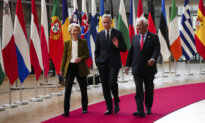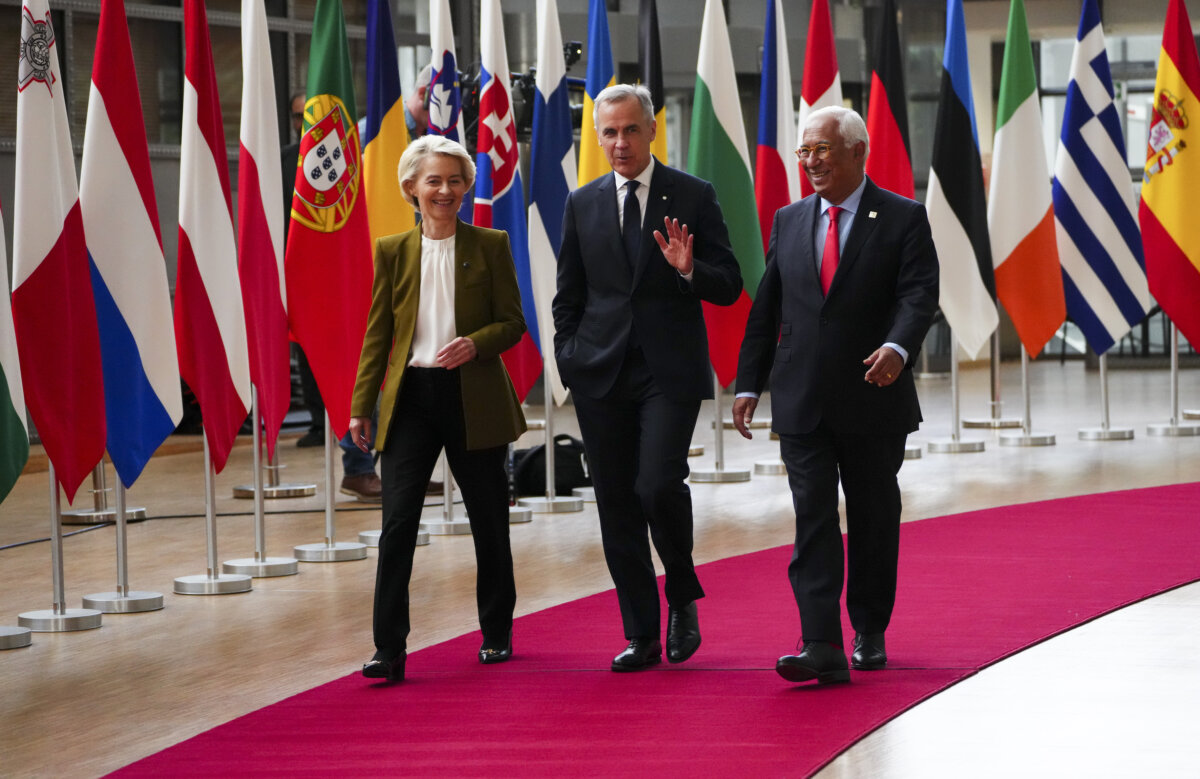
Leaders of Canada and the European Union said they have signed a defence security pact as Prime Minister Mark Carney was visiting Brussels. The deal will in part allow Canada to begin talks to join Europe’s rearmament plan.
“With this new security and defence partnership, which provides for this increased cooperation across the full spectrum of security, it will help us deliver on our new requirements for capabilities more rapidly and more effectively,” Carney said during a press conference on June 23. He was speaking alongside European Council President António Costa and European Commission President Ursula von der Leyen after holding talks during the day.
Von der Leyen said that with the signing of the agreement, talks will “swiftly” begin for Canada to enter and bolster the EU’s 150-billion euro ($240 billion) Security Action for Europe (SAFE) program contained within the ReArm Europe policy.
The new defence pact is strategic in nature, with no clear deliverables announced. A joint statement from Canada and the EU said it will serve as a “coherent, high-level political framework” for discussion around defence and security.
Carney said the “rules-based global order is under threat” and added that “we can nostalgically look back and long for the old order to somehow return, or we can build a new one with purpose and partnership.”
The press conference took place only moments after reports of Iran launching missile attacks against a U.S. military base in Qatar, in response to the U.S. attack on three Iranian nuclear facilities over the weekend. The Qatari foreign ministry said the missiles were intercepted. Hours later, U.S. President Donald Trump said Iran and Israel have agreed to a ceasefire effective midnight Wednesday.
Earlier in the day, NATO Secretary General Mark Rutte said he didn’t believe the U.S. attacks had violated international law.
Asked to comment on the matter, Carney didn’t answer directly but said that Iran has been pursuing nuclear weapons and has a stated objective of eliminating Israel. He added that Iran has sponsored terrorism and that Canada has listed the Islamic Revolutionary Guard Corps as a terrorist entity. “These are violations of international law, these are the ones we looked at,” he said.
Before Iran became a major flashpoint, the EU and Canada had been focused on Russia’s invasion of Ukraine. The dynamic on how to deal with the conflict has changed with the arrival of Trump at the White House, but peace prospects have remained elusive.
There was no joint statement on that conflict from G7 nations at the end of the summit in Alberta last week.
After the summit, Canada announced new sanctions against Russia targeting hundreds of Russia-linked ships and individuals, along with sanctions on components sought by Russia for use in its arms industry. Carney noted in Brussels the EU is preparing its 18th set of sanctions against Russia, which he called a “very significant package of sanctions.”
Carney and world leaders discussed a range of topics at the G7, from defence and economic cooperation to migration, and the summit was where von der Leyen first announced the upcoming security and defence partnership.
Carney has sought closer ties with Europe since being sworn in as Canada’s leader in mid-March, amid trade tensions with the United States. The next day after taking office, Carney took his first international trip as Canada’s leader to the United Kingdom and France where he discussed trade agreements and transatlantic security with French and British leaders.
Following Brussels, Carney will attend the NATO leadership summit at The Hague, primarily expected to focus on boosting NATO members’ defence spending targets. Speaking ahead of the Hague summit, Rutte stated a new defence investment plan would raise the GDP defence spending goal for member states to 5 percent, saying, “The threats we face today demand that we do far, far more to ensure we can effectively deter and defend.”
Aside from a new defence pact, Canadian and European leaders have agreed to launch negotiations around multiple areas on issues like climate change and trade.
On trade between Canada and the EU, von der Leyen said during the press conference that talks are still ongoing to reach the ratification stage of the Comprehensive Economic and Trade Agreement (CETA), a major Canada-Europe free trade deal. “We are committed to get this done,” she said.
CETA reduces trade barriers between the EU and Canada for goods, services, and investment, and also cuts the majority of duties and tariffs between Canada and the bloc. Parts of CETA were first applied in 2017, although matters of consumer rights and environmental and food standards are still being debated ahead of potential full ratification of the agreement.
 Friends Read Free
Copy
Facebook
Tweet
Friends Read Free
Copy
Facebook
Tweet