

Labor Day, celebrated this year on Sept. 7, is a holiday in transition.
It was created by American labor unions in the 1880s. The federal government recognizing it as a national holiday under President Grover Cleveland helped unions to gain prominence.
Yet as unionization has declined, so too has the close association of the day with organized labor.
The Department of Labor’s website now calls it an “annual celebration of the social and economic achievements of American workers.”
Nelson Rivera of New York City is one such worker. He is an assistant supervisor in maintenance, a field he has toiled in for 23 years.
“Labor Day to me is just celebrating people that’ve been working all their lives, like 20 and 30 years,” he told The Epoch Times.
He said it was a day to “cook out with my family, have a good time with them, and relax.”
For many working families like Rivera’s, the Labor Day cookout is a regular event.
It’s also the occasion for many sales, the moment fashionistas have designated to mark the shift to fall colors, and the holiday after which many schools start.
Even that last part has faded, however, with the Pew Research Center finding in 2023 that more than 70 percent of students now start earlier.
America is less organized around Labor Day because American workers are less organized by unions than they used to be.
Only 10 percent of the total American workforce was unionized last year.
Among those, fewer than 6 percent of private-sector workers were unionized, according to government data from the Bureau of Labor Statistics.
The decades-long decline has been helped along recently by some Trump administration moves against public-sector unions.
On the state level, legislatures in red states are pushing against unions in several ways, while their counterparts in blue states are pushing back.
In percentage terms, it has been quite the fall. Unionization of the American economy stood at 20.1 percent in 1983. From the mid-1940s to the mid-1950s, the percentage of the U.S. workforce that was unionized was even higher than that, at more than 30 percent.
That means that the American economy has transformed over 70 years, from roughly one in three workers being unionized in 1955 to one in 10 in the most recent figures.
Last year’s unionization number was propped up by government workers, who the Bureau of Labor Statistics noted are organized at a rate “more than five times higher than the rate of private-sector workers,” or 32.9 percent.
Looking at the private sector alone, only slightly more than one in 20 workers were represented by a union.
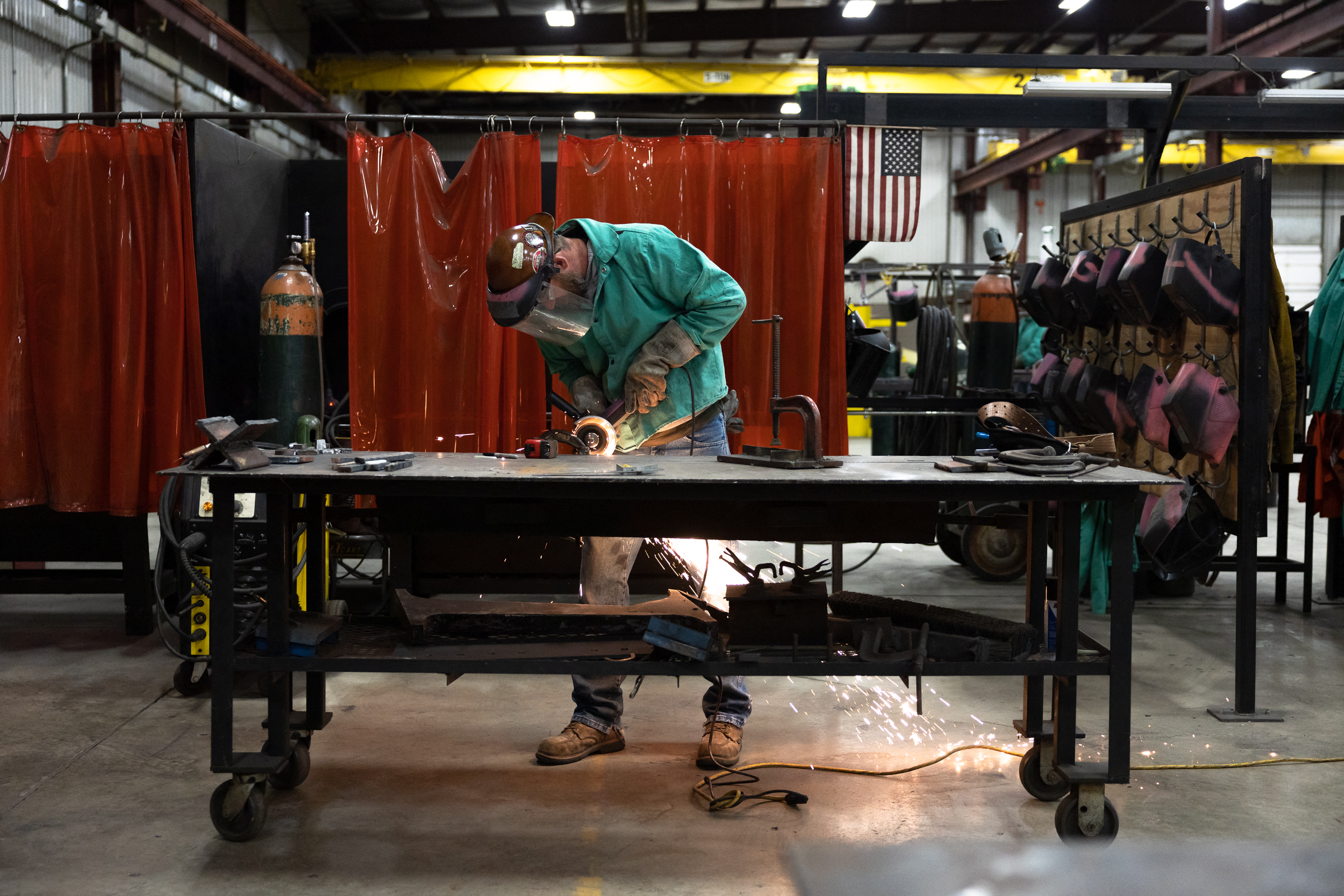 A student does steel work at Ironworkers Local 29 during an apprenticeship in Dayton, Ohio, on Oct. 24, 2022. (Megan Jelinger/AFP via Getty Images)
Trump and Unions
President Donald Trump courted union voters during his three campaigns for the presidency, and the actions of his administration toward private-sector unions have been mixed.
At times, Trump has shored up the union position. He met with the International Longshoremen’s Association leadership as president-elect in 2024 and worked to avert a strike with an agreement to slow any job-replacing automation at East and Gulf Coast ports.
Other times, Trump has done things that unions generally opposed, such as firing the National Labor Relations Board’s Democrat-designated member Gwynne Wilcox in late January 2025.
The firing had to be litigated. That kept the regulatory body from having a necessary quorum for about a year. The lack of regulatory authority contributed to a growing backlog of thousands of cases, which made it very difficult for unions to press unfair labor practice claims.
Trump’s administration has been more oppositional to unions representing government workers.
With one executive order, for instance, the president sought to exclude the workers of 40 government agencies from collective bargaining. After much litigation, the administration has managed to cancel collective bargaining for the workers of several agencies.
In an April court filing, the National Treasury Employees Union said it expects to “lose tens of thousands of members” because of those actions.
The administration also took actions to make it easier to fire civil servants by reclassifying them, successfully urged somewhere in the neighborhood of 140,000 federal workers to take buyouts, and has floated a federal pay freeze for next year.
Unions representing government workers have shed many of their own workers. Collections fell off after the federal government stopped automatically deducting union dues from many workers’ paychecks and depositing them into union accounts.
States and Unions
Actions limiting government unions in ways great and small are also happening at the state level, particularly those controlled by Republicans.
For instance, this year the Idaho legislature passed a bill to prohibit school districts “from allowing taxpayer funds to promote teachers unions.”
The bill forecast that a few school districts “may experience a modest indeterminate increase in revenue,” seeing as how teachers’ unions are now “required to reimburse the school district for any time teachers spend on union-related activities during work hours.”
States with Democratic majorities are generally pushing the other way, as one act of the New Jersey legislature shows.
For the 2026–2027 school year, New Jersey schools are introducing mandated curriculum to turn social studies classes into primers on the past struggles of organized labor, including “notable strikes throughout history.”
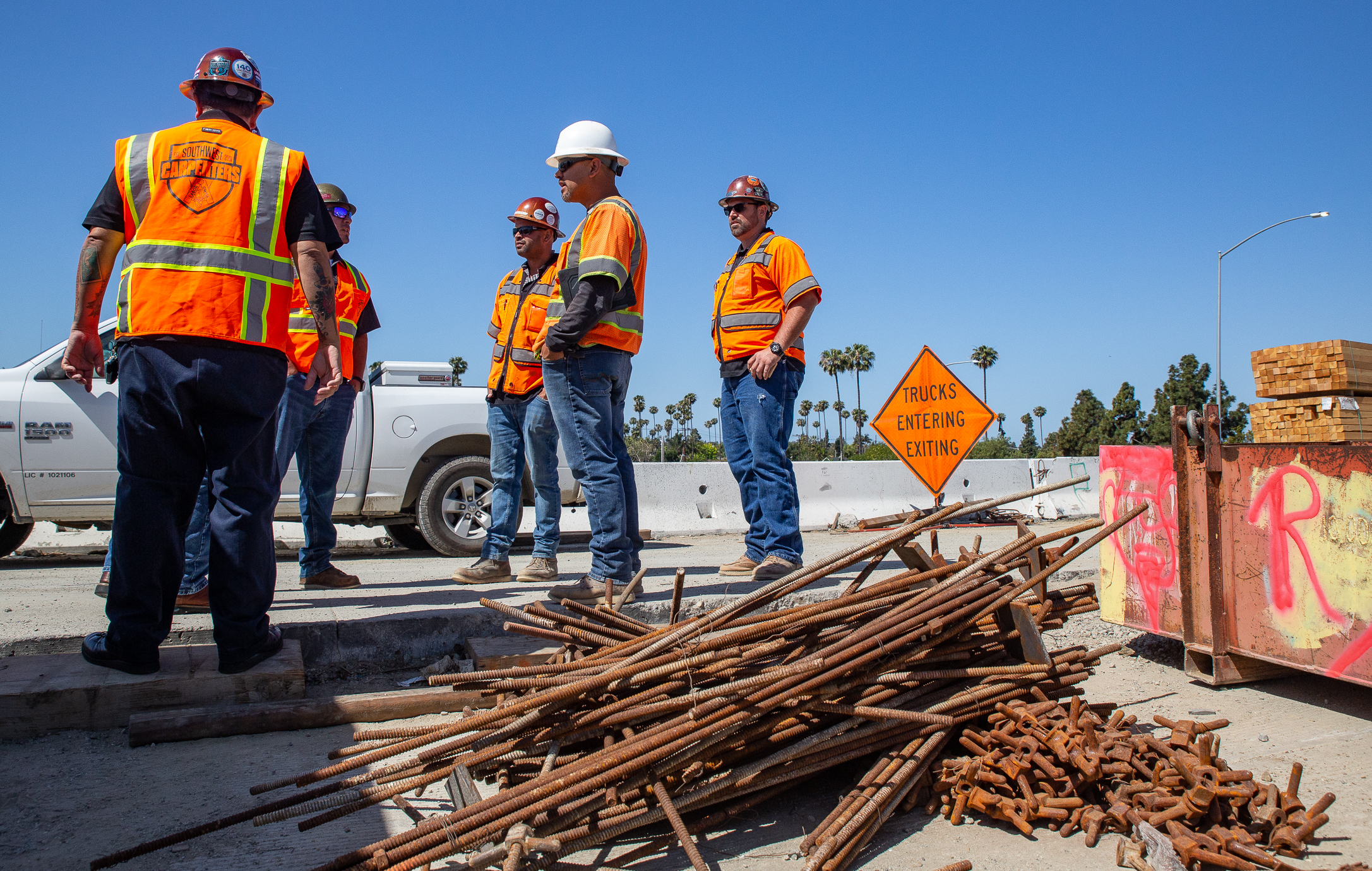 Construction workers chat in Costa Mesa, Calif., on April 21. 2022. (John Fredricks/The Epoch Times)
Where Unions Have a Greater Impact
Yet the story for organized labor in America on this Labor Day is not only a story of decline. There are some successes as well that show how unions continue to exert influence.
Unions continue to push for and win some unionization elections.
And unions in a few sectors have found ways to buck the wider trend and have organized in numbers that are several times greater than in the economy as a whole.
The technical term for the percentage of the economy that is unionized is called union density.
Julia Cartwright is a senior research fellow in law and economics at the American Institute for Economic Research.
She told The Epoch Times that she expects that private-sector union density will either “stay flat or drift slightly lower over the next five years, from 5.9 percent in 2025 to somewhere in the 5.5–6 percent range by 2030.”
Currently, the transportation and infrastructure sectors “sit well above the private-sector average” of union density, Cartwright said, and supplied numbers from government data.
Workers at utilities, which manage significant infrastructure, are 17.8 percent unionized. Transportation and warehousing workers together are 13.6 percent unionized. Construction workers, who are responsible for servicing and building out a lot of infrastructure, are 11.1 percent unionized.
“These industries stay more heavily unionized because the usual union-avoidance playbook doesn’t work as well there,” she said, explaining that “the work can’t be relocated; you can’t offshore a port, a rail line, or a construction site.”
Cartwright said certain laws have also played a role in boosting unionization in these sectors.
Prevailing wage laws, mandated for federal contracting companies by the Davis-Bacon Act of 1931 and mimicked by several states, require “prevailing, often union-scale, pay on public projects, which erases nonunion contractors’ main bid advantage and keeps union contractors and their apprenticeship pipelines viable,” she said.
Parts of the transportation sector have a whole different set of laws regulating unionization, she noted.
The normal rules of the game under the National Labor Relations Act of 1935 treat single workplaces as bargaining units for the purposes of unionization elections.
Railroads and airlines are instead governed by the older Railway Labor Act with “bargaining units spanning an entire carrier’s system,” Cartwright said.
That makes it easier to unionize much larger percentages of those sectors. And more thorough unionization gives unions more leverage.
Rail and shipping are “chokepoint industries,” she said, “meaning industries positioned at narrow pass-through points in the economy where a stoppage cascades far beyond the firm itself.”
Cartwright used as an example a rail or port strike, which can “idle billions of dollars in capital and disrupt supply chains nationwide.”
The large sums of money at risk of disruption have “historically made accommodation cheaper for employers than confrontation.”
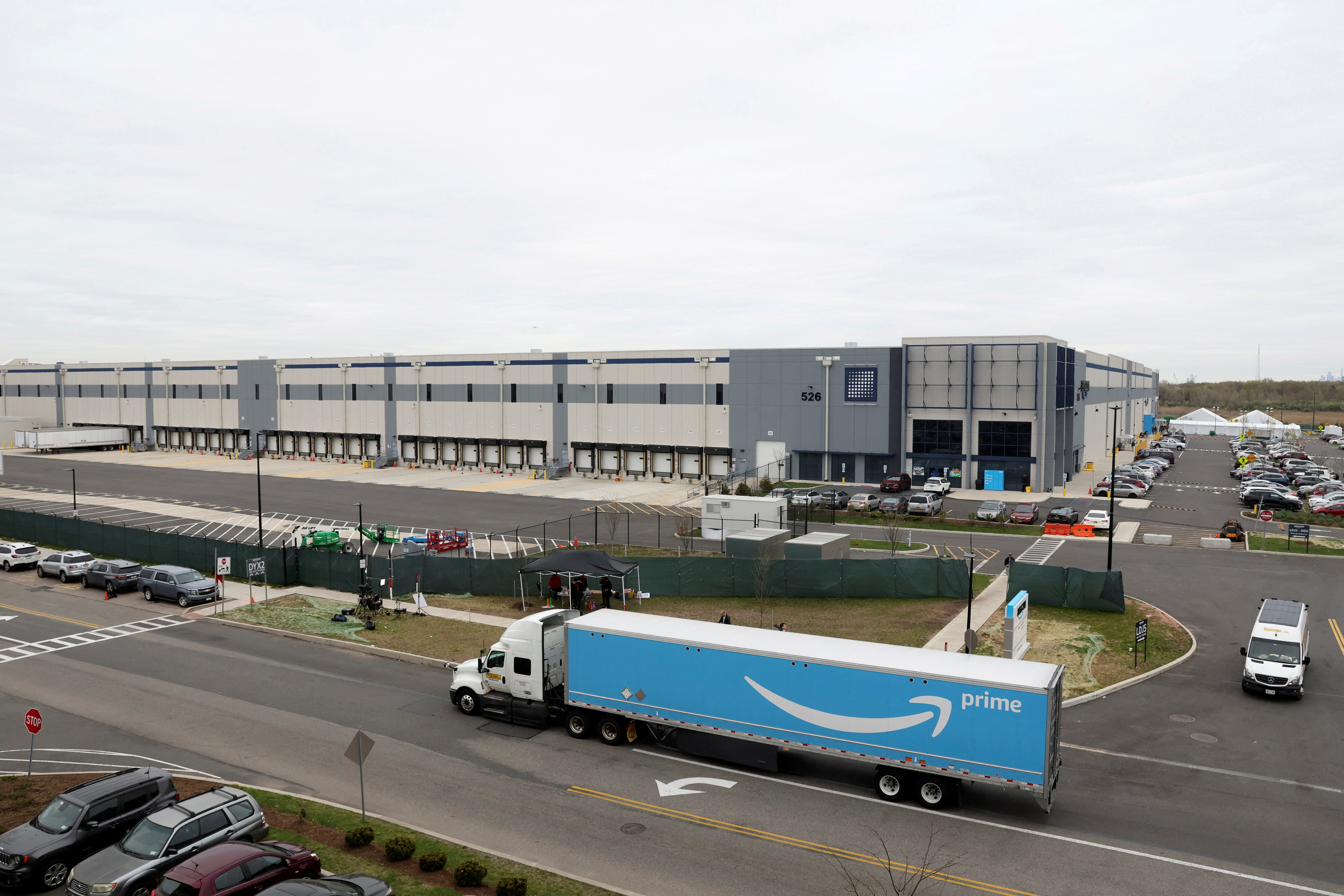 Amazon’s LDJ5 sortation center is seen, as employees vote on unionizing a second warehouse in the Staten Island borough of New York City on April 25, 2022. (Brendan McDermid/Reuters)
Construction, Transportation Trends
Peter Philips is an economist at the University of Utah who has also studied unionization in America. He foresees some strength ahead for unions in these sectors, but also some weakness.
“Union density in the construction sector benefits from construction booms,” he told The Epoch Times, and he thinks demand for data centers to power the growing AI sector fits that bill.
Philips predicted that far greater data center construction will redound “to the benefit of construction unions that will expand their membership to meet the demand.”
In contrast, he thinks the transportation sector is “more of a mixed bag.”
Philips said that economic booms benefit trucking, railroads and airline travel.
Yet trucking firms are finding themselves squeezed by higher diesel prices due to shipping problems through the Strait of Hormuz, and the AI boom could lead to the development of some driverless trucking down the road.
The expansion of driverless trucks, “if they are successfully introduced to the transportation sector,” is likely to “hurt long haul trucking employment, including possibly unionized truckers,” he said.
He thinks that Americans are bound to be skittish about at least some of this.
“It may be a while, if ever, that the public is going to be comfortable with and accept driverless 18-wheelers,” he said.
The contest he sees developing at trucking firms is between rising demand, the struggle to staff for that, and automation, which is one answer to the staffing problem.
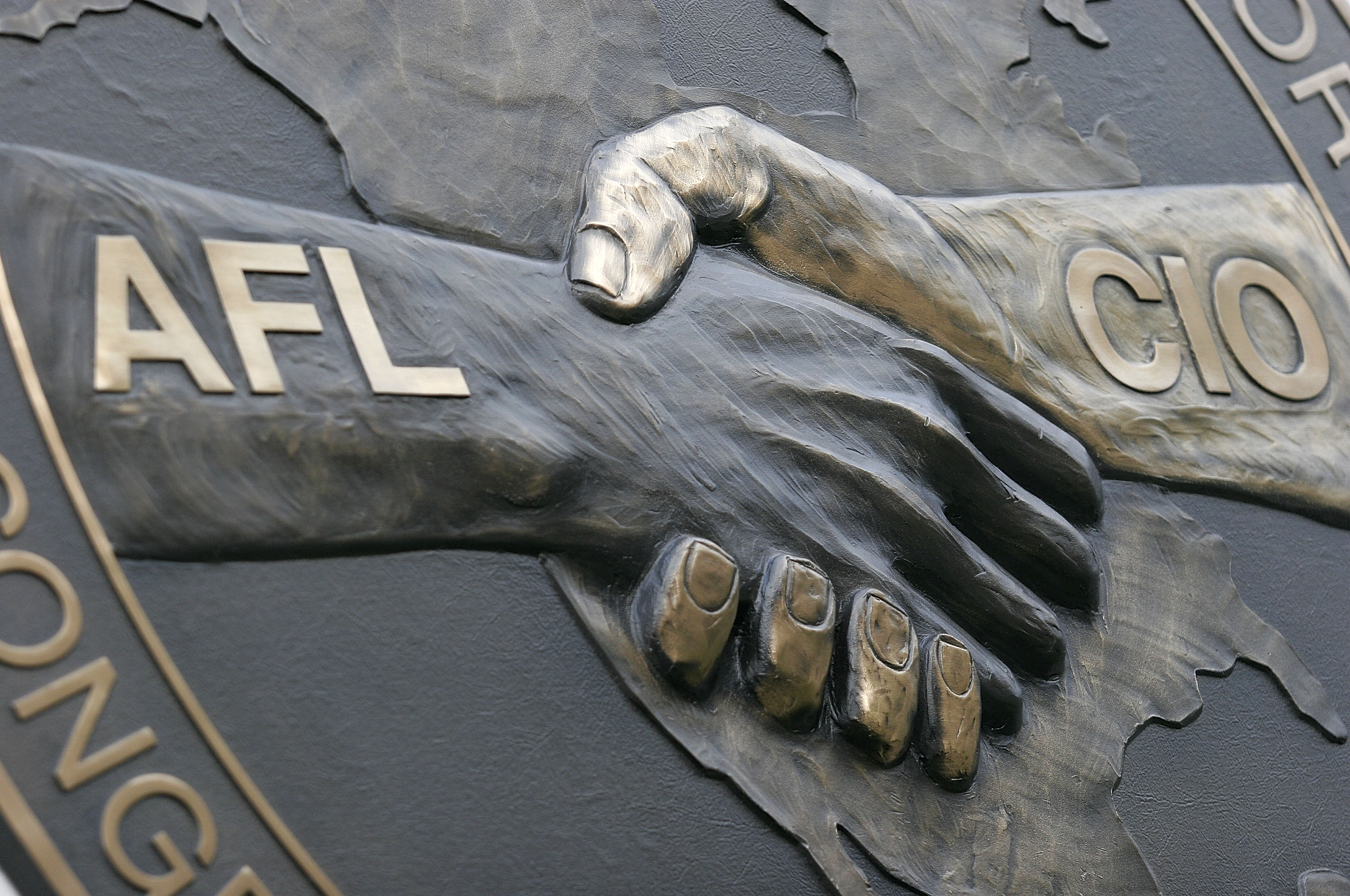 American Federation of Labor and Congress of Industrial Organizations (AFL–CIO) signage on the building at the intersection of 16th Street NW and Eye Street, just two blocks north of the White House, in Washington on July 25, 2005. (Chip Somodevilla/Getty Images)
Recent Union Gains
Drawing on the same government data as Cartwright and Philips, the AFL-CIO trumpeted the recent achievements of organized labor as a whole.
“Union representation grew by 463,000 in 2025, bringing the total number of workers represented by union contracts to 16.5 million,” the union said in a news release earlier this year celebrating results that were the “highest in 16 years.”
The AFL-CIO noted “significant gains in health care, retail, education services and construction” and that unions have made headway in the South, which had been thought by many in organized labor to be hostile territory because of the states’ right-to-work laws.
However, even for all that effort, the percentage of America’s unionized workforce stayed essentially flat.
Cartwright cautioned that percentages of unionization can sometimes be misleading because the size of the American workforce changes over time.
“Unions have been adding members in absolute terms,” she told The Epoch Times, “but the nonunion workforce keeps growing faster, so union density stays roughly the same.”
Cartwright said this growing but still seemingly getting nowhere phenomenon was “starkest in 2022, when unions gained 273,000 members and density still fell because total employment grew by 5.3 million.”
That does not mean that unions are doomed to relative decline. What it does mean on this Labor Day is that unions and their supporters have their work cut out for them.
According to AFL-CIO President Liz Shuler, they are up to that challenge.
“In 2026, workers will continue to organize in every corner of the country and build power to fight for the lives they deserve,” she said.
Sylvia Xu contributed to this article.
 Friends Read Free
Copy
Facebook
Tweet
Friends Read Free
Copy
Facebook
Tweet