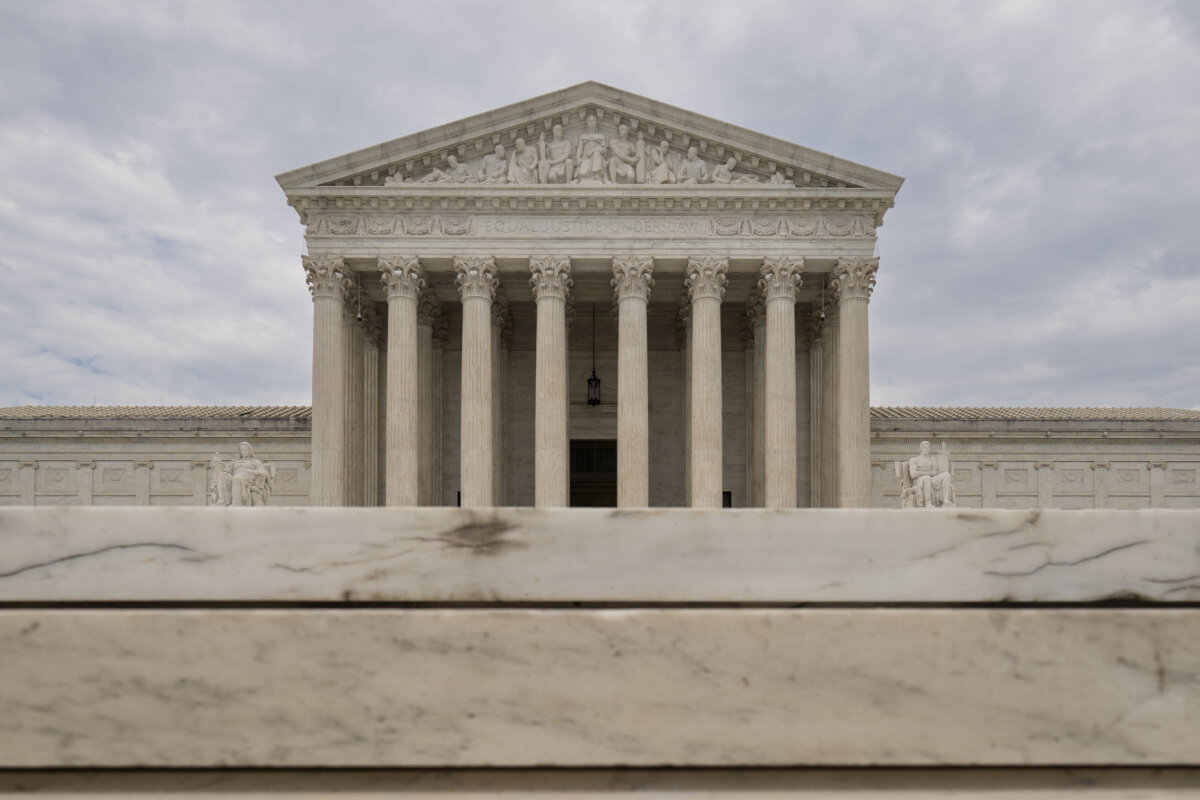

The Trump administration on Sunday petitioned the U.S. Supreme Court after a federal judge blocked new U.S. Postal Service restrictions that were imposed on mail-in ballots—with just two months to go before the midterm elections.
Noting that mail ballots have already begun to be sent out in North Carolina, U.S. Solicitor General John Sauer stated that “more States will begin the mailing process as the injunction remains in place — including Alabama on September 9 and at least five States the week of September 13.”
“Once those ballot envelopes enter the mailstream, there is no retrieving them,” Sauer wrote. “And while the injunction allows the Postal Service and the States to continue taking steps to ensure that their envelopes satisfy the Rule’s requirements … each day the injunction is in place risks sowing confusion and chaos because the injunction makes those preparatory steps voluntary, rather than mandatory.”
In a response on Sunday, Supreme Court Justice Ketanji Brown Jackson ordered a response by Sept. 9 at 4 p.m. ET.
According to a Saturday update from the University of Florida’s Election Lab, 10 people have voted by mail in North Carolina for the 2026 midterms. Those are the only people who have voted in the midterms so far, the university said.
In March, President Donald Trump signed an executive order that told federal agencies to take steps to regulate voting-by-mail, including a provision that establishes and applies U.S. citizen lists for each state. Another part of the order tells the Department of Justice to prioritize investigations and prosecution of state and local officials who issue ballots to people who aren’t eligible to vote in elections.
A final provision mandates that states hand over lists of voters who have requested mail ballots to the Postal Service. It also blocks the agency from mailing ballots to voters who are not on those lists, according to the order.
The filing from Sauer came after U.S. District Court Judge Indira Talwani recently extended an order blocking the U.S. Postal Service (USPS) from executing Trump’s executive order for the November elections.
It followed the 14-day temporary restraining order she granted on Aug. 27, which halted key parts of the Postal Service’s final rule. The short-term freeze was set to expire around Sept. 10 if she had declined to extend it.
Her injunction applies to the Nov. 3 midterm congressional elections and any federal elections that take place before then.
Talwani’s injunction blocks mandatory parts of the Postal Service’s final rule, published Aug. 26, that would assign federal agencies a larger role in who receives a mailed ballot and how those ballots are processed by the USPS.
Her ruling pointed to time constraints around issuing the rule, noting that the midterms are weeks away.
“Plaintiff States are required under state law to mail millions of ballots to voters on a prescribed timeframe. As detailed below, they are unable to pivot this late in the election cycle, nearly guaranteeing significant disenfranchisement for eligible voters,” she wrote.
The Trump administration order also “requires elections officials to create accounts for a new electronic portal, certify that they have received approval regarding the mail ballot design, and thereafter upload to the USPS portal each voter’s information, including name, address, and a unique intelligent mail barcode,” she added.
The Trump administration’s latest petition described the mail-in ballot restrictions as commonsense changes that are within the federal government’s power to regulate the mail.
“Simply put, the best way to address respondents’ fears about inability to comply with the Rule is to grant an immediate administrative stay of the order, followed by a full stay pending further review,” the solicitor general said in the filing. “That will remove the improper cloud of uncertainty that the district court has cast over the Rule, making clear to all involved that compliance with the Rule is not optional and must start without further delay.”
Last month, the Supreme Court stayed an earlier injunction from Talwani, and ruled that the Trump administration can try to implement its mail-in ballot executive order, with the court writing that its decision “does not mean that any measure taken by the Government to implement the Order will necessarily be lawful.”
“But the [executive order] itself does not harm the States, so … [Talwani] lacked jurisdiction to bar the Government from trying to implement it,” the high court wrote.
Matthew Vadum contributed to this report.
 Friends Read Free
Copy
Facebook
Tweet
Friends Read Free
Copy
Facebook
Tweet