Prime Minister Mark Carney reiterated that Canada is ready to resume trade talks with the United States following an Oct. 25 announcement by U.S. President Donald Trump that he will raise tariffs on Canadian goods by 10 percent, “over and above what they are paying now.”
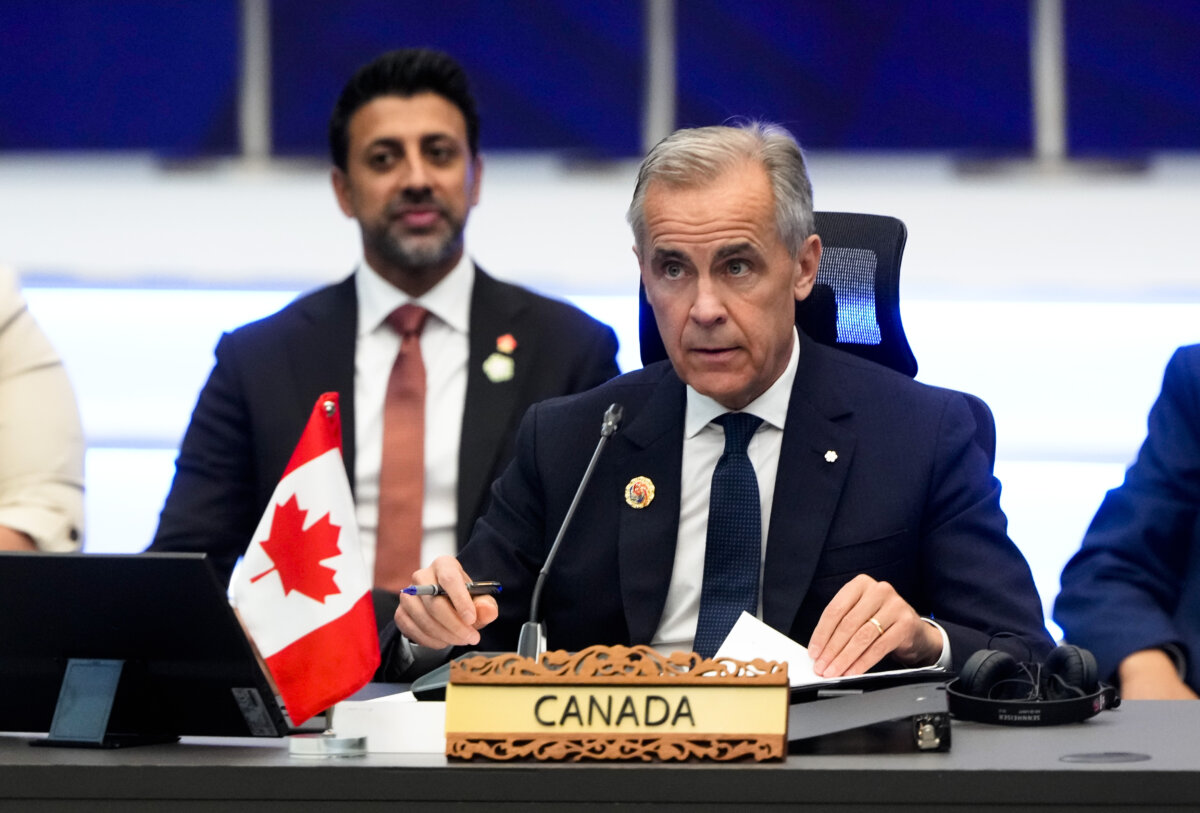
Speaking to reporters in Kuala Lumpur, Malaysia, where he attended the 47th Association of Southeast Asian Nations (ASEAN) Summit on Oct. 26, Carney said his team is “ready to work” with the Trump administration to continue where they stopped in their discussions.
“As I emphasized the other day, the Government of Canada stands ready to build on the progress that we had been making in our negotiations or discussions with our American counterparts, and we have a consistent focus in those discussions of doing the best deal for Canadian workers and their families,” the prime minister said, referring to his remarks made ahead of his trip to Asia on Oct. 24.
Canada and the United States have been in trade talks for several months since the U.S. president imposed tariffs on Canada early into his presidency. The negotiations, however, came to a halt after Trump announced on Oct. 23 that he was terminating further discussions due to an anti-tariff ad by the provincial government of Ontario, which he said misrepresents a speech by late U.S. President Ronald Reagan on trade protectionism.
Following Trump’s announcement, Ontario Premier Doug Ford said on Oct. 24 that he will pause the $75 million ad campaign, but only after the weekend’s World Series games. The move didn’t sit well with the U.S. president, as he took to Truth Social the next day, saying the advertisement was supposed to be taken down “IMMEDIATELY, but [Canada] let it run last night during the World Series, knowing that it was a FRAUD.”
“Because of their serious misrepresentation of the facts, and hostile act, I am increasing the Tariff on Canada by 10% over and above what they are paying now,” Trump added. The U.S. president says the ads are intended to interfere with a U.S. Supreme Court hearing into his administration’s tariffs, while Ontario says the tariffs are to reinforce the message that the two countries are friends and allies, and that tariffs harm both sides.
Carney told reporters Oct. 26 that it’s the “sole responsibility” of his government to continue trade talks with Washington.
“It’s the best way forward,” he said, noting that efforts will be made to shore up Canada’s economy in coming weeks.
“You’ll be seeing within the course of the next two weeks, an ambitious budget which makes generational investments in Canada, and we are in the process of diversifying our trade relationships—the focus of our meetings here in Asia,” he added.
Conservative Leader Pierre Poilievre criticized Carney for his approach to the Trump presidency, saying the Liberal government didn’t manage to get a trade deal with the United States by July 21 as it had announced previously.
“The cost of the Prime Minister’s broken promises is higher U.S. tariffs and lost jobs,” Poilievre said on Oct. 25.
‘Reliable Partners’
During the plenary session of the ASEAN summit, Carney was invited to deliver his remarks, during which he pitched Canada as a reliable partner and one that respects a rule-based trade system.
“We value a rules-based system. We respect trade agreements and the rule of law. We value the free exchange of goods, capital, and ideas,” said Carney to Southeast Asian leaders, who will discuss economic partnerships within the ASEAN region and beyond over the next three days.
Not naming the United States or calling out the U.S. president directly during his speech, Carney told the leaders that the emergence of “transactional bilateral trade” and a “new era of great power rivalry” are challenging the global institutions that middle powers like Canada and the Southeast Asian countries have relied upon. The prime minister emphasized the need to establish reliable partnership, and said Canada is one such partner.
“It underscores the importance of reliable partners who honour their commitments, who are there in tough times, and when things are not working, work collaboratively to fix them,” he said.
Trump has said he is imposing tariffs as he says other countries have been “taking advantage” of the United States, and that the measure is needed to make the United States prosperous.
“Tariffs are not just about protecting American jobs. They’re about protecting the soul of our country. Tariffs are about making America rich again and making America great again,” Trump said earlier this year.
Free Trade
The Malaysian trip marks Carney’s first visit to Asia since taking office. His attendance at the ASEAN summit is part of a nine-day regional tour that will also see the prime minister visit Singapore after Malaysia, followed by a stop in South Korea, where he will attend the Asia-Pacific Economic Cooperation economic leaders’ meeting “to deepen trade relationships in the Indo-Pacific region, shore up defence partnerships, and unlock new opportunities for Canadian workers and businesses,” the Prime Minister’s Office said in news release on Oct. 17.
In his summit remarks, Carney highlighted his government’s intent to double non-U.S. exports over the next decade, and to quadruple defence spending over the next five years, much of which he said will be allocated to cybersecurity and artificial intelligence.
The prime minister also expressed his intention to secure a Canada-ASEAN free trade agreement by next year, committing to put “all the resources in” to finalize the deal.
“This reflects what we want to do as a government. We will bring the same commitment to bilateral discussions with any of you who are interested,” Carney said, noting that Canada had entered into a trade deal with Indonesia this past September—the first-ever bilateral trade agreement with an ASEAN country.
Carney’s office said the prime minister met with the president of the Philippines, Ferdinand Marcos Jr., on the sidelines of the summit and the pair agreed to finalize a free-trade agreement between the two nations in 2026.
As well, Carney met with the prime minister of Vietnam, Phạm Minh Chính, on the sidelines of the summit and the two discussed increasing the two countries’ collaboration in trade, including in energy, aerospace, security, and critical minerals.
A meeting with Sonexay Siphandone, Lao’s prime minister, also on the margins of the ASEAN summit, saw the two leaders discuss deepening cooperation in sectors such as energy, critical minerals, and technology, Carney’s office said.
Chandra Philip, Jacki Thrapp, Omid Ghoreishi, and The Canadian Press contributed to this report.
 Friends Read Free
Copy
Facebook
Tweet
Friends Read Free
Copy
Facebook
Tweet