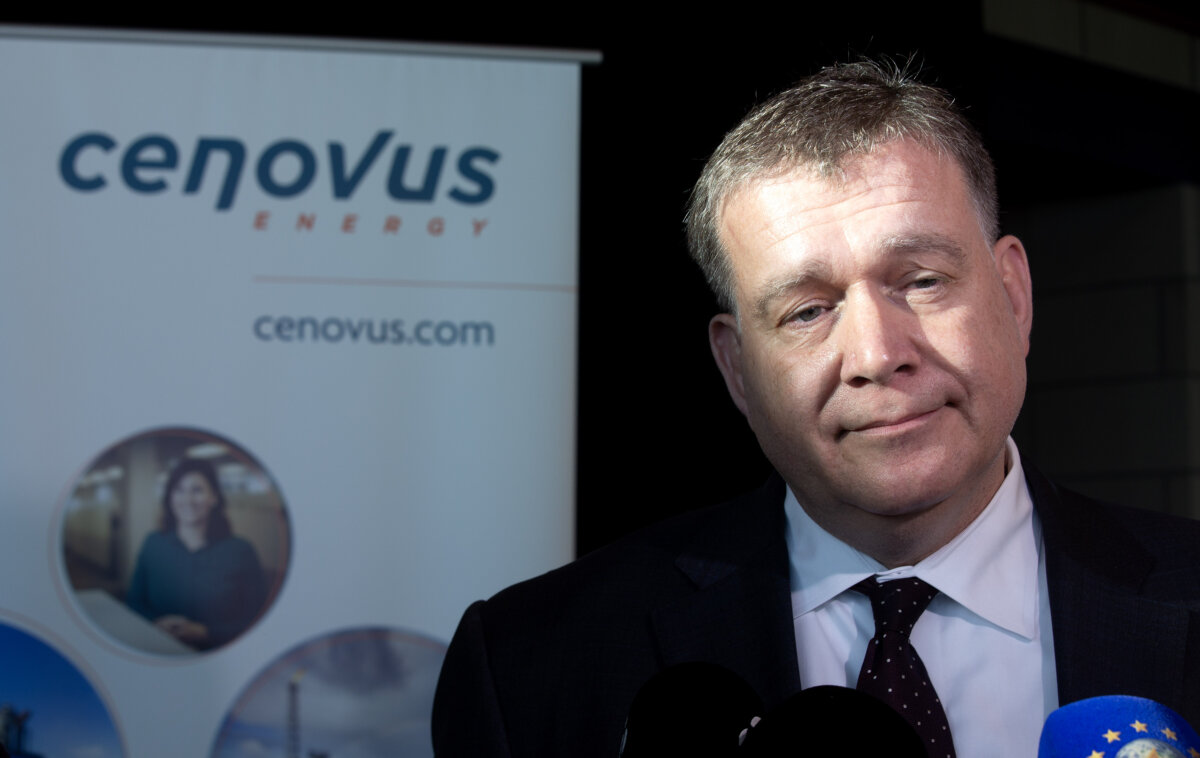

Alberta’s proposed million barrel-per-day pipeline to British Columbia’s coast cannot secure financing from the private sector because of Canada’s existing regulatory framework, says Cenovus Energy CEO Jon McKenzie.
The country’s industrial carbon pricing system makes Canadian oil uncompetitive and hampers the production growth needed or the proposed pipeline, McKenzie said at the Global Energy Show in Calgary this week.
Existing regulations render the pipeline “unfinanceable” for the private sector, added McKenzie, who leads one of the largest oil sands firms in the country.
Prime Minister Mark Carney and Alberta Premier Danielle Smith finalized an agreement in May that outlines a timeline and regulatory pathway for the proposed West Coast oil pipeline, which they say will transport millions of barrels of oil from the oil sands to Asia.
Smith’s agreement with Carney stipulates that the pipeline could be designated a project of “national interest,” with construction potentially starting as early as September of 2027.
Ottawa’s regulatory approvals for the pipeline are directly linked to the development of the Pathways CCS (carbon capture and storage) network, which would capture greenhouse gas emissions from oil sands facilities and transport them via pipeline for permanent underground storage. Neither project can proceed without the other.
McKenzie said the deal fails to address how the industry would ship an extra million barrels of oil a day while also spending capital on the Pathways project, which he said would cost as much as $30 billion.
The deal assumes that Canadian oil and gas producers will invest tens of billions of dollars to “make the 1 million barrel per day pipeline to the West Coast a reality,” McKenzie said.
“It is assumed that the Canadian oil sands producers will bear the costs of the Pathways carbon capture project to make it a reality,” he said. “The reality is that Canadian oil and gas producers are not investing much beyond sustaining capital today. Without a competitive investment regime coordinated by the federal government and the Province of Alberta, the investment required to make this a reality will be challenged.”
Neither the Pathways project nor the West Coast pipeline “really make any sense” without the necessary capital investment, McKenzie said, adding that the deal shows Canada is “increasingly out of step and uncompetitive.”
He said Ottawa’s failure to prioritize the country’s “biggest and most important export” has harmed the economy as investors leave Canada for jurisdictions that are more business friendly.
McKenzie’s remarks sharply contrasted with a speech given by federal Energy Minister Tim Hodgson at the same conference earlier that day.
Hodgson said the agreement between Ottawa and Alberta would create “a carbon market that works” to provide investors with long-term certainty, and described it as “a practical middle ground.”
“The Pathways Project is critical to ensuring Canada’s oil sector continues to grow,” he said, adding that it will demonstrate that energy production and emission reduction can “move forward together.”
He said future completion of the project to decrease carbon intensity would be a “global achievement.”
“We cannot pretend the world no longer needs oil and gas. We know it does. And we cannot pretend emissions don’t matter. We know they do,” he told the audience. “The countries that will succeed will be the ones that both produce the energy the world needs and reduce the emissions associated with producing it.”
Meanwhile, McKenzie argued that carbon capture is not a priority for customers. If it were, he said, pricing signals in the market would be evident, and government intervention would not be necessary.
“Cenovus places over 1 million barrels a day across three continents, and none of our customers have ever suggested or even asked about the carbon intensity of Canadian crudes,” he said.
Carbon Tax
Ottawa wants the oil sands companies to engineer, build, and operate the Pathways carbon capture project, while the government also wants them to pay an industrial carbon tax, McKenzie told the audience.
The industrial carbon tax increases planned over the next decade “will require the premature shut-in and reclamation of oil-producing projects that would otherwise be economic to produce,” McKenzie said. “Industry has been clear that the industrial carbon tax is insidious and it should be revoked.”
Ottawa updated its price trajectory for all industrial carbon pricing systems in Canada in May. The headline price trajectory per tonne of carbon equivalent emissions for all systems is set to rise to $100 in 2027 from $95 in 2026. It is set to rise again in 2030 to $115, and will gradually increase to $130 in 2035. It will then increase 1.5 percent per year starting in 2036 until it reaches $170 per tonne.
Ottawa has said a carbon tax gives large industrial emitters an incentive to reduce emissions that it says causes climate change and has described the measure as the best way to meet the federal government’s climate targets.
McKenzie said the escalating tax makes the energy industry “less resilient at lower commodity prices, and will require the premature shut-in and reclamation of oil producing projects that would otherwise be economic to produce.”
“Much of this is being orchestrated in the belief that we can build a functioning carbon market,” he added. “The reality is that carbon markets are a political construct and there are no examples of functioning, enduring, or investible carbon markets to draw from.”
Hodgson, meanwhile, told the audience that carbon capture is a key part of the Carney government’s strategy to avoid “pitting one energy source against another.”
“Our vision is to see provinces and territories build a connected Canadian electricity system that uses natural gas, carbon capture, nuclear potential, and renewable resources,” he said. “We want to do that to create one of the most competitive energy jurisdictions in the world.”
McKenzie argued that a seamless energy transition from fossil fuels to renewables and alternative energies is “fallacious.”
“In reality, we are entering into a period of energy diversification, not transition,” he said. “We use more wood, coal, oil, and gas today to generate energy than at any point in history. We have come to accept what we always knew from basic economics—there are no solutions, only tradeoffs. There is no free lunch.”
Reuters contributed to this report.
 Friends Read Free
Copy
Facebook
Tweet
Friends Read Free
Copy
Facebook
Tweet