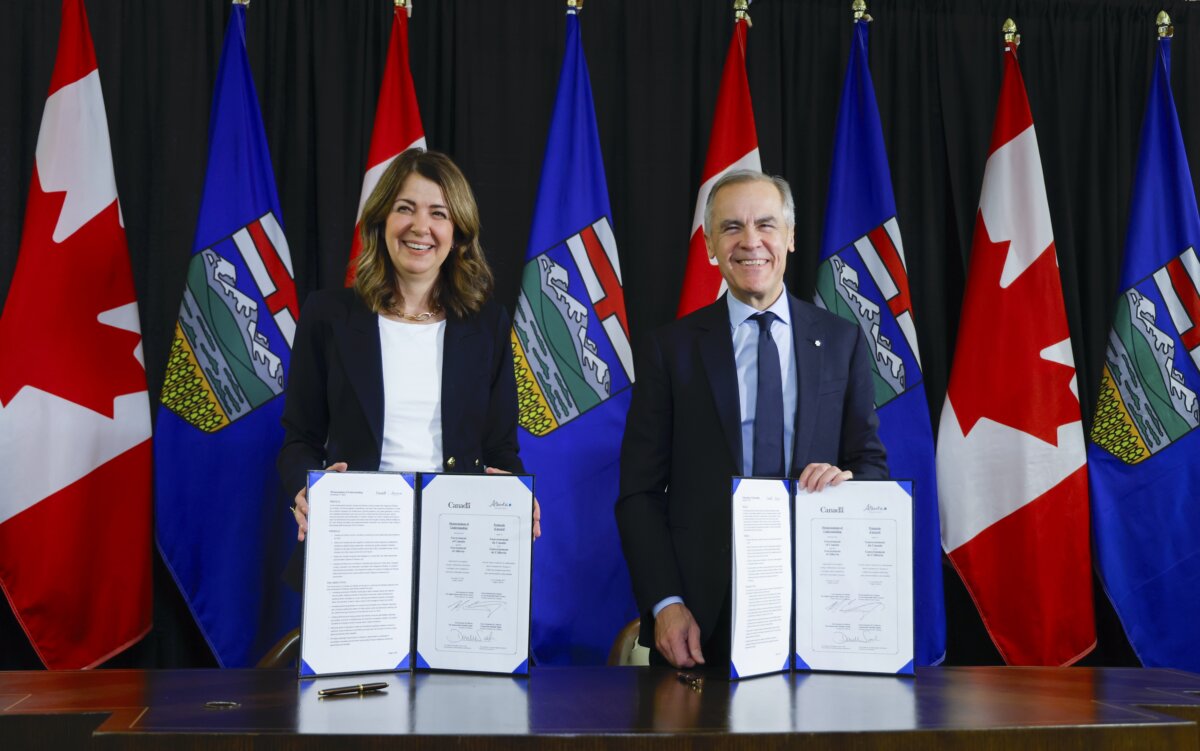

Prime Minister Mark Carney and Alberta Premier Danielle Smith are expected to soon sign a deal establishing the industrial carbon pricing rate for the province.
According to multiple media sources, both governments have agreed that Alberta’s effective carbon price will increase to $130 a tonne by 2040. Ottawa had previously proposed that it would reach $170 per tonne by 2030.
Carney is expected to travel to Alberta on May 15, where he will sign an agreement with Smith that will bring Canada closer to building a new oil pipeline to the West Coast. Smith and Carney signed a memorandum of understanding in November for the building of a pipeline, which would include the construction of a Pathways Alliance carbon capture project.
Canada has a national carbon price that is supposed to apply to all provinces and territories, but Alberta had frozen its pricing system at $95 per tonne through 2026 back in May 2025.
The agreement between Alberta and Ottawa will include rising carbon price floors that ensure industries have incentives to reduce their emissions each year. Alberta’s carbon price will increase to $100 per tonne in 2027, rise to $130 a tonne in 2036, and slowly increase by 1.5 percent per year until reaching $170 per tonne.
Smith had told reporters in Ottawa on May 5 that the $170 per tonne level would have been “completely unachievable” and resulted in oil and gas production caps.
Smith had met with Carney earlier in the day on May 5 to discuss the pipeline, and said following the meeting that she was “much more confident” that a deal would be signed before Alberta submits the pipeline to the Major Project’s Office in June.
Smith had also told reporters that while there was not currently a private sector proponent for the pipeline, that would likely come after there was “some certainty” that the pipeline would get built.
B.C. Premier David Eby told reporters on May 13 that it appeared the industrial carbon tax was being adjusted just for Alberta to $130, despite the rest of Canada having a national standard of $170. Eby said B.C. and Alberta are in “direct competition” on certain projects, and B.C. will “not be in a competitive position if Alberta has a special federal carbon price that the rest of us don’t have access to.”
Eby said he had been in discussions with Carney about how to ensure that B.C. projects get the “same amount of attention as the proposed Alberta pipeline project that still has no route and no proponent.” He called for Ottawa to ensure a “level-playing field” for all the provinces, and not to give “special treatment” to Alberta.
Conservative MP Dan Albas reacted to the announcement on May 13 by saying the industrial carbon tax was “looking more and more like a domestic negotiating tool to extract Liberal friendly concessions for Carney’s political benefit at the expense of Canada’s oil and gas sector.”
 Friends Read Free
Copy
Facebook
Tweet
Friends Read Free
Copy
Facebook
Tweet