

The Canadian military is grappling with a range of challenges linked to an easing of recruitment standards, including new members who lack proficiency in English or French or who face significant mental health issues.
The concerns appear in a leaked report written by the commander of a core military training school in Quebec, first covered by Juno News earlier this week. The report says the changes are hurting completion rates of basic training.
The report was prepared in January by Lieutenant-Colonel M.R. Kieley, commandant for the Canadian Forces Leadership and Recruit School (CFLRS) in Saint-Jean-sur-Richelieu. Kieley details the changes to recruitment policies in recent years and how they have impacted the school.
“As a result of these changes, CFLRS is experiencing significant changes in candidates’ basic capabilities and increasing pressures on staff and instructors,” Kieley says.
The report notes a “dramatic” increase in the number of candidates with “significant” mental health concerns, including anxiety, depression, and suicidal ideation. Kieley said the change came after the Canadian Armed Forces (CAF) announced applicants who suffer from anxiety can join the military.
The CFLRS has also experienced a “notable” increase in the number of candidates who are “unable to learn in the military environment,” with an inability to learn basic practical skills, such as drills, or are unable to read without assistance. The report says “many” candidates admitted during their performance review board proceedings to suffering from Attention Deficit Hyperactivity Disorder (ADHD) or autism spectrum disorders.
In addition, the training school has experienced challenges training permanent residents due to weak skills in either official language, unrealistic training and job expectations, a lack of respect for younger instructors or women, and infighting due to cultural issues.
CAF has made a number of changes to its recruiting process to boost enrolment without changing the training system, which the CFLRS says has contributed to the number of issues the military is facing.
The changes to recruiting include removing the aptitude test, ending language testing and pre-enrolment security reviews for permanent residents, and weakening medical standards to allow candidates to enrol with mental health issues and certain other conditions.
According to the report, 92 candidates were transported to external mental health-care providers on 191 occasions throughout 2025.
“The local suicide crisis centre is typically filled to full capacity with CFLRS candidates,” Kieley wrote in the report, adding that a “significant” number of candidates avoid disclosing mental health issues during recruitment.
Regarding the training of permanent residents, the report says some initial training platoons were composed of candidates with as little as three months of residency in Canada. This led to a “significant culture shock as candidates had not yet acclimatized to Canadian society, let alone Canadian military culture,” the document says.
Kieley noted an example of a Francophone officer training a platoon composed of 83 percent permanent residents, which reported a graduation rate of 48 percent. The platoon was “plagued by allegations of racism … and constant infighting between cultural blocks,” such as Cameroonian candidates from central Africa against those from the western region of Côte d’Ivoire.
This has led to Francophone instructors questioning whether non-citizens should be allowed to become commissioned officers in the military.
Following the recruitment changes, the CFLRS found the overall success rate for basic training candidates in fiscal year 2025-2026 dropped from a range of 83 to 87 percent to 77 percent. The number of candidates requiring multiple attempts to graduate increased from a range of 5 to 7 percent, to 14.89 percent of all candidates.
Recruitment Numbers
The CAF announced on April 20 that it had record recruitment in the last fiscal year, with the intake of 7,310 new Regular Force recruits, including 1,400 permanent residents.
Asked about challenges associated with bringing in permanent residents, top personnel officers told reporters that getting into the CAF is a competitive process, with 44,000 applications submitted last year.
The Department of National Defence (DND) told The Epoch Times in March that 27 percent of all military applicants in the first nine months of fiscal 2025–26 were permanent residents.
This followed Prime Minister Mark Carney saying in February that applications to the CAF had increased 13 percent.
The DND previously told The Epoch Times that enrolling permanent residents can boost troop numbers, as well as increase the “representation of historically underrepresented groups.”
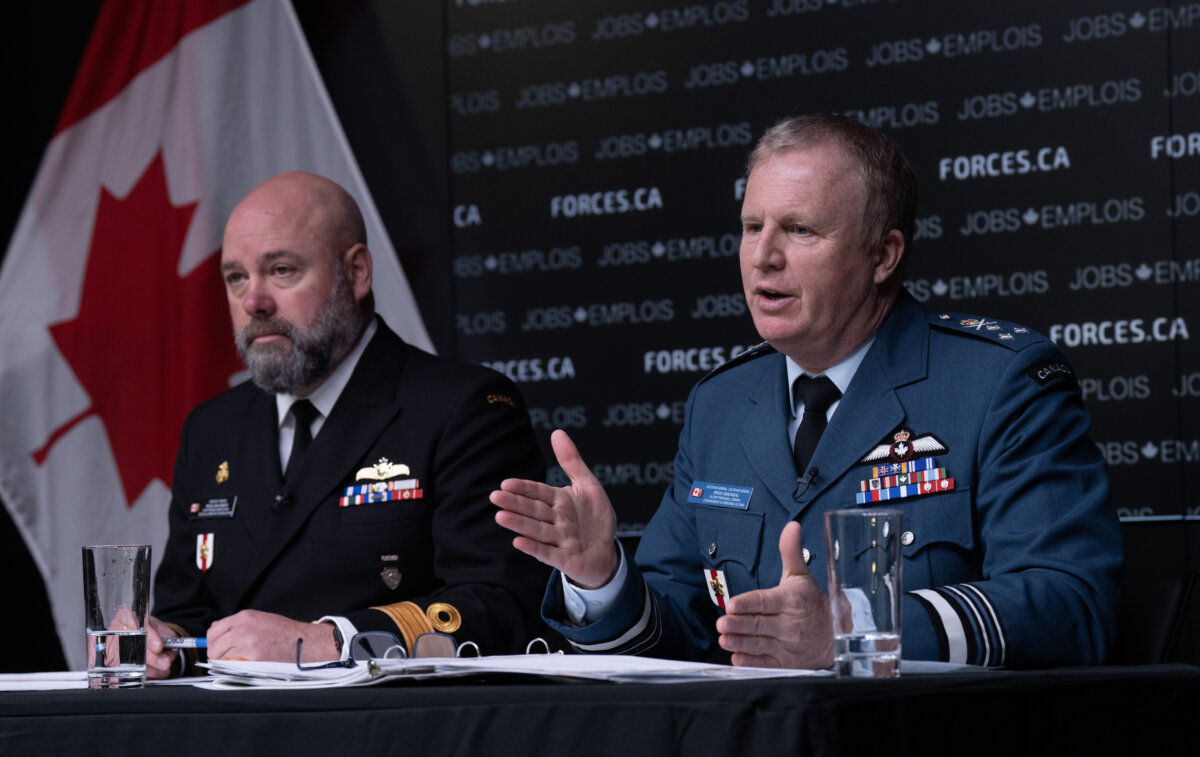
Chief of Military Personnel, Lt.-Gen. Erick Simoneau, told reporters on April 20 that he’s satisfied the intake of permanent residents is increasing diversity in the ranks. The CAF has set the target of recruiting 11.8 percent “racialized” recruits.
“We’re exceeding this target, with 33.7 percent this fiscal year, which is very beneficial for us and very much in line where we should be going,” Simoneau said.
The CAF changed the security clearance process for permanent residents to speed up intake. During 2023-24, the first full fiscal year of allowing foreigners to join the military, 109 candidates were enrolled. The figure for the last fiscal year was 1,400, or roughly 19 percent of all new recruits.
The Epoch Times previously asked DND whether some permanent residents are not proficient in French or English. The department didn’t confirm, but said it only communicates with candidates in official languages.
Meanwhile, Kieley’s report says a lack of understanding the official languages is the main reason recruits are kicked out.
“Inadequate language skills are the leading cause of directed releases for these candidates,” the report says, referring to training permanent residents and new Canadians.
Responding to an inquiry from The Epoch Times, DND said training standards have not been “lowered or compromised.”
“The Canadian Armed Forces is proud to reflect the diversity of Canadian society and views diversity as a strength that contributes to operational effectiveness,” said a DND spokesperson, who added the enrolment of permanent residents is a “carefully managed” element of the CAF’s recruiting strategy. DND said recruiting policies are being continuously reviewed and improved.
Conservative MP James Bezan, his party’s defence critic, issued a statement in response to the Kiely report on May 1, accusing the government of “mismanagement” in military recruiting. He said the Conservatives will ask the House of Commons defence committee to study the CAF’s recruiting policies.
Recommendations
Kieley made recommendations he says would increase the quality of applicants, including maintaining strong control over the enrolment of candidates with pre-existing mental health concerns and minimizing communications saying people who suffer from mental health issues can freely join the CAF.
Kieley also said the CAF should re-establish aptitude testing, conduct formal first official language testing for all permanent residents and naturalized Canadian citizens, adjust the scored application form to make younger applicants more competitive, and establish the maximum percentage of permanent residents on basic training courses at 20 to 25 percent or less.
Requiring all applicants to demonstrate a basic understanding of their potential trade enrolment and the military lifestyle, updating trade descriptions, and re-establishing fitness testing as part of the recruitment process are also among the training school’s recommendations.
Editor’s note: the article was updated with a statement from DND.
 Friends Read Free
Copy
Facebook
Tweet
Friends Read Free
Copy
Facebook
Tweet