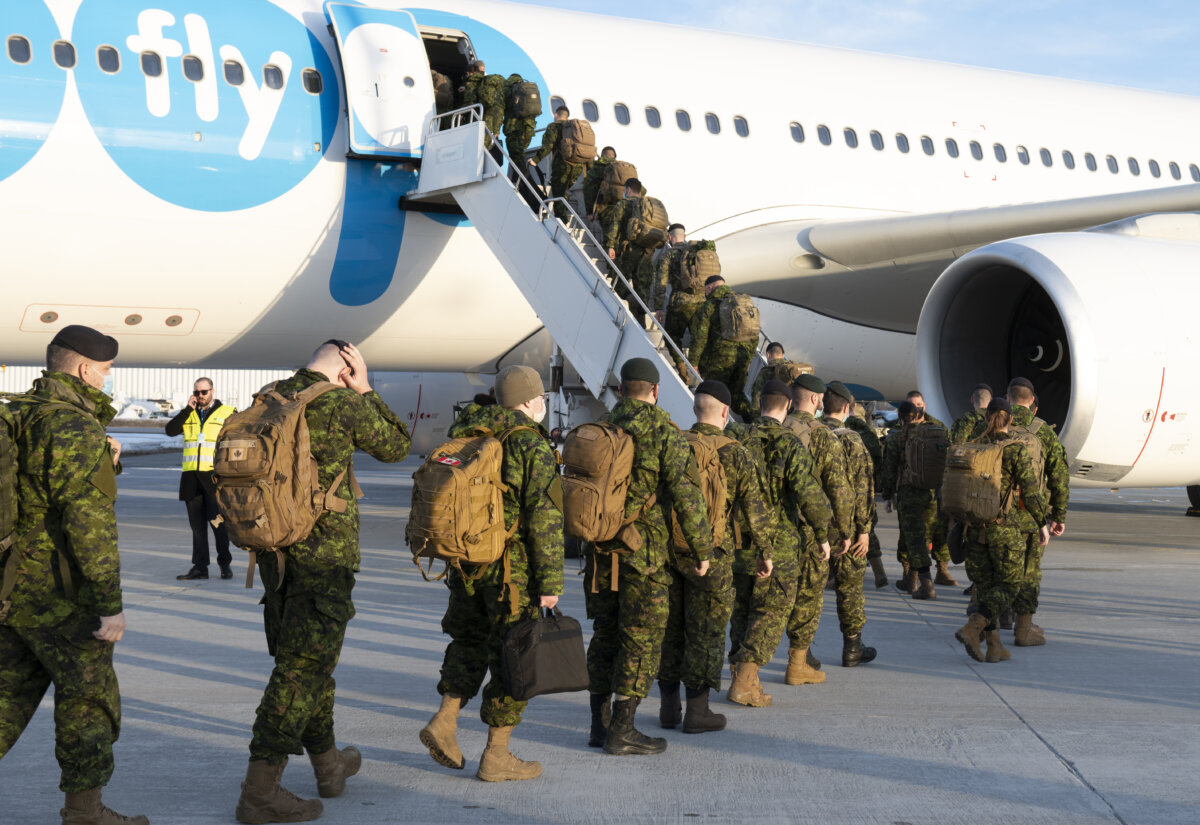

Permanent residents accounted for more than a quarter of all applicants seeking to join the Canadian Armed Forces (CAF) regular force in the nine months leading up to early January, a spokesperson for the Department of National Defence (DND) told The Epoch Times.
“This year’s increase is in line with trends that were emerging in the previous four years,” DND spokesperson Kened Sadiku wrote in a March 5 statement to The Epoch Times. “Permanent residents represent 27% of all applications received between April 2025 and early January 2026.”
Sadiku earlier said that recruiting permanent residents is part of the CAF’s attempt to increase its share of “historically underrepresented groups.”
“We know that a diverse CAF can tackle complex problems and we must draw from a broad pool to recruit the very best applicants to military service,” Sadiku said.
“The CAF is committed to increasing the representation of historically underrepresented groups. For example, permanent residents, who we began enrolling in 2022, represent an important skilled and diverse population in Canada.”
Recruitment
Prime Minister Mark Carney said on Feb. 17 that applications to the CAF had surged nearly 13 percent between April of last year and January of this year, compared to the same period a year earlier. He made the remarks while announcing a new defence industrial strategy he said would bolster Canada’s military and readiness.
A 2025 report from Canada’s auditor general found that only one out of 13 applicants made it through the recruitment pipeline to initial training—and of those who did, roughly 14 percent dropped out due to failed training, medical issues, or voluntary release.
The CAF’s goal is to reach an authorized strength of 71,500 regular force and 38,000 reserve force members by March 31, 2032. Its latest figures, updated Jan. 31, show 66,361 regular force and 31,404 reserve force members.
Between April 1, 2024 and March 31, 2025, CAF figures show 6,710 new members were recruited into the regular force, up from 4,334 a year earlier.
Defence Spending
Carney said last June that Canada would aim to spend 2 percent of GDP on defence by this year. He said that would rise to meet the revised NATO target of 5 percent by 2035, with 3.5 percent from core defence spending and 1.5 percent on defence-related investments.
He said Canada is on track to hit the 2 percent goal this year and will review its progress toward the 5 percent goal in 2029.
NATO’s benchmark for members to spend at least 2 percent of GDP on defence was formally agreed to in Wales in 2014, while the alliance pledged last year to reach 5 percent spending by member states by 2035.
Canada has fallen consistently short of the alliance’s longstanding 2 percent goal, with defence spending reaching 1.37 percent of GDP last fiscal year.
Immigration
Carney’s remarks were followed by a Feb. 18 announcement from Immigration Minister Lena Diab, who said that Canada was expanding its Express Entry immigration program to allow more skilled foreign workers to be fast-tracked for permanent residency, including “skilled military recruits” from foreign nations.
Diab said that foreign military recruits who qualify under Express Entry must have a job offer from CAF and meet military security standards and existing Express Entry eligibility criteria.
“They will be subject to the same security and all military requirements,” Diab said. “This new category will support our government’s commitment to strengthen our armed forces, to defend our sovereignty, and to keep Canadians safe.”
While announcing the Express Entry expansion, Diab said past high levels of immigration to Canada had been required to fill jobs during the pandemic but had also put pressure on “housing, on infrastructure and on social services.”
She said Canada aims for the share of non-permanent residents, including foreign students and temporary foreign workers, to fall below 5 percent of the total population by 2027.
 Friends Read Free
Copy
Facebook
Tweet
Friends Read Free
Copy
Facebook
Tweet