
Canada is expanding trade ties with Mexico but will take a different approach than Mexico has in reaching a deal with the United States, according to two senior ministers, after Mexican President Claudia Sheinbaum recently received a 90-day extension on its trade negotiations with the United States.
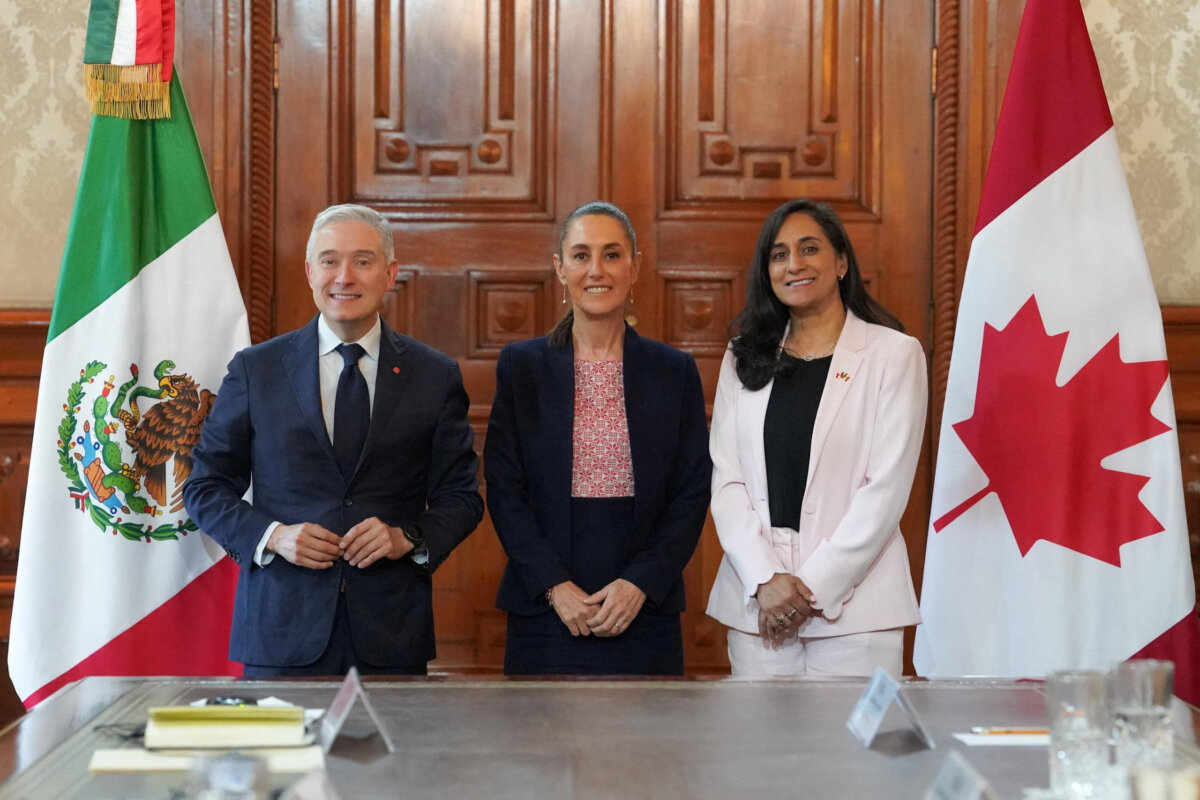
Minister of Foreign Affairs Anita Anand and Finance Minister François-Philippe Champagne spoke with reporters Aug. 5 from Mexico City while on a trip to promote more trade between Canada and Mexico.
The trip is the first in-person meeting between Canadian and Mexican officials since Prime Minister Mark Carney was elected, and takes place amid tensions in both countries’ trade negotiations with the United States.
U.S. President Donald Trump on July 31 said he will hike his country’s tariffs on Canada to 35 percent from the previous 25 percent, but he maintained tariffs on Mexico at the 25 percent level for another 90 days. Products from both Canada and Mexico that are covered by the United States-Mexico-Canada Agreement continue to be exempt from tariffs.
“I want to stress that Canada’s economic relationship with the United States differs significantly from Mexico’s,” Anand said, adding “We have over $2 billion of trade passing through the Canada-U.S. border every single day, and we also have different economic profiles, different levels of integration, and a long-standing economic and defensive security relationship that is perhaps the most integrated in the world.”
Champagne echoed Anand’s remarks, saying that Canada is focused on maintaining a strong relationship with the United States going forward while also seeking the best trade deal possible.
“I keep saying we buy more from the United States than China, Japan, the UK, and France combined, we’re the second largest investor,” Champagne said. Turning his focus to Mexico, he added that Canada’s relationship with Mexico gained renewed momentum after Sheinbaum’s attendance at the G7 conference held in June in Kananaskis, Alta.
Anand and Champagne said they are particularly focused on building even more resilient supply chains with Mexico, boosting port-to-port trade, developing artificial intelligence and the digital economy, and working together on energy security.
“After the meeting with President Sheinbaum, we then were put in touch with additional ministers so that we can broaden the efficacy and the emphasis that Canada is placing on the relationship with Mexico,” Anand said, adding that “what we would really like to see is a full-court press on ministers engaging with their counterparts across government, and that’s what we’ll continue to work on.”
Sheinbaum posted about the meeting Aug. 5 on X, writing that Canada and Mexico had “strengthened the relationship between our two countries.”
Canada’s primary exports to Mexico are electrical equipment, machinery, automobiles, and auto parts, while Mexico’s top exports to Canada are cars, trucks, and auto parts. The two nations’ trade volume totaled around $56 billion in value in 2024, according to Global Affairs, who notes that Mexico is Canada’s third-largest single-country trade partner after the United States and China.
 Friends Read Free
Copy
Facebook
Tweet
Friends Read Free
Copy
Facebook
Tweet