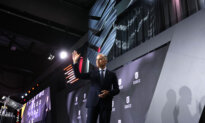

Prime Minister Mark Carney said Canada has entered into negotiations to procure new Swedish radar planes for its military, as opposed to aircraft from two U.S. defence companies.
Canada is negotiating with Saab to buy its airborne early warning aircraft, GlobalEye, which will be used to detect enemy missiles, aircraft, and drones in the Arctic and beyond. The aircraft can track objects up to 650 kilometres away.
Carney told an audience of defence contractors and military officials at CANSEC on May 27 that the purchase of the aircraft “builds Canadian strategic autonomy, creates Canadian jobs, and reinforces Canada’s position as a global leader.”
The Prime Minister’s Office (PMO) said in a statement that the base of the aircraft is the Canadian-made Bombardier Global 6500 aircraft, which is outfitted with Saab radar and sensors.
Once the contracts have been signed, Bombardier could begin manufacturing at least 40 aircraft in its Montreal and Toronto factories. The projected number also includes orders that would come from Canada’s allies.
At least one-third of the projected fleet of GlobalEye aircraft will be manufactured in Canada over the next 15 years. The PMO said this would support 3,000 jobs in Canada’s aerospace and defence sectors.
The GlobalEye aircraft was in competition against both the U.S.-made Boeing E-7 Wedgetail and the L3Harris Aeris X. The Canadian government has also been deliberating whether to purchase Saab’s Gripen jets, or whether it will purchase American-made Lockheed Martin F-35 fighter jets.
The Canadian Armed Forces is seeking to replace its fleet of aging fourth-generation CF-18s, and Ottawa has committed to buy 88 fifth-generation F-35s, to be purchased in stages between 2026 and 2032 at a cost of $19 billion.
Ottawa finalized the purchase of 16 of the 88 jets for $7 billion in 2022, but Prime Minister Carney ordered a review of the F-35 procurement in early 2025 amid U.S. President Donald Trump’s series of tariffs against Canada.
Industry Minister Mélanie Joly said in November 2025 that Ottawa was looking at potential switching to the Gripen for most of its fleet if Lockheed Martin did not agree to improve the contract’s economic benefits to Canada.
While the F-35s would be assembled in the United States, Saab has said its Gripen jets would be assembled in Canada and could create 10,000 jobs. Lockheed Martin has said its F-35 program uses Canadian-made components and is expected to provide more than $15.5 billion in industrial value to Canada over a 50-year span while supporting thousands of jobs.
Defence Minister David McGuinty told a Senate committee on April 27 that the review was ongoing, and that Ottawa was “taking the necessary time to study very, very closely the question of the fighter fleet.”
In mid-May, a high-ranking U.S. defence official said the Pentagon had given Ottawa a classified paper laying out priorities for a collective North American defence pact with Canada, but the Canadian government did not deliver a “credible” response. The official said this was creating a rift in North American defence cooperation, as was Canada’s delayed decision around the procurement of F-35s.
Pete Hoekstra, Washington’s envoy to Ottawa, has said that if Canada doesn’t purchase F-35s, it could have consequences for the operations of NORAD, adding that an “inferior product” could adversely affect the joint defence capability.
 Friends Read Free
Copy
Facebook
Tweet
Friends Read Free
Copy
Facebook
Tweet