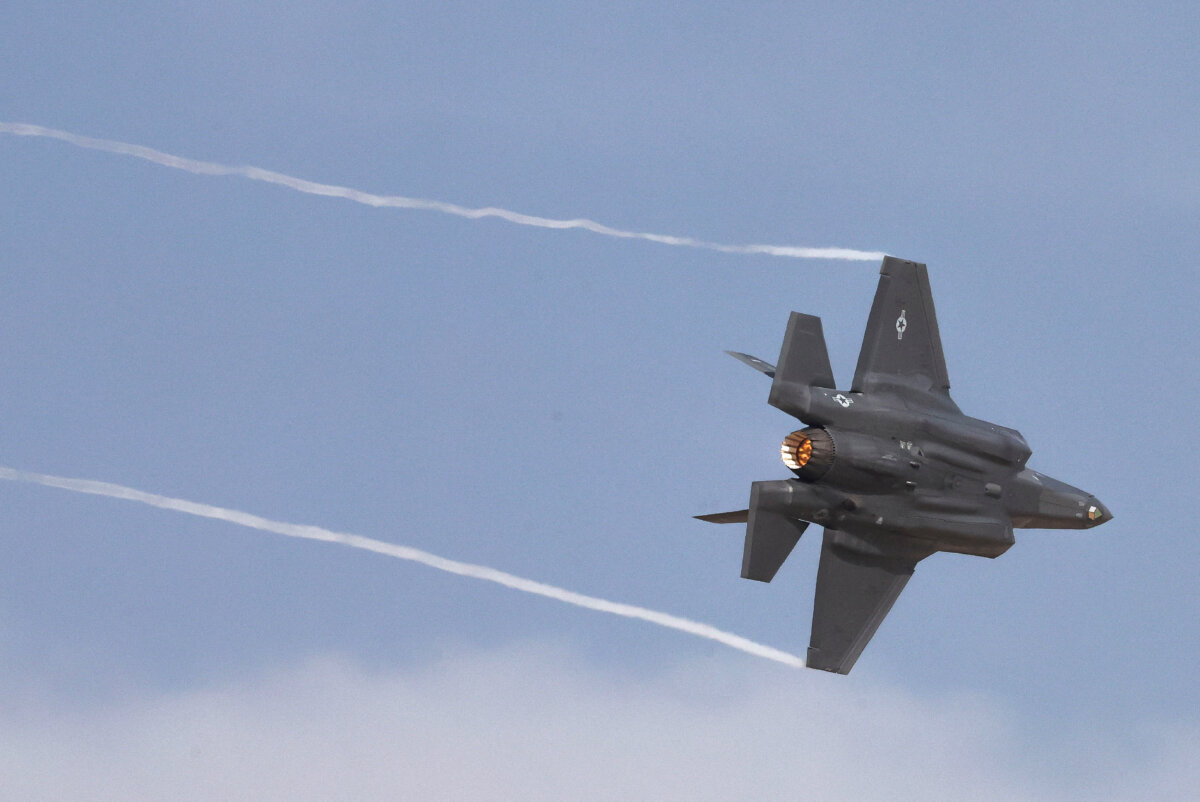

The Department of National Defence has confirmed an internal investigation is underway to address the leak of confidential data comparing two fighter jets that could serve as replacements for Canada’s CF-18s.
“Commercial information related to any solicitation process is considered protected information,” Department of National Defence (DND) spokesperson Andrée-Anne Poulin said in a media statement, adding that the investigation is in its early stages.
CBC/Radio-Canada published DND data it obtained on Nov. 26 that compared the American-made Lockheed Martin F-35 to the Swedish Gripen made by Saab. The data showed that the Gripen had a considerable lead over the F-35 when it came to mission performance and upgradability, with more moderate leads on technical criteria and capability delivery.
The data from 2021 indicated that although both jets passed the mandatory requirements for the Canadian Armed Forces (CAF), the F-35 scored 95 percent on military capabilities, while the Gripen had a score of 33 percent.
The CAF has been seeking to replace its fleet of aging fourth-generation CF-18s, which were introduced in the 1980s. Ottawa committed to buying 88 fifth-generation F-35s in 2022, to be purchased in stages between 2026 and 2032, at a cost of $19 billion.
Auditor General Karen Hogan estimated in early 2025 that the cost of the deal had increased to $27.7 billion due to rising inflation, fluctuations in exchange rates, and heightened global demand for munitions, while an additional at least $5.5 billion would be needed to upgrade infrastructure and buy advanced weapons.
Ottawa had finalized the purchase of 16 of the 88 jets for $7 billion in 2022, but Prime Minister Mark Carney ordered a review of the F-35 procurement this spring in response to U.S. President Donald Trump’s series of tariffs against Canada.
Defence Minister David McGuinty said in August that a review of the F-35 program would be completed by Sept. 21, but the deadline passed without a decision. McGuinty told reporters that “there’s a number of different variables” being considered and that the government would need to “take the time to arrive at the correct answer.”
Industry Minister Mélanie Joly said in November that Ottawa was looking at potential switching to the Gripen for most of its fleet if Lockheed Martin did not agree to improve the contract’s economic benefits to Canada. While the F-35s would be assembled in the United States, Saab has said their Gripen jets would be assembled in Canada and could create 10,000 jobs.
Lockheed Martin has said its F-35 program uses Canadian-made components. It also said the program is expected to provide more than $15.5 billion in industrial value to Canada over a 50-year span, from 2007 to 2058, while supporting thousands of jobs.
“We think that we can use military procurement to get more. That is why we’re looking, indeed, at the Gripen,” Joly told reporters on Nov. 18. “And at the same time, we’re looking at what Lockheed Martin can do.”
U.S. Ambassador to Canada Pete Hoekstra, when asked during a Nov. 21 panel about the United States-Mexico-Canada Agreement, brought up the F-35 program.
“On a number of these issues, we’re actually waiting to see exactly where the Canadian government is going to come out on this, … on the F-35. We’ve got all kinds of people and companies that are involved,” he said.
Some media outlets suggested Hoekstra had said the outcome of U.S.-Canada trade negotiations might hinge on the results of Canada’s assessment regarding its decision to procure F-35 fighter jets. However, the U.S. Mission to Canada clarified in a statement on Nov. 21 that this assertion was inaccurate.
 Friends Read Free
Copy
Facebook
Tweet
Friends Read Free
Copy
Facebook
Tweet