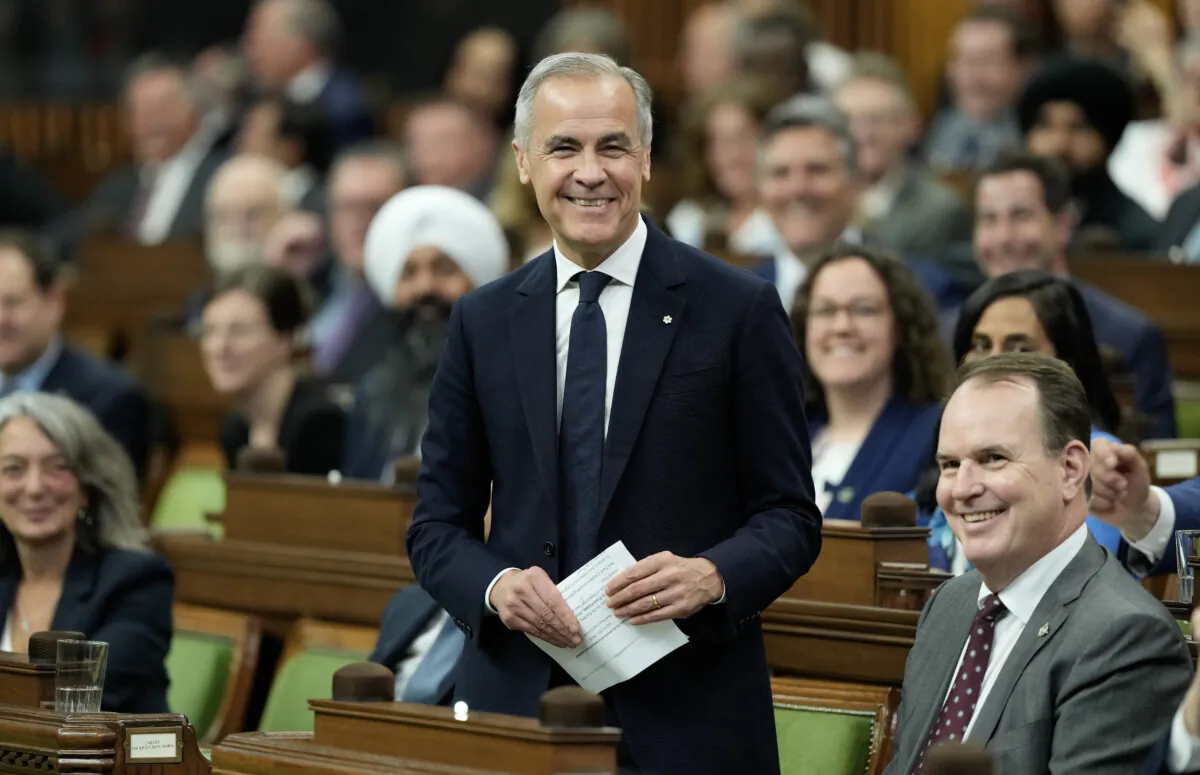


Prime Minister Mark Carney attended his first question period in the House of Commons since being sworn-in as prime minister back in March, taking questions from the opposition on issues such as the budget, major projects development, and the situation with the United States.
Carney had not taken part in this key activity of the House, having been appointed prime minister while Parliament was prorogued, and not having a seat in the House of Commons previously.
Parliament re-opened on May 26 and kicked into gear on May 28 with the first session of question period, also called oral questions, when MPs ask the government about various matters.
Official Opposition Leader Andrew Scheer, the Conservative’s House leader, started off by asking Carney what happened with the tariffs that Canada had imposed in retaliation on the United States during the election campaign.
“During the election campaign, it was ‘elbows up’ as he put retaliatory tariffs on the U.S. Then secretly, he dropped those tariffs to effectively zero,” said Scheer, who asked Carney how he would make up for the shortfall in promised revenues.
“Our tariffs have maximum impact on the United States, minimum impact on Canada, and we are dedicating all the revenues from those tariffs to supporting the workers and businesses affected by the unjustified American action,” replied Carney.
Scheer’s question relates to the Liberal caretaker government issuing remission orders in mid-April to mitigate the impact of Canadian retaliatory tariffs on some sectors of the economy. Finance Minister François-Philippe Champagne had announced the move, but it was not widely promoted by Carney on the campaign trail.
Scheer also asked Carney why his government is not tabling a budget this spring. “If he’s the man with the plan and the guy you hire in a crisis, why won’t he table a budget before he goes on summer vacation?” he said.
Carney responded that his government’s plan includes passing legislation to make “one Canadian economy” and to launch “nation building projects immediately” to grow the economy. Carney said in previous days the government would push to table legislation to remove internal federal trade barriers by Canada Day. He has also pledged to speed up the approval of major projects.
On this aspect, Scheer asked Carney whether he would tell Canadians he is repealing the Impact Assessment Act, also known as Bill C-69. Conservatives say the bill is blocking the approval of projects such as new pipelines.
“Canada’s new government is acting immediately to grow this economy,” repeated Carney, mentioning internal trade and the establishment of a new federal projects office.
Carney left the House of Commons around midway through question period.
New Dynamic
The first question period showed a new dynamic in the Commons. Having lost official party status, the NDP did not get to ask questions early and instead had to wait until the end of the period. Jagmeet Singh is also gone as NDP leader, with MP Don Davies filling in as interim leader.
The confrontation between former Prime Minister Justin Trudeau and Conservative Leader Pierre Poilievre is also a thing of the past.
Poilievre lost his seat in the April 28 election and will need to wait for a series of events before joining the House again. Alberta Tory MP Damien Kurek has agreed to give up his seat in the Battle River—Crowfoot riding so Poilievre can have a chance to win the Tory stronghold, but for that to happen, Carney has to call a byelection, and Poilievre has to win it. Carney has said he won’t be playing “games” and would call a byelection as early as it is possible.
Poilievre told reporters on May 27 that Kurek intends to step down “in a couple weeks” after he gives a speech in the Commons at an unspecified time. Poilievre spoke to reporters before question period on May 28, just outside the House, and said he misses not being able to participate.
“I’d love to be in there, it’s a great place,” said Poilievre. “I love the House of Commons. I love the excitement and the thrill, and I’ve never really been a spectator of the House, but I’m going to work hard to earn the opportunity to do it again.”
Poilievre’s seat representing the riding of Carleton was won by Liberal Bruce Fanjoy, who received a standing ovation and cheers from his Liberal colleagues when he read a statement before question period.
New Conservative MPs Take Part
Some new faces in the Conservative caucus rose to ask questions to the government early in the question period session.
Environment critic Ellis Ross, a former First Nations chief and former B.C. MLA, said Liberal policies around energy had “weakened” the country to the benefit of the United States. He asked whether the government would get rid of regulations capping greenhouse gas emissions from the oil and gas sector.
Energy and Natural Resources Minister Tim Hodgson said the Liberal government was interested in building projects, “including pipelines, where there is consensus.” He repeated that the government is focused on making Canada into an energy superpower with “both conventional and clean energy.”
“We can make Canada strong and protect ourselves from American tariffs, if we work together with indigenous partners, industry, and workers,” he said.
The Liberals have proposed a cap-and-trade system for the oil and gas sector, with an ultimate goal of lowering the country’s greenhouse gas emissions to net-zero by 2050. The government has said this would lower emission levels while also encouraging innovation and technologies to further lower emissions, while the Parliamentary Budget Office has estimated this would lead to the loss of 54,400 jobs and 0.39 percent of Canada’s GDP by 2032.
The Conservative MP who narrowly won his Newfoundland riding following a recount also stood in the House. Jonathan Rowe, a civil engineer, asked whether the Liberal government would “fully repeal” the industrial carbon tax, adding that his province of Newfoundland and Labrador has the highest unemployment rate in the country, and that the tax is harming its mining and forestry workers.
Environment Minister Julie Dabrusin said the government wants to ensure the energy Canada provides is “low risk, low cost, and low carbon,” which is why it will ensure “polluters pay.” The Liberals have proposed a new system that rewards people for making lower-emission choices while making “big polluters” in industry pay for this system.
On May 27, the Liberals tabled a ways and means motion to repeal the legislative framework on the consumer carbon tax.
Conservative MP Andrew Lawton, a former author, reporter, and broadcaster, also asked if the government would repeal the Impact Assessment Act.
Industry Minister Mélanie Joly responded that Canadians in the manufacturing sector are “feeling the brunt” of the trade war with the United States, and that the government will “continue to fight for them.”
 Friends Read Free
Copy
Facebook
Tweet
Friends Read Free
Copy
Facebook
Tweet