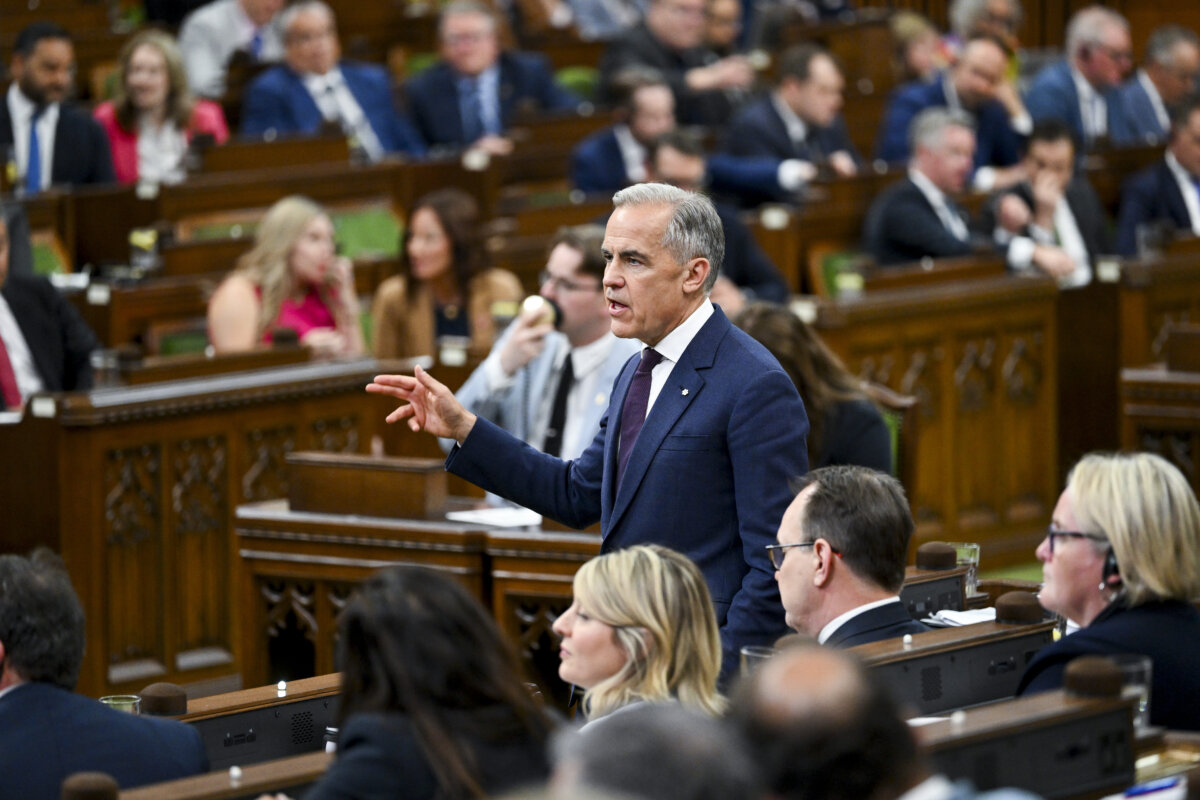

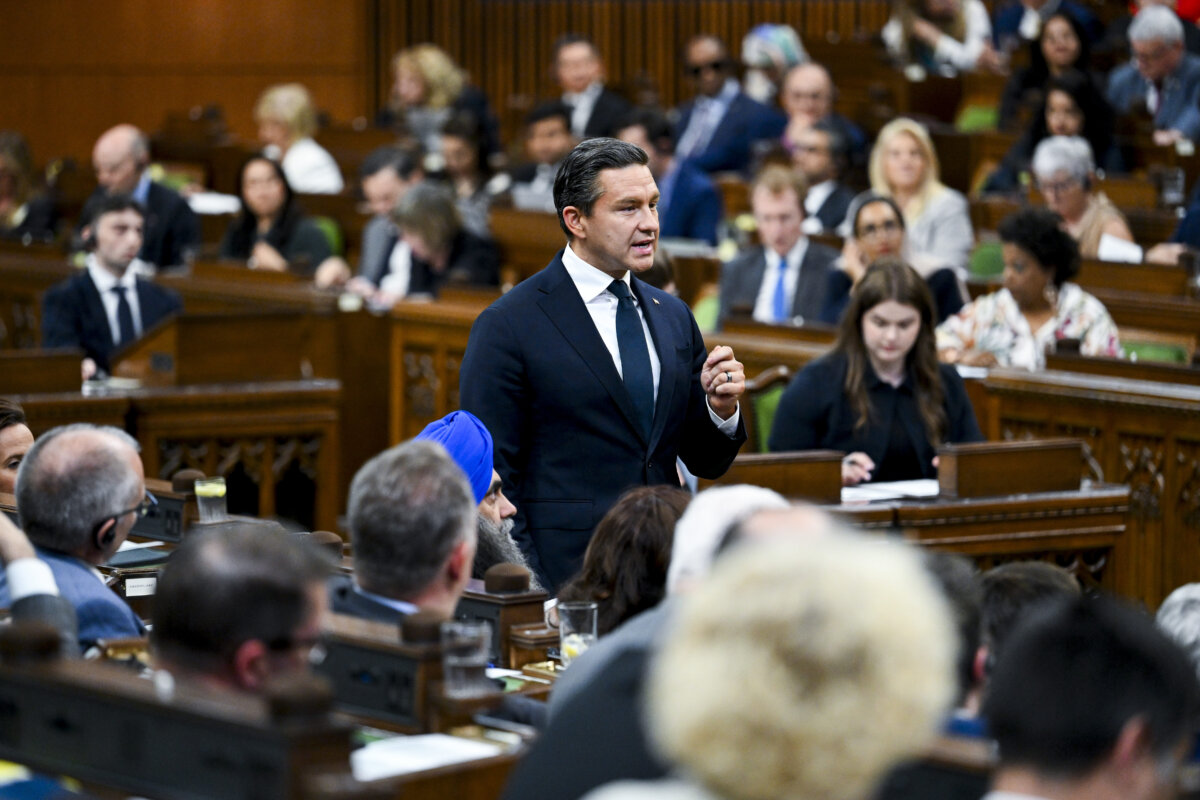
Prime Minister Mark Carney defended his government’s economic track record in the House of Commons as Conservative Leader Pierre Poilievre pressed for an answer on whether Canada is in a real or “technical” recession.
In his response, Carney argued his government is laying the groundwork for an economy that will be “stronger, more resilient, more independent.” He pointed to rising business investment and wage growth despite U.S. tariffs and ongoing global economic uncertainty.
The exchange came during question period on June 3, where Poilievre asked Carney whether Canada is in a recession or a “technical” recession.
“We’ve had two consecutive declining quarters of GDP growth. We are the only country in the G7 that can say that. The only country in the G7 that has seen the economy shrink in three of the last four quarters. The only country whose GDP is smaller than it was a year ago, when the prime minister took office,” Poilievre said.
“Will he tell us, are we in a recession or a technical recession? Which is it?”
The Tory leader’s comments come after Statistics Canada data released on May 29 revealed Canada’s economy saw no growth in the first quarter of 2026 following a decline in the final quarter of 2025.
The StatCan data said Canada’s economy fell by 1 percent in the fourth quarter of 2025 and by 0.1 percent in the first quarter of 2026 on an annualized basis. The technical definition of a recession is two consecutive quarters of negative GDP growth. On a quarterly basis, Canada narrowly escaped the technical definition of a recession.
Carney pointed to a new report by the Organisation for Economic Co-operation and Development that said Canada will have the second strongest economy in the G7 this year and next.
“GDP growth is expected to strengthen over 2026 and 2027,” the June 3 report said, adding that GDP is expected to reach 1.2 percent and 1.7 respectively as the economy “recovers from the 2025 trade‑related slowdown triggered by higher US tariffs.”
The report noted household consumption and government spending on defence and infrastructure “will continue to underpin growth,” while business investment is expected to recover gradually.
Poilievre argued that every other country in the G7 has had to face the same pressures from tariffs, wars, and energy prices, yet Canada is the only country to have entered a recession.
“Canadians are skipping meals. There are 112,000 Canadians who have lost their jobs. We have the second worst unemployment rate in the G7. Can the prime minister stand up and answer a very simple question: Are we in a recession or just a technical recession?” Poilievre said.
Poilievre sent a letter to Carney on May 31, urging the prime minister to appear before Parliament and outline his government’s plan to address the economy’s decline. He said Canada’s economic downturn is seen in job losses, a high unemployment rate, declining business investment, growing debt among Canadians, and increased food bank use.
“The only way out of this Liberal recession is to reverse the policies that caused it in the first place,” he said at a May 29 press conference, adding that his party is calling on the prime minister to table a bill in the House of Commons to reverse all economic policies Liberals have introduced over the last decade.
Meanwhile, Carney argued in the House on June 3 that the policies his government has put in place are allowing for the creation of “a more resilient, more prosperous, stronger, more sustainable economy, and a more independent economy.”
He also said foreign investment in Canada is at twice the rate of any other G7 country, business investment is up 10 percent in machinery and equipment, and non-U.S. exports are on course to double.
StatCan said imports rose by 2.9 percent in the first quarter, primarily driven by imports of metal products and scrap metal, while exports declined by 0.1 percent and was led by fewer exports of passenger cars and light trucks. The federal agency also pointed to a decline in business investment and household savings.
Some economists told The Epoch Times last week that while the recession is relatively minor and GDP growth could be revised upward, the overall outlook for the Canadian economy could still be cause for concern.
Canada’s technical recession drew a reaction from U.S. President Donald Trump, who once again called for Canada to join the United States as its “51st state.”
Matthew Horwood contributed to this report.
 Friends Read Free
Copy
Facebook
Tweet
Friends Read Free
Copy
Facebook
Tweet