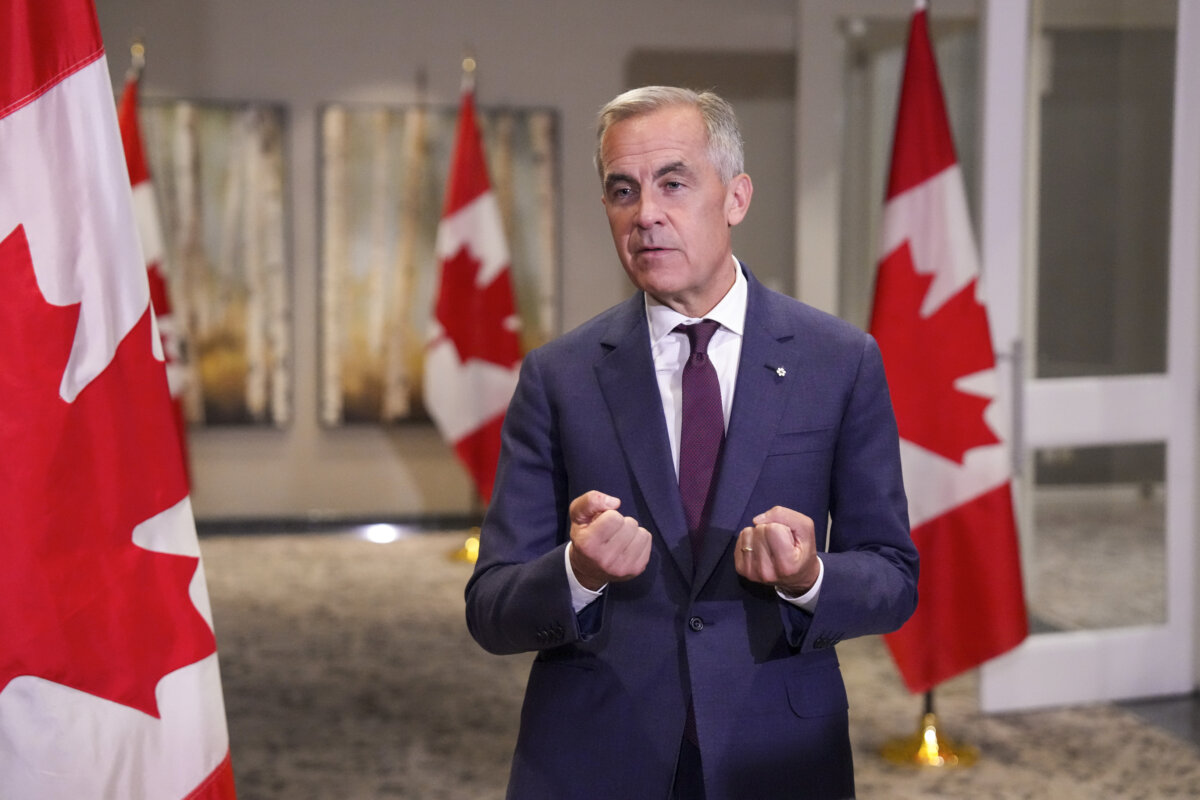
Prime Minister Mark Carney says he had a lengthy conversation with U.S. President Donald Trump earlier this week and that some agreements could be reached on trade.
“We expect there could be agreements, small agreements, in a few strategic sectors,” Carney said. “There’s nothing guaranteed but we’re making progress.”
Carney commented on the conversation before the start of cabinet meetings in Toronto on Sept. 3, after being asked by reporters about the topic.
Conversations with foreign leaders are typically reported by the Prime Minister’s Office by way of readouts. In the case of the evening call between the leaders on Sept. 1, no readout was issued.
“I last spoke to the president Monday evening,” Carney said. “We spoke at length on a wide range of issues, including on trade—but geopolitical, other issues, labour issues, et cetera. It was a good conversation.”
Trade talks between Ottawa and Washington had stalled after Trump raised his baseline tariff rate on Canada to 35 percent on Aug. 1. Negotiations started anew after Carney announced on Aug. 22 that Canada would drop its counter-tariffs.
The counter-tariffs targeting $30 billion worth of U.S. goods were officially removed on Sept. 1. The tariffs had become an irritant for Washington since they applied to goods falling under the United States-Mexico-Canada free trade agreement (USMCA).
Trump’s baseline tariff of 35 percent applies only to Canadian goods not covered by USMCA or which fall under U.S. sectoral tariffs such as on metals and autos.
With the resumption of talks, Canada-U.S. Trade Minister Dominic LeBlanc was in Washington last week to meet with U.S. Commerce Secretary Howard Lutnick. LeBlanc said after the meeting that it had been “constructive.”
This week, Carney said Clerk of the Privy Council Michael Sabia will be in the U.S. capital to lead trade negotiations. Sabia, whose two latest jobs included heading Hydro-Québec and serving as deputy minister of finance in the Trudeau government, was appointed to the top public servant role by Carney in June.
Carney said his government is focused on removing the sectoral tariffs on industries deemed strategic. Steel, aluminum, and automobiles are deeply integrated sectors with the U.S. economy and have been hit the hardest.
The prime minister said there’s a “very senior team” conducting negotiations, but cautioned not to “expect immediate white smoke on one of these strategic sectors.”
Trump has imposed sectoral tariffs on national security grounds in a bid to shore up domestic manufacturing.
Other countries which have concluded trade deals with the United States to avoid Trump’s “reciprocal” tariffs have not been able to get the sectoral tariffs removed. Some did get a discount however, such as the United Kingdom on steel, or Japan and Korea on autos.
In this context, Carney said that Canada has the “best trade deal of any country in the world,” noting that 85 percent of trade with the United States is tariff-free due to the goods protected under USMCA.
Cabinet ‘Planning Forum’
Carney made the comments on trade with the United States before attending meetings with his cabinet ahead of the return of Parliament on Sept. 15. The meetings have been framed as a “cabinet planning forum” instead of the usual cabinet retreat at this time of year.
“It’s a combination of getting some external perspectives on the world, on the United States, what’s happening in technology, the mood of the country,” Carney said.
The prime minister said the meetings would help set his government’s priorities for the next six to 12 months, while noting the need to focus on building the economy and addressing other issues such as affordability and community safety.
Conservatives have maintained their focus on those issues in recent days ahead of Parliament’s return, blaming Liberal laws and policies for increases in violent crime and youth unemployment.
Tory Leader Pierre Poilievre called for the abolition of the Temporary Foreign Worker program on Sept. 3, saying it’s being exploited by employers and negatively impacts the job market for Canadians.
Carney commented on the matter when asked by reporters during his press conference and said the program cannot be erased, “but we can definitely improve it as a whole.”
 Friends Read Free
Copy
Facebook
Tweet
Friends Read Free
Copy
Facebook
Tweet