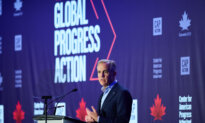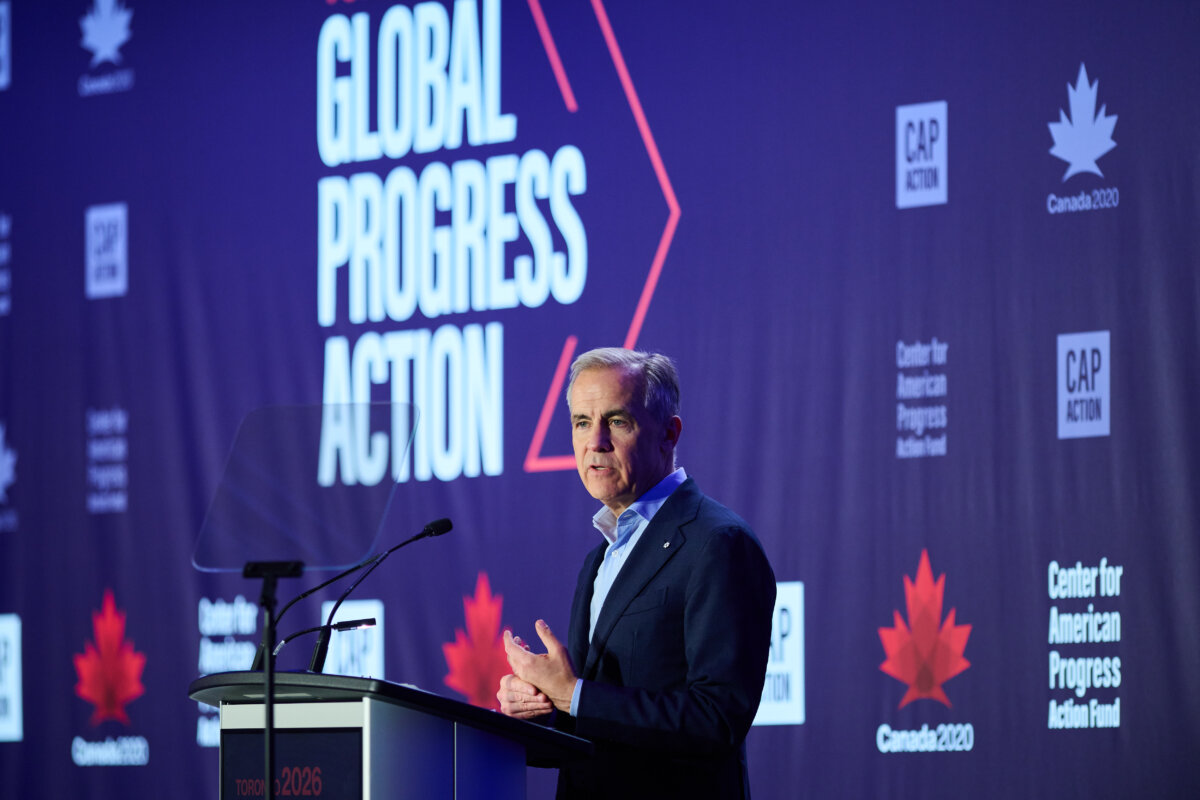

Speaking at the recent Global Progress Action Summit in Toronto, Prime Minister Mark Carney said Canadians are facing a “more dangerous world,” and that his response is to prioritize “actual building.”
Carney said that Canadians must “build anew” amid challenges to the international rules-based order, echoing his remarks to a global audience at the World Economic Forum in Davos, Switzerland, followed by remarks to Canadians in Quebec City in January.
“It’s a more dangerous world. We have to take care of ourselves, and as Canadians, we will always take care of each other, building a country that’s not just strong … not just prosperous, but fair. Not just for some, most of the time, but for all Canadians, all of the time,” he told summit attendees on May 9.
The annual summit brings together international progressive leaders, policymakers, and strategists. This year’s summit was also attended by former U.S. President Barack Obama, who met with Carney on the first day of the meeting on May 8.
Carney said there are “those whose politics is to destroy,” and said the new progressive response to this is “building for all.”
Paraphrasing the lyrics of a Leonard Cohen song, Carney said that it was “through the rupture that the light gets in.”
“In this more uncertain world, building for all, actual building—concrete, steel, and code—is the new progressive politics,” he said.
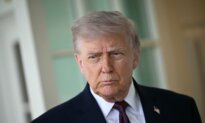
Carney also made a reference to “rupture” in the international order in his Jan. 20 speech in Davos, where he urged middle powers to band together to stand up to great powers, while criticizing U.S. ambitions to acquire Greenland and impose tariffs. His speech was criticized by U.S. President Donald Trump, who said Canada “should be grateful” to the United States, and in reference to Carney’s agreements with Beijing, said China “will eat them up.”
In his speech at the summit, Carney said that while Canada has benefited from trade with the United States, U.S. tariffs are creating deep challenges for Canadian workers and firms in affected industries.
He also touted his government’s trade diversification efforts, saying while he wants deeper integration with the United States, “if that route is not ultimately possible, we will invest heavily in new markets and products.”
“We’ll reward those who build, buy, and produce in Canada, and we will build new partnerships abroad. We’re already applying the main lessons of the past 18 months—that we must build our strategic autonomy.”
Speaking on domestic issues, Carney emphasized housing, as well as safe use of artificial intelligence.
Carney said housing had become unaffordable in part because Canada had not built enough affordable homes for about 30 years. He said his government is focused on shifting to large-scale construction of affordable housing, including creating a new government agency to build more homes.
On the issue of AI, Carney said that the same values used in physical nation-building—such as inclusivity, sustainability, and solidarity—should also guide how Canada builds in the digital world.
Besides Obama, the summit was also attended by former U.S. Secretary of Transportation Pete Buttigieg, former Prime Minister of Sweden Magdalena Andersson, German Minister of Finance Lars Klingbeil, and U.S. Senator Elissa Slotkin.
Buttigieg, Andersson, and several Canadian ministers, including Minister of Industry Mélanie Joly, Minister of Foreign Affairs Anita Anand, and Minister of Finance François-Philippe Champagne, were key participants in various engagements at the summit.
 Friends Read Free
Copy
Facebook
Tweet
Friends Read Free
Copy
Facebook
Tweet