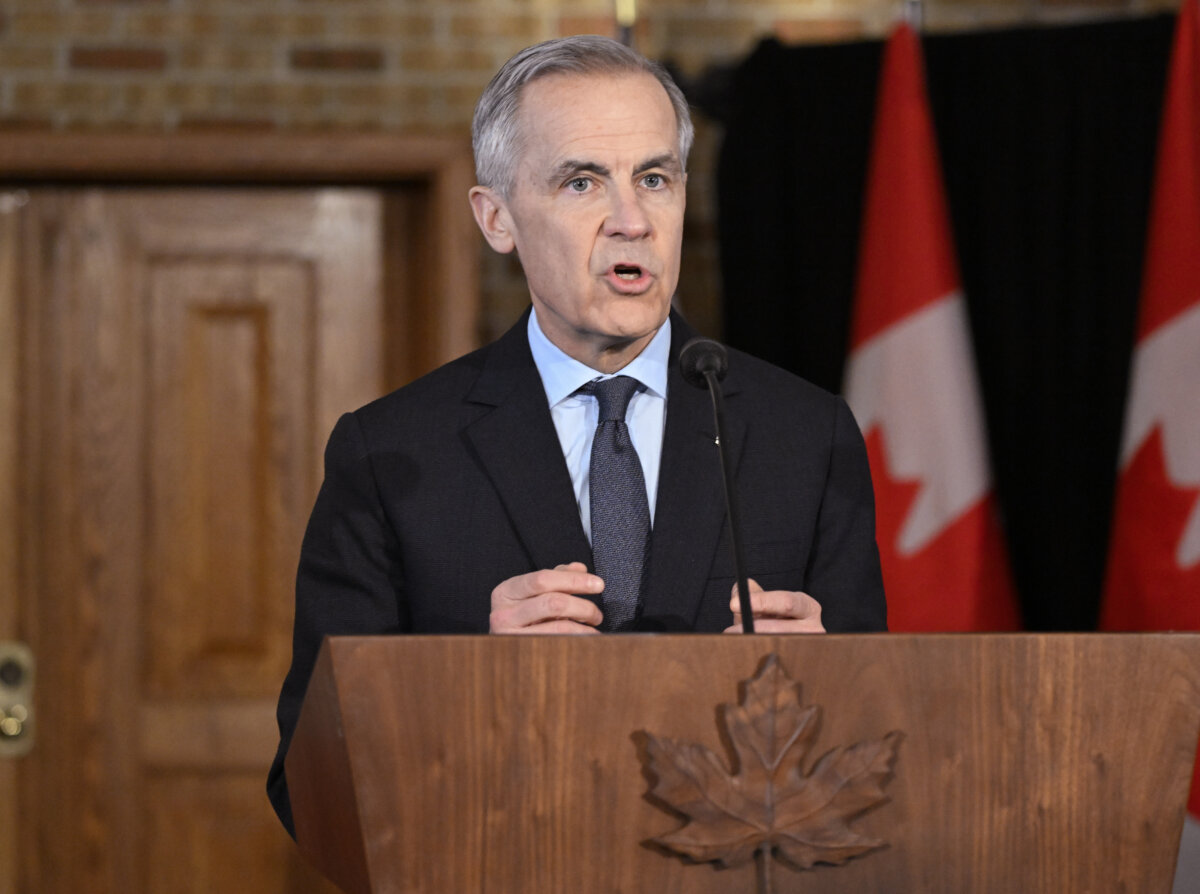
Prime Minister Mark Carney emphasized national unity in responding to U.S. President Donald Trump in an address to the nation on Jan. 22.
Carney made the comments during the Liberal cabinet retreat in Quebec City, a day after returning from the World Economic Forum in Davos, Switzerland, where he urged countries and companies not to comply with unspecified “great powers” that he said are using “coercion” and seeking to use economic integration and tariffs as leverage.
Carney said Canada needs to be a “bastion of security and prosperity” and defend its sovereignty and borders. He also said the country needs to be a “beacon” in a time of “rising populism and ethnic nationalism.”
“In a time of rising walls and thickening borders, we can demonstrate how a country can be both open and secure, welcoming and strong, principled and powerful,” he said.
Stressing the importance of unity, Carney said unity “does not necessarily require uniformity,” adding that “we can share a country without conforming to a single identity.”
Carney also addressed recent comments Trump made at the World Economic Forum that Canada “lives because of the United States” and “should be grateful to us.” Trump’s words were a reaction to Carney’s speech the day before, in which he was critical of “great powers,” alluding to the United States.
Carney said on Jan. 22 that Canada “does not live because of the United States. Canada thrives because we are Canadian.”
U.S. Commerce Secretary Howard Lutnick said on Jan. 22 that Ottawa’s recent pursuit of closer ties with China could cost Canada in trade negotiations with the United States, and suggested that the prime minister’s remarks in Davos were motivated by election campaigning.
Speaking from the Citadelle of Quebec, a military base constructed in 1850 to secure the city against American attacks, Carney cited Canada’s history in the aftermath of the Battle of the Plains of Abraham in 1759. He said this battle marked the time when Canada “began to make the historic choice to favour adaptation over assimilation, partnership over domination, collaboration over division.”
Carney said while Canada’s foundation was “imperfect” and based in part on the “dispossession of indigenous peoples and the violation of treaties made with them,” Canada has become richer and more equitable by engaging with the idea that “we can share a country without conforming to a single identity.”
The prime minister laid out his priorities for the Parliamentary session set to begin next week, saying his party will push for deeper economic cooperation with the provinces and territories, reform Canada’s criminal justice system, bolster border security, and make investments in defence and artificial intelligence.
Carney said his government would stand up for Liberal government policies like child care and pharmacare, and would protect the vulnerable, “whether they’re a newcomer, a person with a disability, or a member of the Two-Spirited LGBTQI+ community.”
Carney also said that Canada is a “modern, progressive, liberal state,” and that “Canadians are inclusive.”
“We know our country is stronger when everyone belongs, when newcomers are welcome, when minorities are protected, when indigenous peoples are true partners,” he said.
In Carney’s speech at the World Economic Forum he called for middle powers not to comply with major world powers that he said were seeking to use “economic integration as weapons, tariffs as leverage, financial infrastructure as coercion, supply chains as vulnerabilities to be exploited.”
Carney also said Canada supported Greenland and Denmark in their dispute with the United States after Trump recently threatened to put tariffs on eight European countries due to their opposition to American control of Greenland. Trump announced on Jan. 21 his 10 percent tariffs would not go forward as planned on Feb. 1 because he had formed the framework of a future deal regarding the island during a meeting with NATO Secretary General Mark Rutte.
Before arriving in Davos, Carney had also made a stop in Doha, Qatar, which was the first official visit by a Canadian prime minister. Prior to that, Carney met with Chinese leader Xi Jinping, saying his government is seeking a “strategic partnership” with Beijing, and agreed Ottawa would cut its 100 percent tariff on 49,000 Chinese electric vehicles to 6.1 percent. Ottawa said in exchange Beijing would reduce or remove some tariffs on Canadian agricultural and seafood products until at least the end of 2026.
The Prime Minister’s Office said the cabinet retreat on Jan. 22 and 23 will focus on priorities such as reaching a new trade and security deal with the United States, strengthening Canada’s economy, returning immigration to “sustainable levels,” reducing the cost of living for Canadians, creating more affordable housing, bolstering the Canadian Armed Forces, and cutting the cost of government.
 Friends Read Free
Copy
Facebook
Tweet
Friends Read Free
Copy
Facebook
Tweet