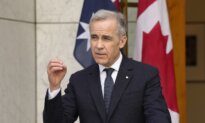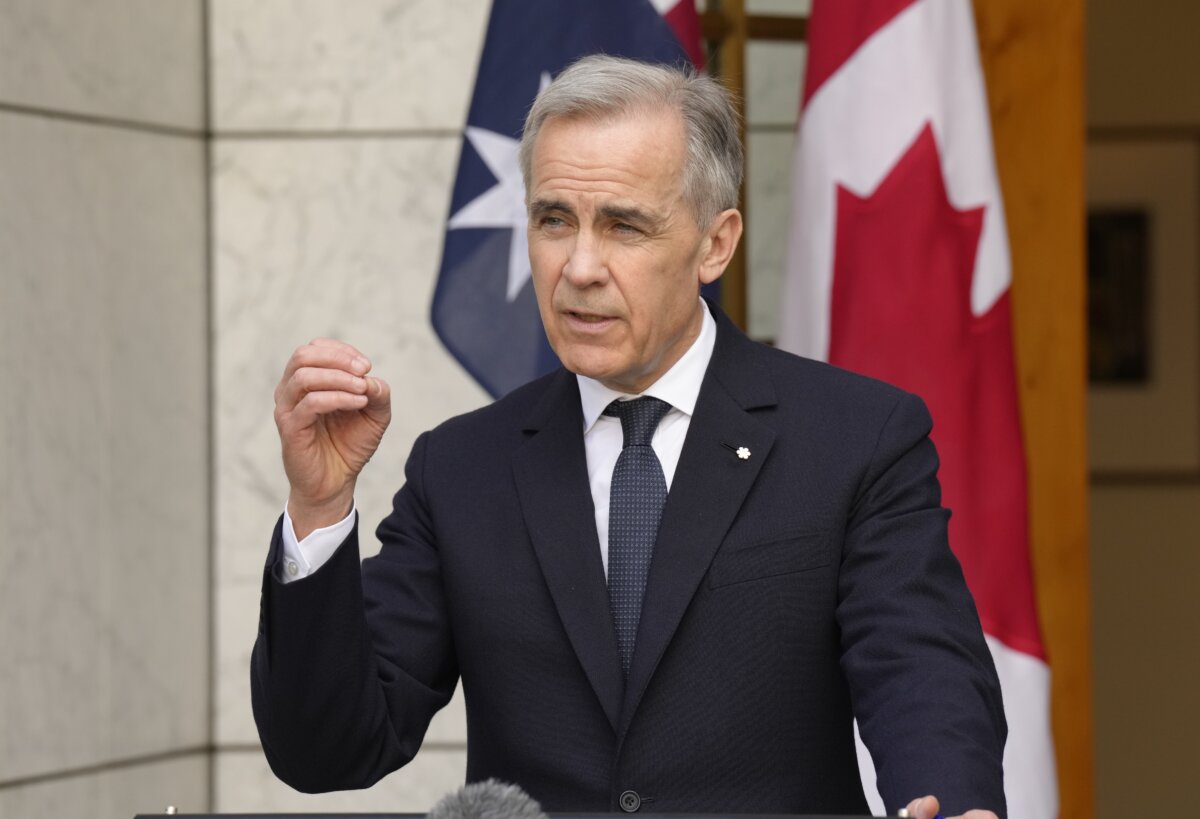
Prime Minister Mark Carney said he can’t “categorically rule out” Canadian military involvement in the U.S.-Israeli intervention in Iran as the conflict widens, but said Canada’s focus is on de-escalation.
Carney made the comments at a March 5 press conference in Canberra alongside Australian Prime Minister Anthony Albanese, adding that any resolution or cease-fire of the widening conflict in Iran must include assurance that the Iranian regime can’t develop a nuclear weapon.
“One can never categorically rule out participation. We will stand by our allies,” Carney said in response to a press question on whether Canada’s military might become involved in the conflict in Iran.
Carney repeated his earlier point that Canada seeks a de-escalation of the conflict.
“We want to see a broader de-escalation of these hostilities with a broader group of countries than just the direct belligerence involved,” he said.
“We recognize, we stress that that cannot be achieved unless we’re in a position that Iran’s ability to acquire a nuclear weapon, develop a nuclear weapon, and to export terrorism is ended.”
Carney added that any future Canadian military participation against Iran relies on a “fundamental hypothetical” in which the conflict spreads even more widely. He noted that Canada currently has no participation in the strikes against Iran’s regime but said Ottawa “will always defend Canadians” and “defend our allies.”
The comments followed an earlier address to Australian parliament in Canberra in which Carney said Canada and Australia must work together as “middle powers” to shape global security and economic rules in a period of geopolitical “rupture.”
The United States and Israel launched the military operation in Iran after the failure of multiple rounds of negotiations on Iran’s nuclear program.
Iran War
In the immediate aftermath of the start of the war on Feb. 28, Carney had said directly that Canada supports U.S. action to prevent Iran from obtaining a nuclear weapon. However, he later shifted his position on the armed conflict, saying on March 4 that he doesn’t agree with how the United States and Israel have conducted the war. He emphasized Canada’s desire for de-escalation and called on all sides of the conflict, including the United States, to “respect the rules of international engagement.”
Asked about the differences in the statements on March 5, Carney said that the first statement did not include a call for de-escalation because it was in the very first stages of the U.S. and Israeli military intervention.
“We made a statement. Australia made a statement within hours of the beginning of the hostilities, and the objectives of the hostilities, as we understood it, could not have been achieved in that period,” Carney said.
Carney added a condemnation of Iran’s regime, saying it has “exported terrorism for decades across the Middle East” and referencing that it has “killed scores of Canadians” including in Iran’s Islamic Revolutionary Guard Corps’ shooting down of Flight PS752 on Jan. 8, 2020, which killed all 176 on board including 55 Canadian citizens and 30 Canadian permanent residents.
Canberra has also been supportive of the U.S. action, with Albanese saying on Feb. 28 that his government supports the United States “acting to prevent Iran from obtaining a nuclear weapon and to prevent Iran continuing to threaten international peace and security.”
Canada–Australia Ties
Carney’s remarks came during his first bilateral visit to Australia since becoming prime minister in March of last year.
During an earlier address to lawmakers in Canberra on March 5, Carney called Australia and Canada “strategic cousins” and “great friends” who are working together to deepen economic and security ties.
“The question today for middle powers like us is whether we establish the conventions and help write the new rules that will determine our security and prosperity, or let the hegemons dictate outcomes,” Carney said, echoing his address at the World Economic Forum in Davos, Switzerland, in January.
“Yes, the world will always be driven by great powers. But it can also be shaped by middle powers that trust each other and act with speed and purpose.”
Carney’s speech at Davos, levelling veiled criticism of the United States, drew a negative reaction from U.S. President Donald Trump in his own speech at the summit, where he said Carney “wasn’t so grateful.”
Agreements With Australia
While in Canberra, Carney also announced that Canada and Australia have signed an agreement on expanded cooperation on critical minerals as part of the G7 Critical Minerals Alliance, saying the two nations are “the world’s critical mineral superpowers,” and “produce one-third of global lithium, one-third of global uranium, [and] 40 percent of iron ore.”
Albanese said the agreement will align Australia’s critical mineral strategic reserve with Canada’s defence stockpiling system and boost collaboration in multiple ways including coordination of marketing strategies and enhancing supply chains.
The agreement also includes deeper Canadian–Australian cooperation on artificial intelligence, energy, and defence technology, along with biannual meetings between the two nations’ defence ministers and new annual gatherings of economic ministers.
Carney said Canada and Australia will also keep collaborating on Australian-developed over-the-horizon radar technology, which Canada plans to install in the Arctic for improved threat detection.
 Friends Read Free
Copy
Facebook
Tweet
Friends Read Free
Copy
Facebook
Tweet