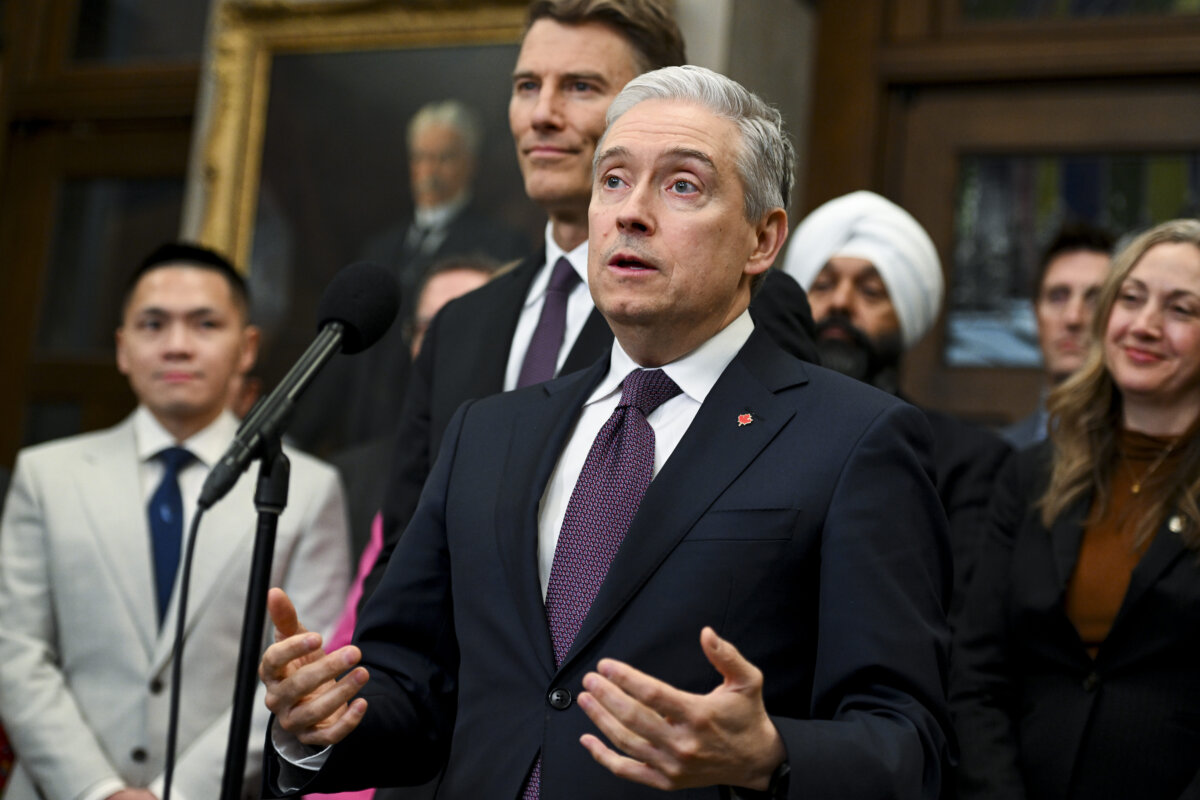

After leading a Canadian trade delegation in China this week seeking to boost ties in the financial sector, Finance Minister François-Philippe Champagne said he raised the issue of “supply chain integrity” during his visit.
Champagne made the comments to reporters on April 3 when asked if he had discussed forced labour in China.
Champagne is on a visit to China from March 31 to April 4 as part of Ottawa’s plan to deepen relations with Beijing. The minister was accompanied by Bank of Canada Governor Tiff Macklem, Superintendent of Financial Institutions Peter Routledge, as well as business leaders in the finance and insurance industries.
Champagne said first strengthening cooperation in financial services is a key step in order to increase trade between Canada and China. The Liberal government seeks to increase merchandise trade with China by 50 percent by 2030.
The finance minister’s visit comes after Prime Minister Mark Carney went to China in January and announced he is pursuing a “new strategic partnership” with the world’s second largest economy. As part of this initiative, Champagne met with Chinese central bank Governor Pan Gongsheng, and the two signed a joint statement to launch the Canada-China Financial Working Group.
During his visit, Champagne also met Vice Premier He Lifeng and his counterpart at finance Lan Fo’an. Champagne said he invited He to visit Canada.
Speaking to reporters on April 3, Champagne was asked whether the issues of forced labour and human rights were raised during his meetings with Chinese officials.
“We did speak about supply chain integrity,” he said. “That was a core message that I conveyed to our Chinese counterpart to say that obviously Canada puts a lot of importance on supply chain integrity and that our bilateral trade needs to be conducted in accordance with international standards.”
The comments came as China’s use of forced labour was in focus on Parliament Hill in recent days.
Liberal MP Michael Ma appeared to dismiss the existence of forced labour in China during a House of Commons committee meeting on March 26, as he attacked the credibility of a China expert testifying. Ma faced strong reactions from opposition MPs and human rights advocates, and subsequently apologized for his comments.
Following the committee meeting, Ma would not tell a reporter whether he believes forced labour is taking place in China, only saying it’s a worldwide phenomenon. Carney took a similar stance when asked by reporters this week, while adding that some areas in China are at “higher risk.”
Later in the week, the United States Trade Representative released its annual report on foreign trade barriers—in which it listed forced labour as a new trade irritant for Canada.
Canada has passed laws since 2020 to prevent goods made by forced labour from entering its market, but the United States says that enforcement has been inadequate.
“It does not appear that Canada is effectively enforcing its forced labor import prohibition, meaning goods made with forced labor may be able to enter and compete in Canada’s market,” says the report.
The Canada Border Services Agency prohibited only two shipments of forced labour goods from 2020 to late 2025, whereas U.S. customs denied entry to nearly 23,000 shipments over a similar timespan.
Canada has an obligation under the United States–Mexico–Canada Agreement (USMCA) on free trade to prevent goods made by forced labour from entering the economic bloc.
Concerns about Chinese forced labour also come as Canada is about to see Chinese electric vehicles (EVs) enter its market. As part of a deal to have China reduce or drop its retaliatory tariffs on Canadian agricultural and seafood products, Carney slashed the 100 percent tariff rate to 6.1 percent on up to 49,000 Chinese EVs in the first year.
Human Rights Watch has warned that forced labour of people of the Uyghur ethnic and religious minority in China, heavily persecuted by the communist regime, is contained in parts used to make Chinese EVs.
Champagne told reporters that there were no talks about the auto sector “per se” during his visit, when asked whether there were discussions about investments in Canada’s auto industry.
Concerns were raised by Ontario Premier Doug Ford this week over the news that a Chinese carmarker might take over the idle Stellantis plant in Brampton. “We can’t have cheap Chinese parts and kits coming over to be assembled. We’re dead against this,” Ford told CBC News.
Ottawa and Stellantis are in a dispute over federal subsidies given to the company for the plant.
While Champagne said there were no discussions about autos, he said the issue of Chinese tariffs on Canadian pork was raised. China reduced or removed some tariffs on Canadian goods in March, but kept the duties on pork and canola oil.
“Part of my message to the Chinese side was, really, we need to get to a point where we remove these trade irritants that exist between Canada and China,” he said.
Champagne is leading efforts to deepen ties with China, while in his role as industry minister in the Trudeau government he led several initiatives to protect the Canadian economy from Chinese encroachment, spying, and intellectual property theft.
They include banning Chinese telecommunications companies from the 5G infrastructure, strengthening measures related to takeovers of strategic sectors by state-owned companies, and curbing joint research with Chinese military institutions.
Champagne now says Canada is pursuing a “pragmatic” and “eyes wide open” engagement with China. He said Ottawa has been “very clear” with Beijing on the sectors where there can be cooperation and those where it’s not possible.
“There’s a lot of opportunities in the sectors that we have identified where we’re talking about energy, we talked about tourism, we talked about financial services, wealth management, pension management, the banking sector,” he said.
On energy, the minister said there’s “certainly a lot of interest from the Chinese side,” amid the current energy crisis spurred by the Iran war.
The Canadian Press contributed to this report.
 Friends Read Free
Copy
Facebook
Tweet
Friends Read Free
Copy
Facebook
Tweet