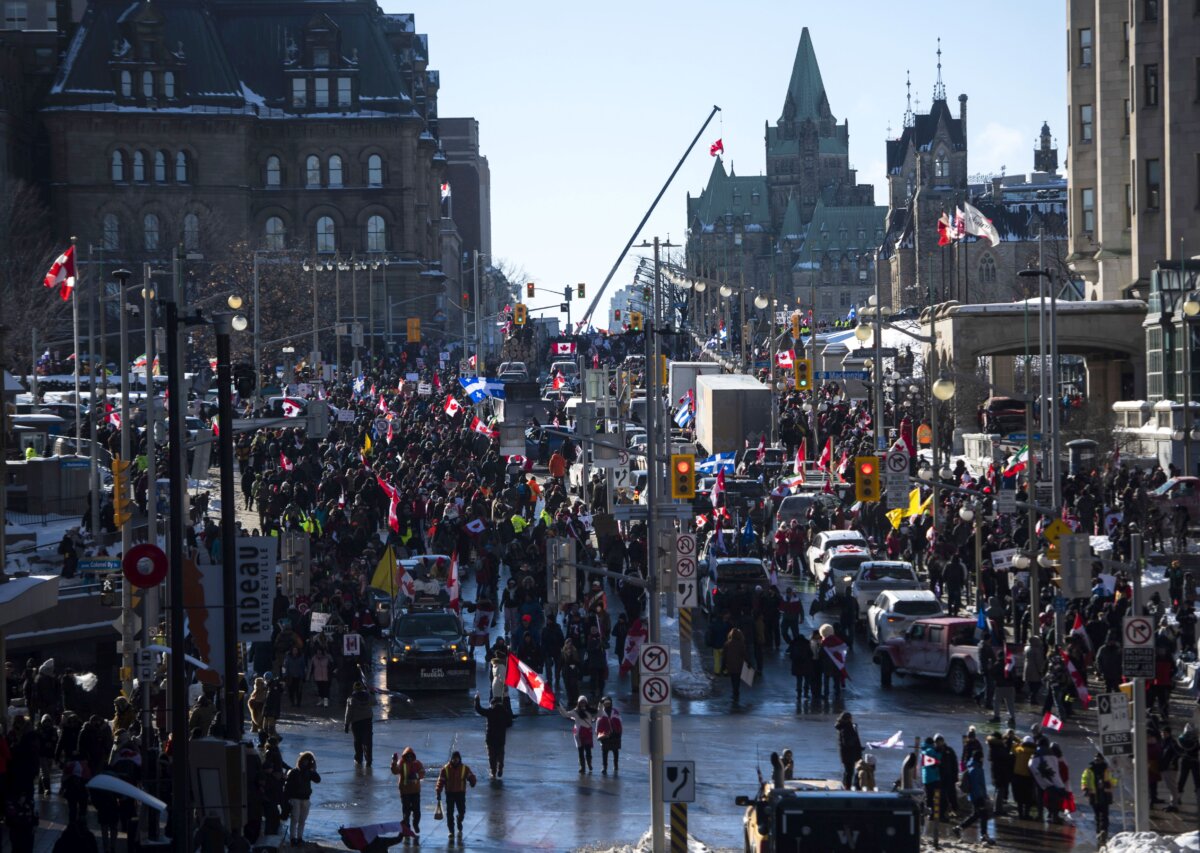

A Freedom Convoy protester is challenging a court ruling that denied a stay of proceedings in his case, saying the judge erred by not considering the federal government’s decision to freeze his bank accounts.
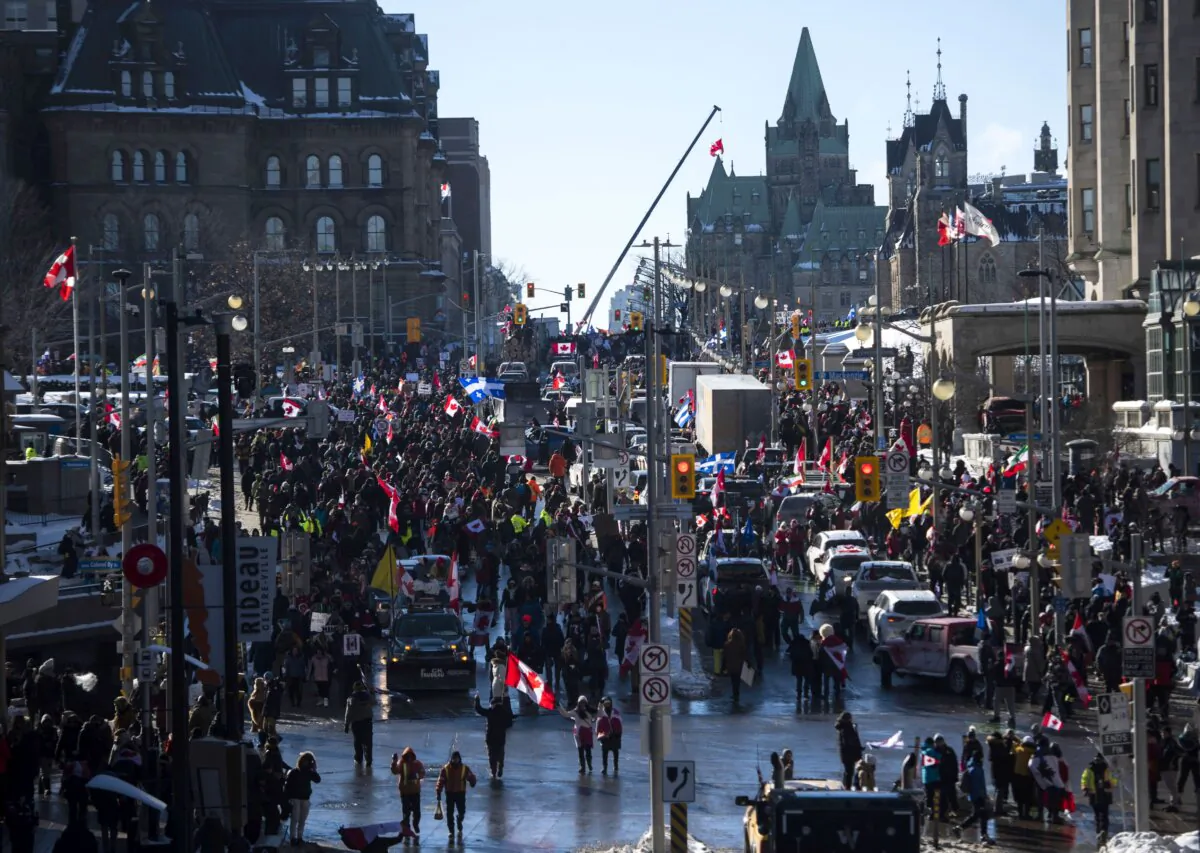
Evan Blackman was arrested during the police operation to dismantle the Convoy demonstration in downtown Ottawa on Feb. 18, 2022, following the federal government’s invocation of the Emergencies Act. He was found guilty by the Ontario Court of Justice on Nov. 21 of mischief and obstructing police, according to a release from the Justice Centre for Constitutional Freedoms (JCCF). The legal advocacy group has been supporting Blackman’s case.
Blackman was sentenced to a conditional discharge with 12 months’ probation, 122 hours of community service, and a $200 victim fine surcharge.
Blackman had been acquitted of all charges in his first trial in 2023, but the Ottawa Crown Attorney’s Office had appealed, and a retrial was ordered. In the Nov. 21 decision, the court dismissed Blackman’s application for a stay of proceedings, which sought a remedy for the freezing of three of his personal bank accounts under the emergency measures.
Judge Richard Blouin ruled that the freezing of Blackman’s accounts was legally unrelated to his arrest or prosecution, and concluded that he lacked standing to seek a stay.
Blackman has now filed an appeal in his case, saying the judge erred when he ruled that he did not have standing to request a stay. A stay granted by the courts suspends a case until further notice. If the Crown does not recommence the process, the charges will be dismissed.
The court filing says that as a result of Blouin’s decision, the court failed “to consider any evidence proffered by the appellant on the issue of standing.” The filing also says the judge “failed to consider the merits of the Appellant’s application for a stay of proceedings.”
Stay Dismissed
In Judge Blouin’s Nov. 21 decision, he called the case “straightforward” and characterized the protest as “an occupation of downtown Ottawa.”
The court decision notes that Blackman filed an application to stay the proceedings, while the Crown argued that the application be dismissed.
The Crown said the freezing of the bank accounts was done by a “non-state actor” and was not relevant to the criminal charges.
Blackman argued his accounts were frozen by an “unconstitutional” state decision and the court should “disassociate itself from this conduct.”
Blouin said he agreed with the Crown, and said the fact that Blackman was facing criminal charges was not connected to his frozen bank accounts.
“Blackman’s assets would have been frozen even if he had left Ottawa on February 17 and not attended the downtown core February 18,” said the court decision.
The judge dismissed the application, saying Blackman did not have standing to apply for a stay as there was no connection between the frozen bank accounts and the criminal charges.
“It did not taint the police investigation. And, it had no effect on the criminal proceedings against Mr. Blackman,” Blouin said.
Emergencies Act
Blackman’s bank accounts were frozen for more than a week after the federal government invoked the Emergencies Act on Feb. 14, giving law enforcement expanded powers to arrest demonstrators, compel towing companies to remove protesters’ vehicles from downtown Ottawa, and freeze the bank accounts of some protesters.
Federal Court Justice Richard Mosley issued a ruling on Jan. 23, 2024, against the federal government’s invocation of the act, saying the decision did not “bear the hallmarks of reasonableness.”
Mosley also said that the government’s decision infringed on the Charter rights of freedom of thought, belief, opinion, and expression, and there were other alternatives available to the government.
Mosley’s ruling was in contradiction to the report of the Public Order Emergency Commission, which was created following the Convoy protest to look into whether the federal government was justified in invoking the Act.
The Commission determined in February 2023 that the government had met the high threshold to invoke the act. Commissioner Paul Rouleau said the government had “reasonable grounds” to believe there was a “national emergency” that threatened the security of Canada.
A hearing date for Blackman’s appeal has not yet been scheduled.
JCCF lawyer Chris Fleury said the case raised questions about how peaceful protest is treated in Canada, and the “lasting consequences” of the federal government’s use of the Emergencies Act.
“The freezing of protestors’ bank accounts was part of a coordinated effort to suppress dissent, and courts ought to be willing to scrutinize that conduct,” he said in the release.
Matthew Horwood contributed to this report.
 Friends Read Free
Copy
Facebook
Tweet
Friends Read Free
Copy
Facebook
Tweet