
More business and self-employed people who share an office space are moving away from the big cities.
Once sited only in larger cities and used primarily by startups, small businesses, and freelancers, the facilities are now being established in regional areas and attracting larger corporations.
Driven by higher fuel costs, bigger businesses are looking to disperse their workforce and offer employees a central CBD office as well as closer-to-home solution, according to Flexible Workspace Australia’s 2026 industry report.
Large companies now occupy around 15.5 percent of total floorspace in co-working spaces, up from 7.2 percent in 2022, including giants like Fujitsu, Monday.com, Xero, Village Roadshow Pictures, and Vanguard.
It comes amid a regional population boom.
Last year, regional Australia grew by 94,700 people—more than Greater Sydney (75,200) or Greater Brisbane (58,200) and just under Greater Melbourne (105,000).
Three out of the five fastest-growing regional areas were in Victoria, with one each in New South Wales (NSW) and the Northern Territory.
While flexible workspaces make up only a tiny fraction of the 5.3 million square metres of office space in Sydney’s CBD, they’re starting to dominate the smaller end of the market.
Fifty-three percent of all 5- to 10-person offices in Sydney are now flexible workspaces, as are more than three-quarters of all 1- to 4- person offices, the report said.
Desk occupancy rates have increased while vacant floorspace has reduced, according to the report, which encompasses a national survey of operators, industry data from over 1,900 co-working spaces and innovation hubs, and expert opinion.
Recent data shows a sharp spike in search interest starting in late 2025 and accelerating into January 2026.
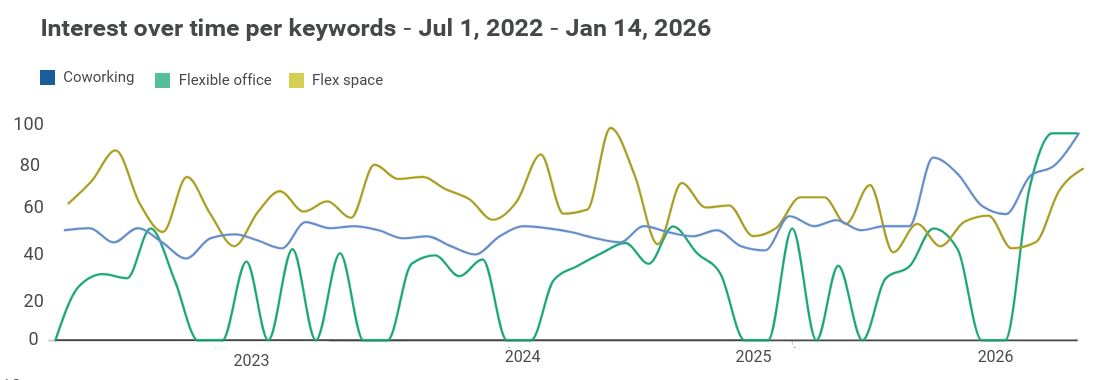
The report suggests this is due to a “new wave” of demand, likely driven by the maturing of hybrid work policies and businesses seeking flexible alternatives to fixed leases.
The role of flexible space will only grow as businesses adopt AI and hybrid work, it says.
Ophelie Cutier, the report’s main author and the chief executive of Perth- and Sydney-based startup hub Spacecubed, said the industry was in its infancy when she entered it 14 years ago.
“There had been huge growth before COVID,” she said, but many smaller operators didn’t survive the pandemic lockdowns, leading to half of all spaces in Sydney and Melbourne closing.
The rate of businesses shifting from leased to flexible space has doubled in the last three years, Cutier said. “So that’s a very big uptick.”
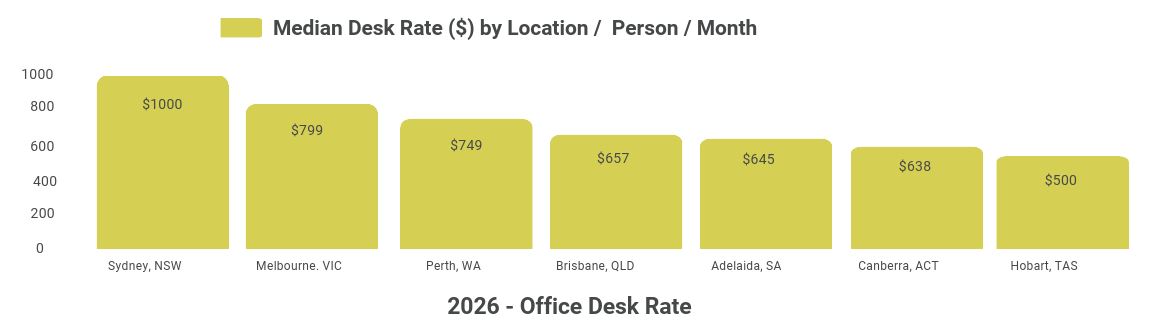
The median rate for a desk in a co-working space ranges from around $500 per person in central Hobart to $1,000 per person in Sydney’s CBD, although spaces outside major cities are considerably cheaper.
“It’s become like the gym or the childcare centre or the coffee shop—it’s needed as part of an [commercial] asset’s genetic makeup because it helps bring people to the asset,” said Jessie Grew, co-chair of Flexible Workspace Australia and chief executive of Wotso, which has 42 coworking hubs across Australia and New Zealand.
 Friends Read Free
Copy
Facebook
Tweet
Friends Read Free
Copy
Facebook
Tweet