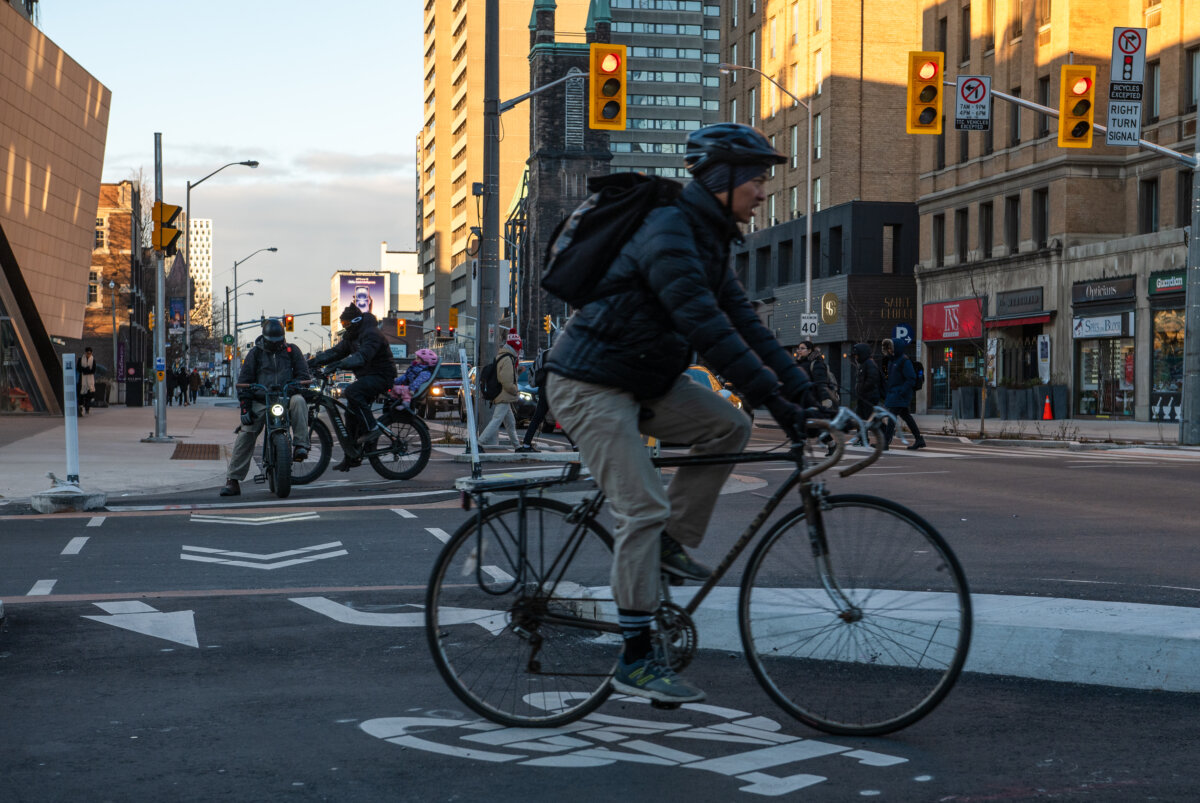

An Ontario judge has ruled that the province’s plan to get rid of various designated bike lanes in Toronto is unconstitutional.
In his July 29 decision, Justice Paul Schabas said that the province’s plan to scrap 19 kilometres of designated bike lanes in downtown Toronto would raise the risk of injury to cyclists and would not reduce traffic jams, as the province had said.
In late October of last year, Ontario Premier Doug Ford’s government put forward provincial legislation to get rid of the bike lanes and replace them with vehicle traffic lanes, saying it would reduce traffic, in a move that Toronto Mayor Olivia Chow called “arbitrary” and said would be a potential provincial overreach into city affairs.
A Toronto city council vote in November came out against the planned removal of the lanes, saying it overrode the city’s municipal authority and finding it would cost an estimated $48 million to remove the lanes.
The case against removing the bike lanes was brought before the Ontario Superior Court of Justice in December by Cycle Toronto and other applicants who said that getting rid of the lanes would cause danger to the safety of cyclists.
In his decision, Schabas said that there is no compelling evidence that getting rid of the bike lanes would “reduce congestion” and said the removal potentially infringes protected rights under section 7 of the Canadian Charter of Rights and Freedoms. Section 7 readsL “Everyone has the right to life, liberty and security of the person and the right not to be deprived thereof except in accordance with the principles of fundamental justice.”
Schabas also cited expert testimony from an injury prevention epidemiologist saying that removing the bike lanes would be a significant danger to cyclists.
Schabas’s verdict found that the public interest outweighs the Ford government’s traffic objectives. A growing body of Charter litigation has moved to expand the protections under Section 7.
“In my view, based on that full record, the assumption of public good does not tip the balance in favour of the government,” Schabas ruled. “The demolition and reconstruction will create its own impacts on traffic—both for cyclists and motor vehicles—and will likely result in considerable disturbance and congestion while that is taking place.”
A spokesperson for the Ontario Ministry of Transportation said in a July 30 email to The Epoch Times that they oppose the July 29 decision and plan to appeal, adding that “we were elected by the people of Ontario with a clear mandate to restore lanes of traffic and get drivers moving by moving bike lanes off of major roads to secondary roads.”
Cycle Toronto Executive Director Michael Longfield said Schabas’s decision is a “win” for all Torontonians and will make streets safer.
“There’s lots of folks in this city that are both excited and, frankly, very relieved,” Longfield said in a July 30 interview with The Epoch Times. “Yes, we’re facing traffic issues, but these are the same issues other cities are facing, and to pretend that the Premier’s figured out some cheat code of ripping out bike lanes, and that’s what’ll solve it, I think it’s pretty disingenuous.”
There were six cyclist deaths in Ontario last year, something Longfield said would be improved by building more safe and accessible bike lanes.
Ontario passed Bill 212 in 2023, under which municipalities must get provincial permission to build a bike lane that involves removing a lane of traffic.
 Friends Read Free
Copy
Facebook
Tweet
Friends Read Free
Copy
Facebook
Tweet