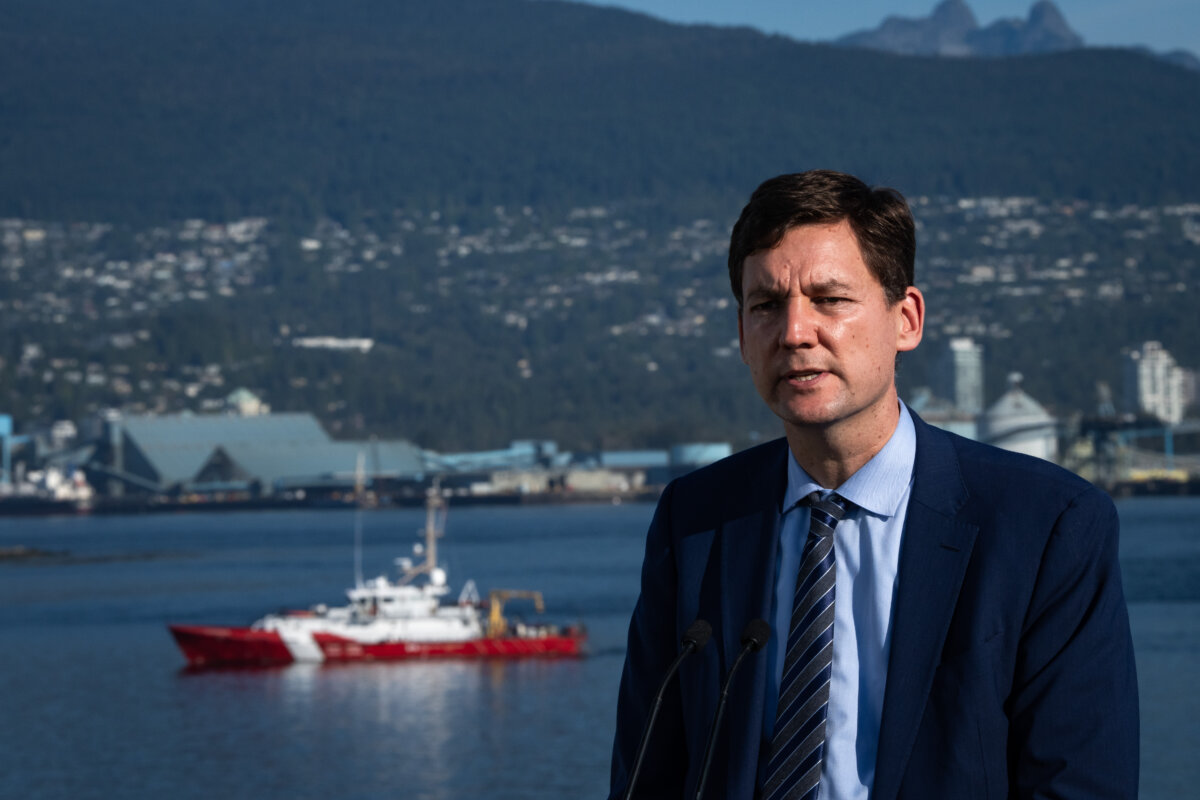

B.C. Premier David Eby said he is open to a potential proposal for a pipeline through the province, but that he does not support an end to the ban on oil tankers operating off B.C.’s northern coast.
“We have been quite frank with Alberta and with the federal government that although we never supported the pipeline and we’re not enthusiastic about it, we’re good team players on Team Canada and we’re willing to do what we can to support an expansion project if it’s needed,” Eby told reporters in Surrey, B.C., on Nov. 21.
Eby also said Alberta and Saskatchewan had called for the removal of the ban on oil tankers operating off the coast of B.C. “when there isn’t even a project to justify removing the oil tanker ban.”
“We are and have been engaging with Alberta on their concerns about being able to access global markets … but I’m a bit challenged by the approach they’re taking to our province right now,” Eby added.
A day earlier, Eby reacted to a recent Globe and Mail report citing unnamed government sources that said the federal government and Alberta and Saskatchewan were nearing an agreement on a proposal for a potential new oil pipeline stretching from Alberta to the B.C. coast, which would be built alongside a carbon capture project. The report added that the agreement could potentially involve exemptions to the oil tanker ban in areas where the pipeline accesses B.C. tidewater.
Eby said British Columbians “know our coast and the opportunities it can unlock better than anybody else,” and needed to be able to protect it.
B.C. Conservative Leader John Rustad said his party has also spoken with Alberta Premier Danielle Smith about plans to lay the groundwork to build a pipeline to the northern coast of B.C.
Eby had previously indicated lack of interest in a pipeline running through the province, saying in June that Smith’s “vision for a north coast pipeline is many, many years off and there’s no proponent.”
Earlier this year, the federal government passed the One Canadian Economy Act, also known as Bill C-5. The legislation enables the government to streamline federal approval processes to have major projects built faster, with the aim of speeding up approval times from five years to a maximum of two years.
Prime Minister Mark Carney announced the first five major projects being referred to the newly created Major Projects Office for consideration in September. While a pipeline was not included in the five projects, the government outlined six projects that are “at an earlier stage and require further development,” which included a Pathways Plus carbon capture and storage project and a “pipeline that will substantially reduce emissions” in Alberta.
While Carney has said that a pipeline was “highly likely,” the prime minister also previously said that Ottawa would not overrule a province’s opposition to pipeline construction.
Smith has called for Ottawa to lift the ban on oil tankers operating off B.C.’s northern coast in order to allow the pipeline to ship oil to other countries. The tanker ban, enacted in 2019, prohibits oil tankers carrying more than 12,500 metric tons of crude oil from docking or loading at ports on B.C.’s northern coast.
Smith has said her government is preparing a bid to the Major Projects Office for an Alberta–B.C. pipeline to clear regulatory requirements and attract private investment.
“What stands before us right now is a once in a generation opportunity to unlock our wealth of resources and become a world leading energy superpower, creating lasting prosperity for generations to come,” Smith said.
A poll by Angus Reid released in October suggested that a majority of British Columbians are in favour of an Alberta–B.C. oil pipeline. According to the poll, 56 percent of respondents were in favour of a potential pipeline, while 34 percent were opposed.
 Friends Read Free
Copy
Facebook
Tweet
Friends Read Free
Copy
Facebook
Tweet