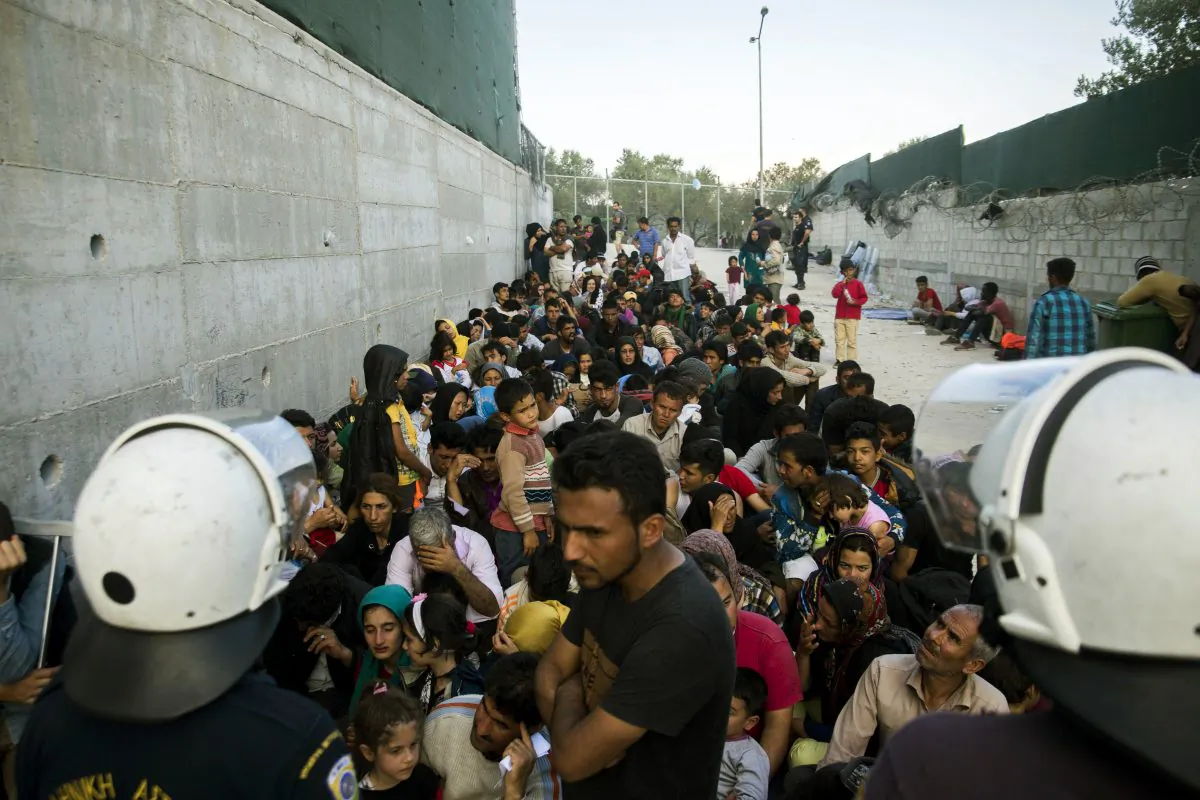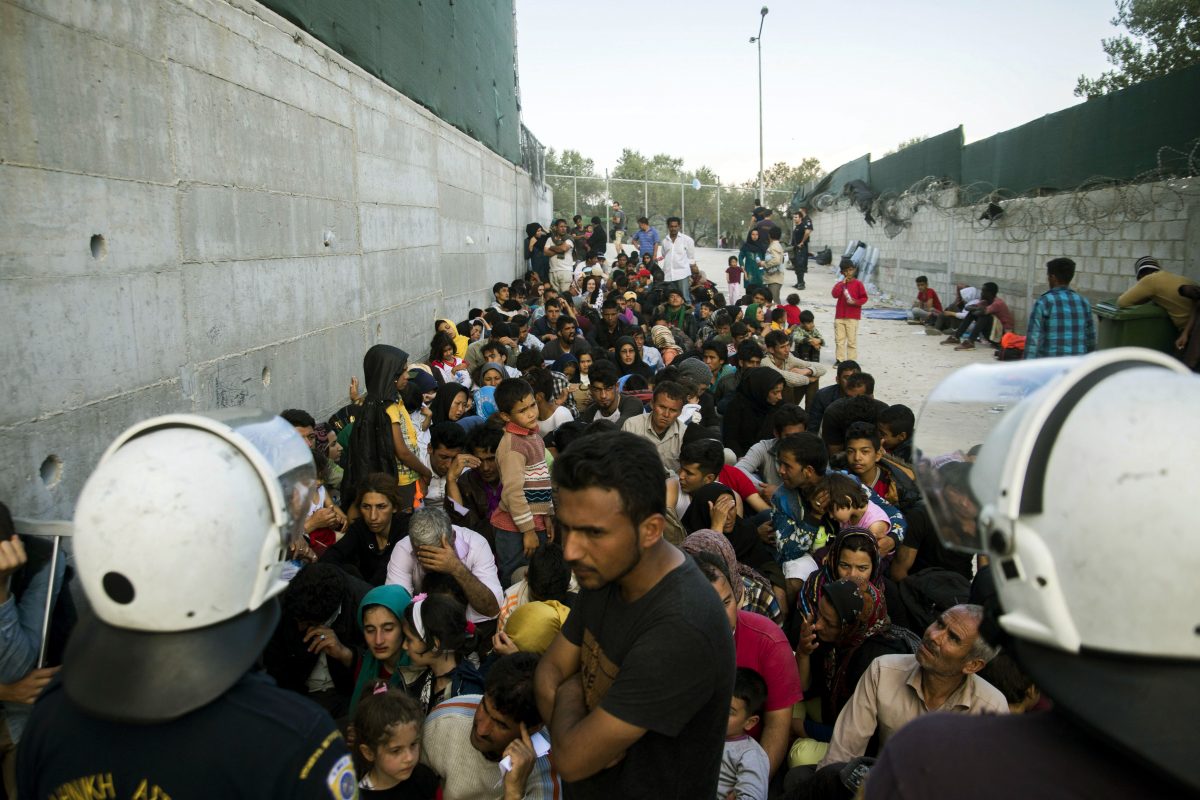

The foreign-born population of the European Union exceeded 64 million, or 14 percent of the population, in 2025—a historic high. Spain alone accounted for roughly one-third of the bloc’s annual increase, according to a new report from the Center for Research and Analysis of Migration at RFBerlin, an independent research institute.
The study, titled “The Immigrant Population in the European Union: Growth, Concentration and Dispersion” and authored by economists Tommaso Frattini and Camilla Piovesan, draws on Eurostat and U.N. Refugee Agency data to map the sharp and uneven growth in migration flows across the 27-member bloc.
Over the past 15 years, the EU’s foreign-born population has surged from about 40 million in 2010 to roughly 64 million today. From 2024 to 2025 alone, the total grew by 2.1 million, a 3.4 percent annual rise, following an even larger gain of 2.6 million the previous year.
The report notes that some 4.35 million people who had fled Ukraine were under temporary protection in the EU by December 2025. Data for Portugal were unavailable at the time of the study and were excluded from EU-wide aggregates.
The UK is not included in the study, as it is no longer a member of the EU.
Germany Leads in Absolute Terms, Spain Surges Fastest
Germany remains by far the largest host country in absolute numbers. Its foreign-born population rose from about 10 million in 2010 to nearly 18 million in 2025, an increase of roughly 70 percent in 15 years. France and Spain now each count between 9.5 million and 9.6 million foreign-born residents, while Italy stands at about 6.9 million, according to the study.
Spain stands out for the sheer pace of its growth. The country added 700,000 foreign-born residents in a single year, an 8 percent jump from 8.8 million to 9.5 million between 2024 and 2025. That figure is more than double the EU average, meaning that Spain absorbed close to one-third of the bloc-wide increase in 2025.
On April 14, the country’s socialist-led government approved plans to grant legal status to half a million illegal immigrants.
Looking at population shares rather than absolute numbers, the picture shifts considerably. The EU average, the authors write, sits at 14.2 percent, but Luxembourg tops the ranking at 51.6 percent, followed by Malta (32 percent), Cyprus (27.6 percent), Ireland (23.3 percent), and Austria (22.7 percent).
Germany sits at 21.2 percent, Spain at 19.3, France at 14, and Italy at 11.8. At the lower end, Poland, Bulgaria, and Slovakia each register below 5 percent.
Asylum applications follow a similarly concentrated pattern. In 2025, the EU registered 669,365 first-instance asylum applications, with Spain (141,000), Italy (126,600), France (116,400), and Germany (113,200) together receiving roughly 74 percent of all filings. Germany also hosts the largest refugee population in the bloc with 2.7 million people, well ahead of France’s 751,000.
Where Are the Immigrants From?
The report has a blind spot, analysts say: It provides no breakdown of origin countries for the EU’s overall stock of 64 million foreign-born residents.
For Erika Steinbach, chairwoman of the German conservative Desiderius Erasmus Foundation, that silence is no accident. She told The Epoch Times that a significant share of this migration originates from predominantly Muslim countries, citing Afghanistan, Syria, Morocco, and various African nations. There appears to be “a desire to avoid drawing attention to these countries of origin,” she said, calling it “consistent with the general culture of silence surrounding violent offenders from these regions.”
For Viktor Marsai, director of the Migration Research Institute based in Budapest, Hungary, the figures confirm a long-running shift in the composition of several EU societies, but he said he believes that the real numbers run higher than the official statistics suggest.
The foreign-born share, in his estimation, often stands above 20 percent in many European countries, with Germany and France approaching 26 percent or more of the population either born abroad or having two foreign-born parents.
His estimates align with recent national data. Earlier in April, Germany’s Federal Statistical Office reported that 21.8 million people, or 26.3 percent of the population, are either immigrants themselves or the children of two immigrant parents.
In France, the French Immigration and Demographics Observatory, drawing on data from the French National Institute of Statistics and Economic Studies, places the share with an immigrant background at 30 percent over three generations.
However, comparable figures are difficult to pin down with precision because France and Germany, unlike the United States and the UK, do not collect demographic data on ethnicity, making it harder to calculate transparently the real number of citizens with a non-European background.
Speed, Not Just Scale
What sets Europe apart from other regions, Marsai argues, is not the scale of demographic change but its speed. Without a significant reduction in numbers, he warned, “it will be very hard to stop the transformation of Western Europe.”
Sweden, in his telling, was an almost completely homogeneous society until the 1960s before opening up significantly through humanitarian programs in the 1990s. It now counts more than 20 percent foreign-born residents.
Portugal moved even faster, with the foreign-born share rising from about 4 percent at the turn of the century to between 15 percent and 17 percent today.
“[The figure has] more than tripled, almost quadrupled, in 25 years,” he said.
Jean-Yves Le Gallou, president of the French foundation Polémia, cofounder of the Iliade Institute, and author of “Remigration: For a Europe for Our Children,” puts a date on the projected tipping point. If the current trend continues without rapid reversal, he told The Epoch Times, “European populations will be a minority in cradles between 2035 and 2050, depending on the country.”
Schools, Prisons, and Religious Tensions
For Steinbach, the figure of 64.2 million foreign-born residents is not merely a statistical milestone but the cumulative effect of years of lax immigration policies, particularly on the part of Germany. The consequences, she argued, are felt in everyday life: in classrooms with growing numbers of children who do not speak German, in deteriorating public safety on streets and in public spaces, in strained welfare budgets, and in a long-running housing shortage.
Le Gallou points to French prison statistics as another marker of strain. Detainees, he said, divide into roughly three groups of similar size: “foreigners holding non-French citizenship, French nationals with an immigrant background, and French citizens of Franco-European origin.” He cites French data but argues that the same pattern plays out across European countries.
Steinbach offered a parallel German picture. The main non-European countries of origin, she said, are Syria, Afghanistan, and Turkey, and the inflow “has contributed to a dramatic decline in educational attainment,” with more than 52,000 students leaving German schools each year as “functional illiterates,” a figure she contrasted with near-universal literacy a century ago. She also linked the trend to a housing shortage that has “worsened dramatically” and to a sharp rise in violent crime, noting that “nearly one in two inmates in German prisons now has a migrant background.”
Steinbach also said a significant proportion of migrants from outside Europe, in her assessment, “have no desire to integrate,” and “some even openly declare an intention to Islamize the country.”
Attacks on Christian churches are rising, she added, while Jewish residents in cities such as Berlin “cannot walk the streets wearing a kippah without risking harassment or assault.”
Marsai also links the rise of anti-Semitism and anti-Israel sentiment in parts of Western Europe directly to the scale of immigration flows from the Middle East.
Foreign Influence
Cultural distance, in Marsai’s view, makes integration markedly more difficult, and the effects extend well beyond domestic life into foreign policy. Diaspora communities, he argues, can shape the host state’s positions abroad in ways that are not always visible.
According to an analysis by the Paris Institute of Political Studies, Turkish communities have become “one of the pillars of Turkey’s influence strategy in Europe,” used by Ankara as political leverage and as a means to gather information on sensitive issues to strengthen its hand in diplomatic negotiations.
A similar dynamic plays out in France with the Algerian diaspora, which the Algerian regime treats as a “strategic relay” of its official narrative, organizing support campaigns for the regime and targeting its opponents, according to an analysis by the French Choiseul Institute.
Iran has built closely on this network, particularly through the Quds Force, French Iranian journalist Emmanuel Razavi told The Epoch Times. Lacking a direct foothold in France, which imposes sanctions on Tehran, “the Islamic Republic relies on Algerian intermediaries to extend its reach into immigrant neighborhoods,” he said. The message, in Razavi’s words: “We are capable of harming you by fueling internal tensions through the suburbs. Listen to us and negotiate.”
The implications, Marsai said, may eventually reach Washington. The replacement of European populations by African and Muslim immigrants could substantially affect the United States, a concern echoed in the U.S. National Security Strategy, which warns that “within a few decades at the latest, certain NATO members will become majority non-European,” leaving open the question of whether they will view their alliance with the United States in the same terms as those who signed the original charter.
Policy Shifts and Response
Whether Europe has already passed the point of no return, Marsai said, is a real debate. However, he insists on optimism.
“I have three children, so I have to remain optimistic,” he said.
Steinbach’s foundation, named after the humanist Erasmus of Rotterdam, is determined to counter the trend, she said, lest Europe’s cultural foundations grow fragile. As a result, such efforts, she pointed out, are conducted without German state funding and rely entirely on private donations.
Le Gallou traces the legal scaffolding of today’s situation to a lengthy historical arc. Non-European immigration began as a deliberate policy in the 1960s, he noted, but the decisive shift came in the late 1970s and early 1980s, when Europe moved “from an immigration law to a right to immigration,” reframing the legal logic toward the individual entitlement of the immigrant rather than the interest of the host state.
Le Gallou frames “remigration” as the policy answer: a project aimed, in his words, at restoring “more harmonious societies” and ensuring “that Europe remains the homeland of Europeans.” He grounds the argument in what he calls a fundamental principle, defining Europeans as “the indigenous people of Europe” and asserting “the legitimate and fundamental right of peoples to preserve their cultural, historical, linguistic, and civilizational identity.”
He said he believes that the political ground is shifting, particularly among younger Europeans. Opinion polls, he said, show that “a significant portion of Europe’s youth is identitarian.” Cross-border alliances are forming, and the idea is gaining traction in the platforms of major political parties in France, Germany, Spain, and Italy.
 Friends Read Free
Copy
Facebook
Tweet
Friends Read Free
Copy
Facebook
Tweet