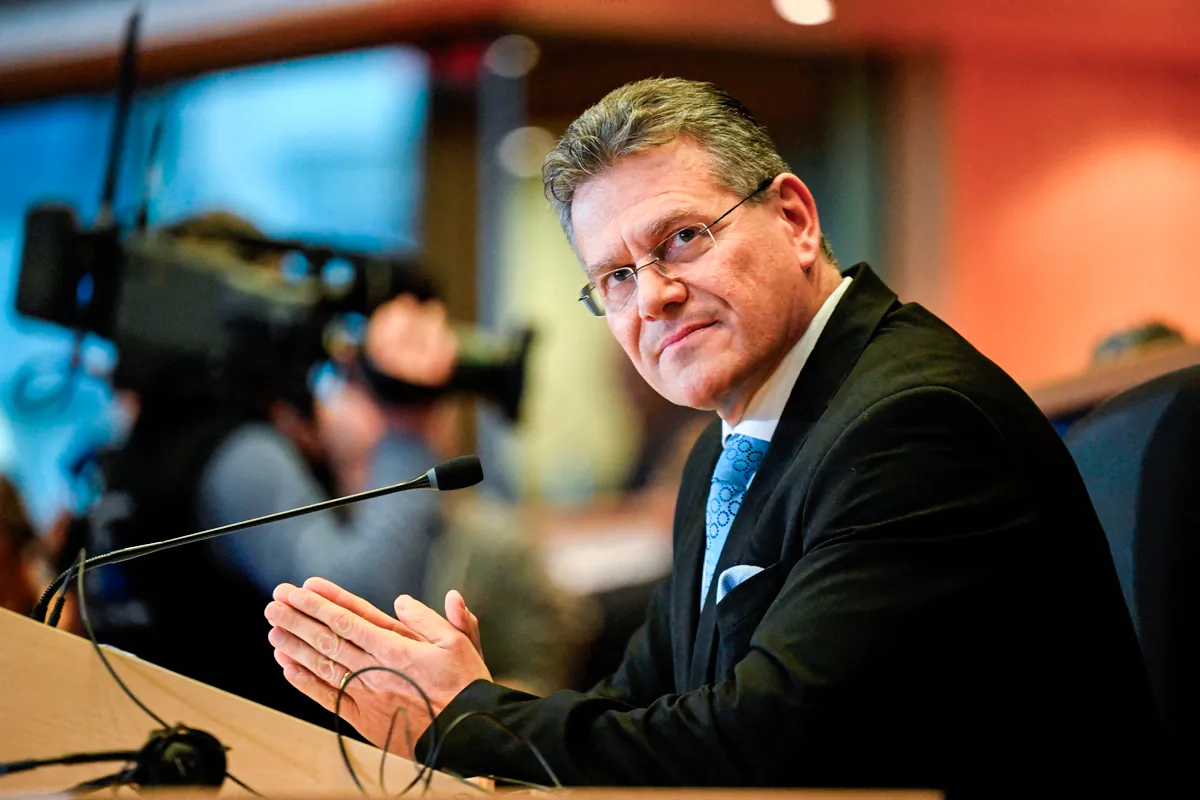

European trade ministers are gathering in Brussels on Monday to discuss transatlantic trade relations after the United States announced plans to impose a 30 percent tariff on imports from the European Union.
Arriving at the Foreign Affairs Council on Trade meeting, European Commissioner for Trade Maros Sefcovic said that a tariff at this level would severely disrupt trade flows between the United States and the EU.
“An idea of 30 percent tariff rate is effectively prohibitive to the mutual trade,” Sefcovic told reporters. “We remain convinced that our transatlantic relationship deserves a negotiated solution, one that builds the basis for renewed stability and cooperation.”
The commissioner said he intends to speak with U.S. counterparts later on Monday, noting that negotiations over the past weeks had appeared close to reaching an agreement.
“We have been negotiating this agreement in principles for four weeks, and I think that we’ve been we’ve been almost there,” he said, adding that the U.S. announcement changes the dynamic of talks.
U.S. President Donald Trump has accused the EU of maintaining unfair tariffs and non-tariff barriers against U.S. exports and warned that the 30 percent rate could be increased if Europe retaliates.
The EU, the largest U.S. trading partner, said on Sunday it will extend the suspension of its countermeasures to U.S. tariffs until next month.
The announcement by European Commission President Ursula von der Leyen followed an earlier statement in which she said the bloc would take all necessary steps to safeguard its interests, including proportionate countermeasures if required.
Trump initially gave trading partners until July 9 to reach agreements with his administration, threatening tariffs if talks failed.
Letters have since been sent to more than 20 countries, including Mexico, notifying them of similar 30 percent tariffs.
Speaking about the risks of a prolonged trade dispute, Sefkovic said that higher tariffs could damage transatlantic supply chains and disrupt the flow of $1.7 trillion (1.4 trillion euros) in goods and services traded annually between the EU and the United States.
According to Sefcovic, the current uncertainty cannot persist indefinitely, and the EU must prepare for all possible outcomes, including measures to “restore the balance” in the transatlantic relationship.
Italy’s Foreign Minister Antonio Tajani said on Monday the EU has prepared 21 billion euros ($24.5 billion) in tariffs on U.S. goods if talks with the United States fail.
Tajani warned additional measures could follow, but said he remains hopeful for a deal. He called for “zero tariffs” and an open market between Canada, the United States, Mexico, and Europe.
Trade Volumes
Bilateral trade between the European Union and the United States reached a new high in 2024, with total trade in goods and services amounting to 1.68 trillion euros ($1.96 trillion), according to EU figures.
That figure exceeds the entire Gross Domestic Product (GDP) of Spain. On average, goods and services worth more than 4.6 billion euros ($5.38 billion) cross the Atlantic each day.
The EU recorded a trade surplus of 50 billion euros ($58 billion) with the United States in 2024 when combining both goods and services, while U.S. data showed a goods trade deficit of 235.6 billion euros ($275.4 billion), up 12.9 percent from 2023.
In a letter sent to EU leaders, Trump defended the planned tariffs, describing the trade relationship as “far from reciprocal.”
“Please understand that these Tariffs are necessary to correct the many years of European Union Tariff, and Non-Tariff, Policies and Trade Barriers, which cause the large and unsustainable Trade Deficits against the United States,” Trump wrote. “This Deficit is a major threat to our Economy and, indeed, our National Security!”
EU Seeks to Avoid Escalation, Diversify Trade
Speaking on Monday, Danish Foreign Minister Lars Lokke Rasmussen, representing the EU Presidency, said the transatlantic trade relationship is at a critical juncture.
“We do not want any kind of trade war with us. It will be devastating, not just for the Americans, but also for Europe,” Rasmussen told reporters. “So we don’t want to escalate things.”
Rasmussen also welcomed progress in the EU’s efforts to diversify its trade partnerships, highlighting an agreement in principle with Indonesia reached over the weekend.
Sefcovic said that talks are ongoing with other partners in the Asia-Pacific region, including South Korea, Japan, Vietnam, Singapore, and the Philippines.
The EU is also preparing for a summit in Beijing later this month while continuing negotiations on major trade deals with Mexico and Mercosur, the South American trade bloc.
During a news conference with Indonesia’s president on Sunday, European Commission President Ursula von der Leyen said, “When economic uncertainty meets geopolitical volatility, partners like us must come closer together.”
Correction: A previous version of this article misstated the U.S. dollar conversion of the average value of goods and services that cross the Atlantic each day. The Epoch Times regrets the error.
 Friends Read Free
Copy
Facebook
Tweet
Friends Read Free
Copy
Facebook
Tweet