
The European Commission presented a proposal for the next Multiannual Financial Framework (MFF) on July 16, setting out a 2 trillion euro ($2.2 trillion) budget for 2028–2034, with a focus on defense and economic competitiveness.
EU Budget Commissioner Piotr Serafin said 300 billion euros ($330 billion) would go to agriculture, 218 billion euros ($239 billion) to less developed regions, and 451 billion euros ($496 billion) to a European Competitiveness fund.
He outlined a package to the European Parliament, describing the proposal as “a modern, more flexible budget” aimed at responding to Europe’s evolving priorities.
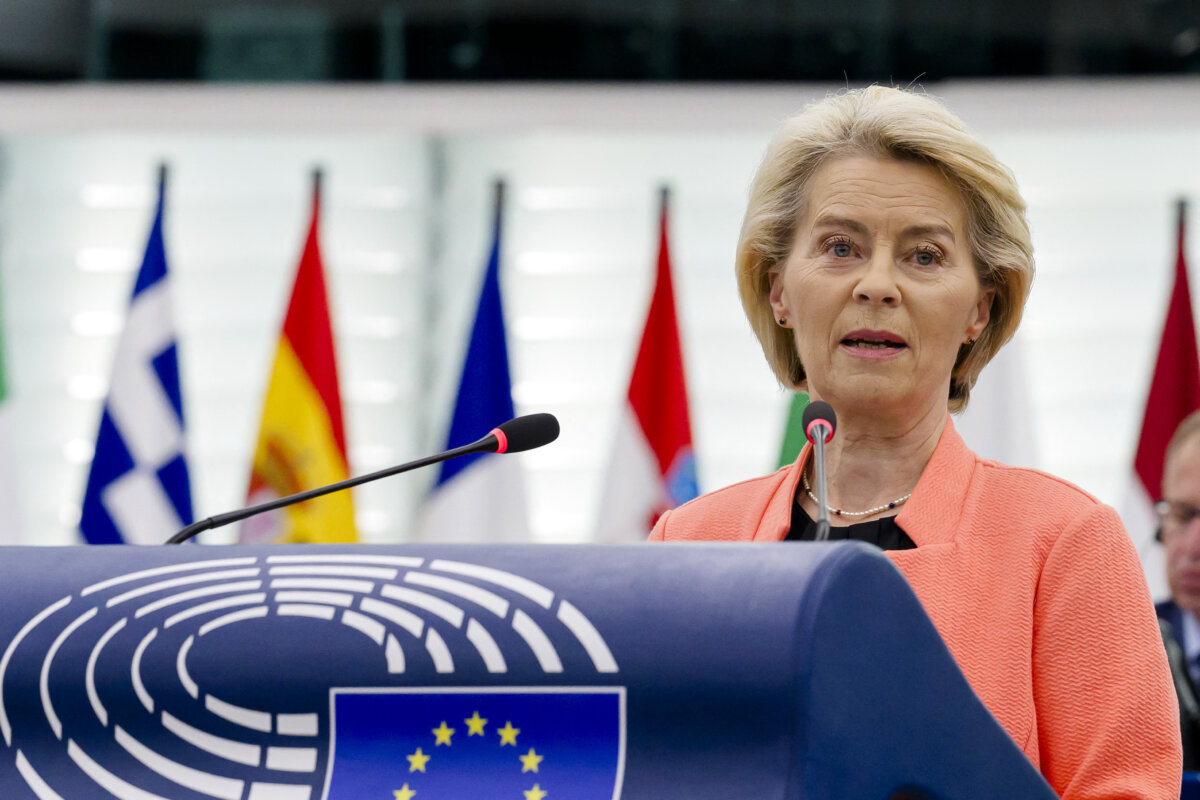
Shortly after, European Commission President Ursula von der Leyen said in a press conference that the bloc is investing more in its “capacity to respond” and more in its “independence.”
Serafin told MEPs the package reflects lessons learned from recent crises, including the COVID-19 pandemic and the war in Ukraine.
“The goal of this next MFF is a modern, more flexible budget that builds on past successes and responds to the challenges of today,” he said.
Three-Pillar Structure
The next EU budget will focus on three main areas: helping member states through partnership plans, supporting businesses and beneficiaries with the Competitiveness Fund, and assisting external partners via Global Europe.
Serafin said that in national and regional partnership plans, 300 billion euros ($330 billion) will be earmarked for farmers, with an additional 2 billion euros ($2.2 billion) allocated for fishermen.
Less developed regions will receive 218 billion euros ($239 billion) to support cohesion and regional development.
Funds for borders and migration management will be tripled, with regions bordering Ukraine, Russia, and Belarus receiving a bonus in the allocation of funds to reflect their specific challenges, Serafin said.
The new budget also allocates 131 billion euros ($144 billion) to defense and space, a fivefold increase over the current level, Serafin told the European Parliament.
The draft budget’s third pillar combines all the instruments of foreign policy under Global Europe, allocating 200 billion euros ($233 billion) to strengthen Europe’s external action and partnerships.
This includes up to 100 billion ($116 billion) euros in off-budget commitments for Ukraine’s recovery and reconstruction.
“This is a long-term commitment to Ukraine’s recovery and reconstruction,” Serafin said.
Additionally, a significantly bolstered Connecting Europe Facility will channel 81 billion euros ($88 billion) into infrastructure projects, including a 10-fold increase in military mobility funding.
Von der Leyen said that the budget’s 400 billion euro ($435 billion) crisis instrument will allow rapid funding in emergencies and will be accessed only by a unanimous European Council decision.
Budget Criticism
Budget co-rapporteur Siegfried Muresan criticized the European Commission’s proposal, highlighting poor cooperation with MEPs and insufficient information.
He called for increased support for farmers and reforms to align policies with new objectives, while opposing changes that weaken these policies.
“We want a budget that is aligned with the priorities of the union, firstly,” Muresan said. “Secondly, we want a budget which is sufficient and which gives predictability and certainty to the beneficiaries, to research, to farmers, to the local and regional level.”
He added that the proposed package would weaken the budget and the European Union.
An agreement on the new EU budget requires backing from all 27 member countries and sign-off from the European Parliament.
Talks will continue in the coming months to adopt the new budget framework before the current MFF expires in 2027.
 Friends Read Free
Copy
Facebook
Tweet
Friends Read Free
Copy
Facebook
Tweet