
The European Commission’s new European Democracy Shield claims that it will “counter information manipulation and disinformation” and strengthen democratic resilience through a “whole-of-society approach.”
But critics warn that by centralizing narrative control in Brussels, the European Union risks outsourcing press freedom to government-funded bodies and transforming democratic debate into a managed information system.
Unveiled on Nov. 11, the EU presented what it called “a series of concrete measures to empower, protect, and promote strong and resilient democracies across” the bloc’s 27 member countries.
Supporters say the European Democracy Shield is a necessary bulwark against foreign malign influence, a long-overdue response to Russia and other authoritarian regimes.
The Shield
The EU argued that “authoritarian regimes seek to exploit divisions, sow mistrust, and restrict democratic actors such as free media and civil society.”
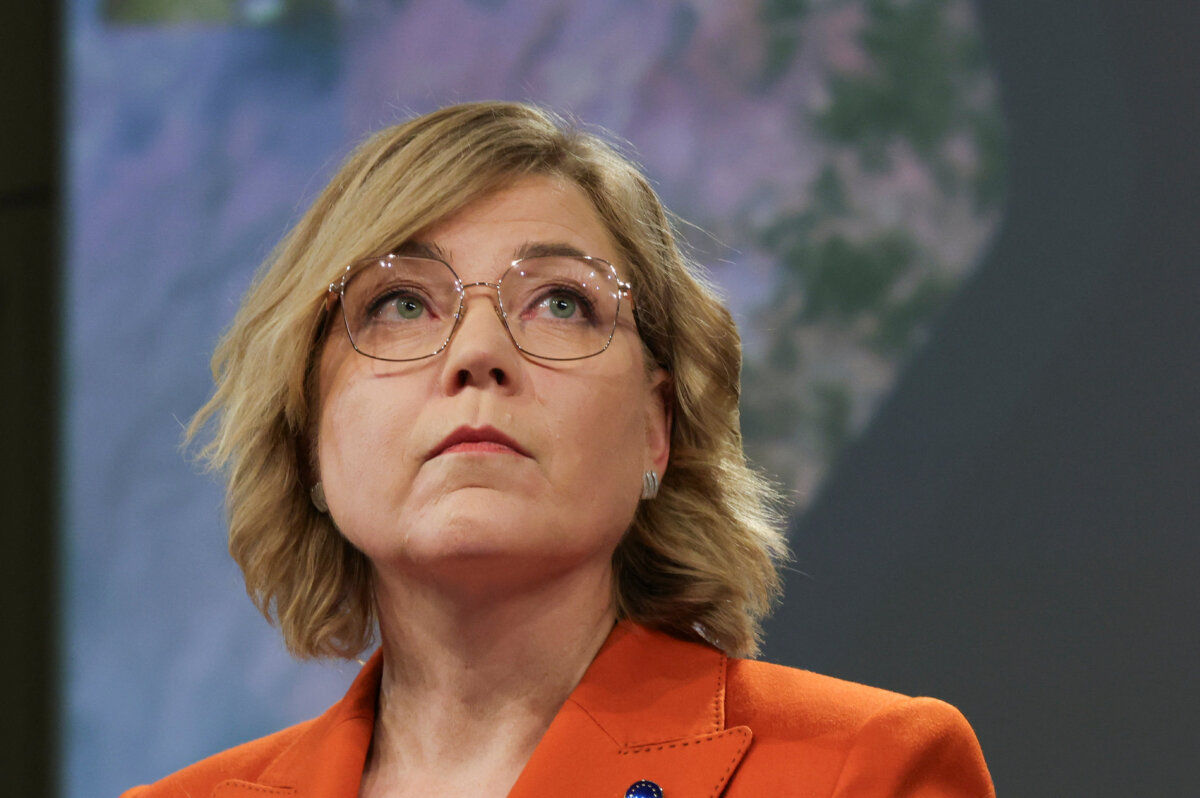
The shield will work to “demonetise disinformation, by removing advertising revenues that reward false content,” according to Executive Vice-President of the European Commission for Technological Sovereignty, Security and Democracy Henna Virkkunen.
She said that “a pan-European, independent network of analysis” is crucial to defending information integrity.
Digital transformation has opened new avenues for expression but also “new vulnerabilities,” according to EU Commissioner for Democracy, Justice, the Rule of Law and Consumer Protection Michael McGrath.
“Disinformation, algorithmic manipulation, financial pressure on media, and AI tools now threaten our democratic way of being,” he said.
The shield also expands the EU’s ability to pressure online platforms, via the already-enforced Digital Services Act (DSA), to take down posts that fall under those definitions.
Part of the plan also deepens the EU’s role in election and media monitoring and introduces a coordinated crisis-response mechanism to safeguard “the integrity of the information space.”
To support this, a newly created European network of fact-checkers will operate across all EU languages, while the European Digital Media Observatory will broaden its work analyzing election narratives and media trends.
‘Which Press Can Be Independent After Receiving Millions?’
The political establishment’s driving force with the European Democracy Shield is “fear,” Antonio Tanger Correa, vice-chair of the Patriots for Europe group and the group’s coordinator on the EDS committee, told The Epoch Times.
The Patriots for Europe group is a conservative alliance and the third-largest group in the European Parliament.
Correa acknowledged that there is “some disinformation” and “fake news in social media” but said there is anxiety in Brussels about losing control of the narrative to media outlets that they don’t subsidise.
“I mean, which press can be independent after receiving millions?” he said.
“Of course, we know what they are trying to do, but they are losing ground.”
Some media outlets continue to grow because “they are not misleading people.”
“They are really good people, and that’s what they are afraid of,” said Correa, who is also vice-president of Chega, Portugal’s second-largest political party.
‘State-Guided Boundaries’
“[Such an] expansion of institutional authority raises serious concerns about institutional overreach and the erosion of pluralism,” said Adina Portaru, a senior counsel for Europe at ADF International in Brussels, a U.S. faith-based legal advocacy organisation.
The Commission’s proposal markedly extends the EU’s power to “shape, oversee, and intervene in public narratives and online information flows, framed as a defence of democracy,” she said in a statement emailed to The Epoch Times.
Under this banner, Portaru said, the Commission is “effectively equipping itself with broad new instruments for influencing speech, regulating technological ecosystems, and steering public debate.”
“These intertwined regimes will erode fundamental freedoms by normalising state-guided boundaries on political expression and treating dissent as a regulatory risk rather than a democratic necessity,” she said.
US Pushback
U.S. lawyer Preston Byrne told The Epoch Times that he thinks EU laws gag free speech.
“The EU Democracy Shield will violate the First Amendment rights of American citizens and companies online,” he said in an email.
Byrne has been working with U.S. companies that have received letters from Ofcom, the UK’s regulator responsible for enforcing the Online Safety Act (OSA).
The OSA has already given regulators sweeping powers to compel platforms to remove content deemed harmful, with the EU pursuing a similar model at a continental scale with the DSA.
The Trump administration has signaled that Brussels’s approach to policing online speech is “incompatible” with America’s free speech tradition.
“I am sure they are going to pour hundreds of millions of dollars into it, much as Ofcom poured hundreds of millions of dollars into the Online Safety Act’s enforcement apparatus,” Byrne said.
He believes he can stop the Democracy Shield at “the American shoreline for a cost of $0.”
Byrne said a bill he has offered to New Hampshire legislators could serve as a “template for a U.S. fightback against global censorship, if adapted for federal use.”
“If the GRANITE Act we are currently rolling out at the state level gets taken up and enacted federally, we will be able to inflict savage financial penalties on European governments if they attempt to reach into the United States with the shield. There are no indications yet that there will be federal action, but I am optimistic that state action will prompt it,” he said.
Funding
Much of the Shield’s policymaking input has come from nongovernmental organisations (NGOs) that depend heavily on EU financial support.
For example, the Media Freedom Rapid Response consortium stated that it welcomed the shield’s focus on free and independent media, fighting disinformation, and “healthier information ecosystems” to protect European values and security. It is co-funded by the EU.
In April, Transparency International EU urged the EU to use the Shield to protect Europe from “Putin’s Russia and the Trump administration—and internal forces seeking to dismantle democratic principles.” It is funded by the EU.
The Democracy for Transition Coalition, a grouping of organisations working on democratic and environmental issues and co-coordinated by the European Environmental Bureau (EEB), claimed in May that safeguards within the shield must be ensured, but “protective gear is not enough.” The EEB itself stated that it is “funded by the European Union.”
Fact-Checkers
The EU stated that an “independent European Network of Fact-Checkers” will be set up to boost fact-checking capacity in all EU official languages.
The exact organisations that will form or lead the network have not yet been publicly specified.
In 2022 and 2023, EU-funded fact-checking organisations wrote the rulebook for what counts as independent fact-checking journalism, which is now poised to be enforced across the European information sphere.
Under the European Fact-Checking Standards Project, AFP Fact Check, assessed by AllSides as left-leaning, worked alongside Correctiv.org in Germany and Maldita.es in Spain, both of which had described the COVID lab-leak theory as a “hoax.”
‘Influencer Network’
“This creates a system in which the EU influences who is considered credible and what information is desired,” German politician Christine Anderson, a member of the European Parliament for the conservative Alternative for Germany party, told The Epoch Times by email.
“EU institutions must not do this, because such a controlled public sphere contradicts a pluralistic society. I find it completely incomprehensible how the Commission even came up with the idea of wanting to build an influencer network to push its own narratives.”
She said that a civil society “paid for by politicians can no longer independently control political power; this is more reminiscent of China than of liberal democracy.”
“Democracy doesn’t need subsidized guardians, but rather informed citizens. Those who want to protect democracy from criticism and dissenting narratives weaken it,” Anderson said.
‘Online Manipulation Techniques’
The Epoch Times asked the EU Commission what democratic oversight would prevent the Monitoring Centre from expanding its scope into general political speech policing.
And also, if NGO advisers receive EU funding, how could the commission guarantee ideological balance and inclusion of critics in the framework?
A spokeswoman for the EU Commission told The Epoch Times by email that “strengthening the integrity of the information space is key to supporting rights such as freedom of expression.”
She said that citizens “must be able to access and partake in a reliable and trustworthy information space—free from interference.”
“Individuals, political, media, or other actors have the right to express themselves freely, including in a way that some may find shocking or disruptive,” the spokeswoman said.
She said that at the same time, there has been a “proliferation of online manipulation techniques” including the “inauthentic” deployment of bots or fake accounts, websites designed to mimic official sources, as well as deepfakes and the artificial amplification of content.
“This is where the focus is, on organised campaigns where hostile actors aim at manipulating information and shaping people’s views to interfere in the democratic sphere and democratic processes in the EU and its neighbourhood,” the spokeswoman said.
The Media Freedom Rapid Response consortium, Transparency International EU, and EEB did not respond to The Epoch Times’ request for comment.
 Friends Read Free
Copy
Facebook
Tweet
Friends Read Free
Copy
Facebook
Tweet