
Taiwan security analysts said remarks by U.S. and Japanese defense chiefs at the 2026 Shangri-La Dialogue point to a more practical U.S. Indo-Pacific strategy, with Washington pressing allies to carry a greater share of the regional defense burden while Japan assumes a more visible frontline role against Beijing’s military pressure.
The annual defense forum, hosted by the International Institute for Strategic Studies in Singapore from May 29 to 31, brought together defense ministers, military officials, and security experts from across the region.
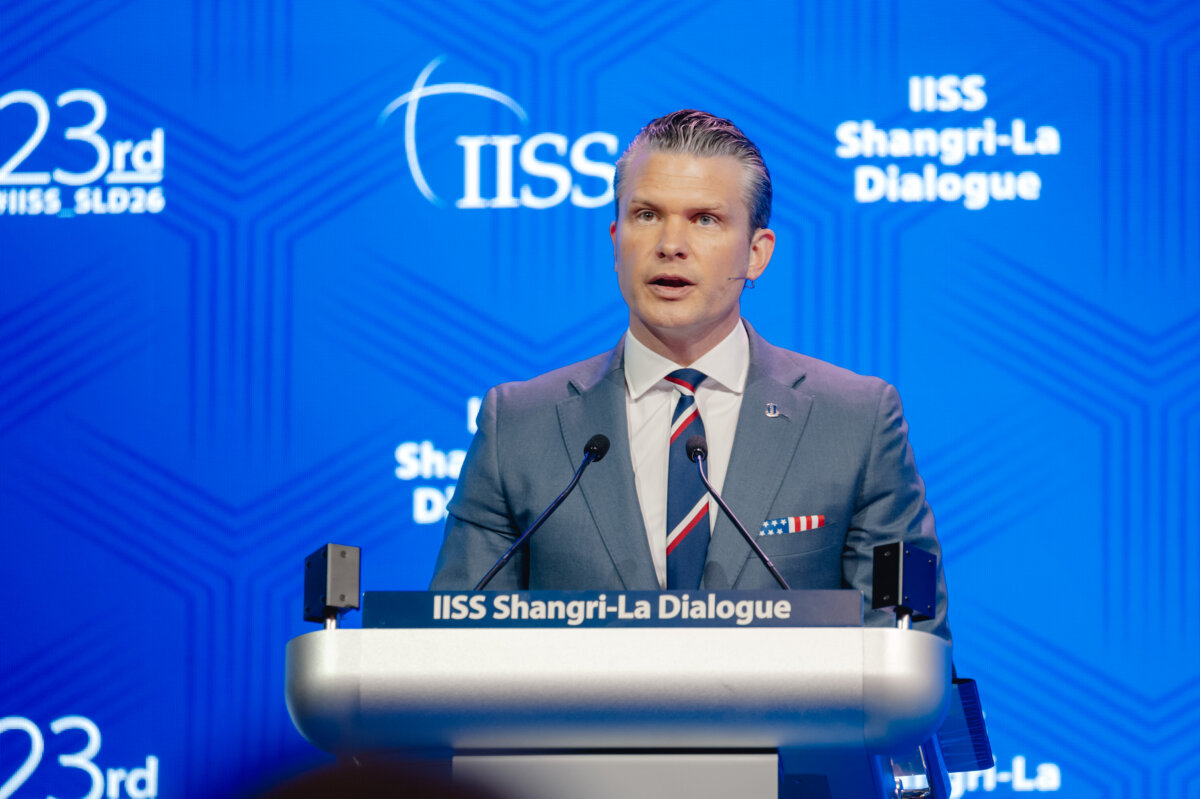
Secretary of War Pete Hegseth told the forum that Washington is moving “away from a model of dependency and toward one of true partnership,” saying the United States needs “partners, not protectorates.”
Hegseth said the Trump administration’s Pacific strategy centers on “deterrence by denial along the first island chain.”
Taiwanese analysts interviewed by the Chinese edition of The Epoch Times said the remarks should not be read as a retreat from the Indo-Pacific, but as a shift toward making allies build more practical military capacity.
Hsieh Pei-hsueh, an associate research fellow at Taiwan’s Institute for National Defense and Security Research, said Hegseth’s message was that Washington would rather spend less time trading public warnings with Beijing and more time pushing allies to take on concrete defense responsibilities.
“Strong, quiet, clear,” Hsieh said, referring to Hegseth’s repeated phrase at the forum. This could be understood as doing more and saying less, Hsieh said.
Hegseth Calls for Burden-Sharing
Hegseth said the United States was seeking a “favorable but durable balance of power” in which no state, “including China,” could impose hegemony over the region.
He said Washington would prioritize “lethal capabilities, strategic discipline, and business-like cooperation over empty rhetoric,” and that regional security could no longer rest disproportionately on American military power.
“A favorable balance of power requires capable allies with real military strength, real industrial capacity, and real political resolve,” Hegseth said.
Shen Ming-shih, a senior research fellow at Taiwan’s Institute for National Defense and Security Research, told the Chinese edition of The Epoch Times that Hegseth’s remarks were consistent with a long-standing U.S. goal of building a denial-defense system in the Indo-Pacific.
Shen said the central purpose remains countering the Chinese Communist Party’s external military expansion, especially around the Taiwan Strait and the Western Pacific.
He said Washington may be lowering the public tone to avoid unnecessary escalation with Beijing, while continuing military preparations for worst-case scenarios.
Japan Pushes Back Against Beijing
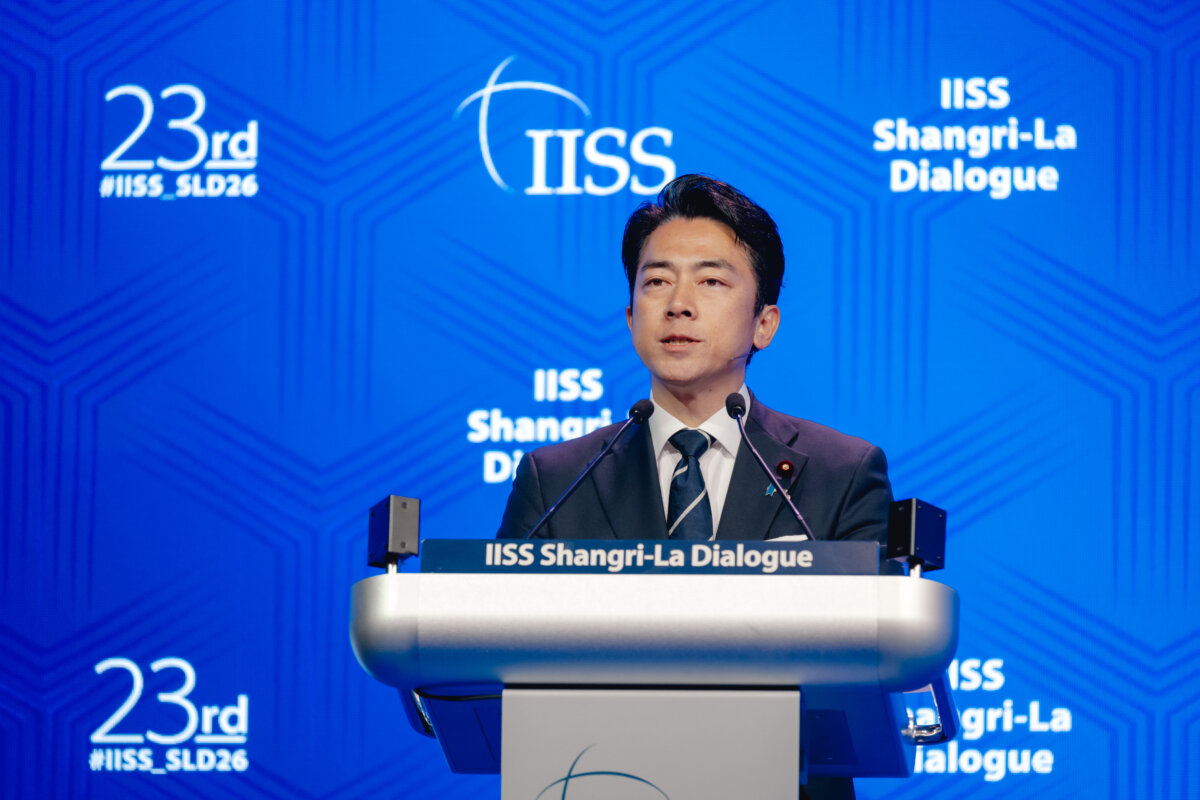
Japanese Defense Minister Shinjiro Koizumi used his Shangri-La address to reject Beijing’s accusation that Japan is returning to “new militarism.”
Koizumi said Japan would steadily build its defense capabilities “with a high degree of transparency,” citing artificial intelligence, unmanned systems, cyber, space, and other emerging technologies.
He said Japan has neither nuclear weapons nor strategic bombers, while “a country” with a large nuclear arsenal and strategic bombers was accusing Japan of militarism.
“Isn’t it strange?” Koizumi said.
Koizumi did not name China in that line, but later said in response to a question that China’s military buildup and activities are matters of “serious concern” for Japan and the international community because of insufficient transparency.
He also said Japan would strengthen the deterrence and response capabilities of the U.S.–Japan alliance, expand training through reciprocal access agreements with Australia, the Philippines, and the United Kingdom, and deepen defense cooperation with ASEAN countries.
Japan–Philippines Defense Ties Advance
Japan and the Philippines also used the Shangri-La period to advance bilateral defense cooperation.
Koizumi and Philippine Defense Secretary Gilberto Teodoro Jr. met in Singapore on May 31 and agreed to continue discussions on transferring Abukuma-class destroyers and one TC-90 aircraft to the Philippines, according to Japan’s Ministry of Defense.
The two sides also discussed training, maintenance, sustainment, equipment management, information-domain cooperation, and early tangible outcomes under their defense working group.
The meeting followed a May 28 summit between Japanese Prime Minister Sanae Takaichi and Philippine President Ferdinand Marcos Jr., after which Taiwan’s Ministry of Foreign Affairs welcomed the joint statement.
Taiwan’s Ministry of Foreign Affairs said the statement marked the first time Japanese and Philippine leaders had used a joint statement to express concern over peace and stability across the Taiwan Strait.
The ministry also rejected Beijing’s claim that Japan–Philippines maritime-boundary negotiations would involve Taiwan’s maritime territory, saying China has “no right to comment” on the territory and waters of the Republic of China, Taiwan’s official name.
Analysts See 2-Layer Defense Structure
Hsieh said Japan’s position in the first island chain gives it a direct role in regional deterrence.
He said Beijing is especially sensitive to Japan because of Japan’s industrial base, advanced technology, and geographic position near the East China Sea and Taiwan.
Hsieh said the United States appears to be moving somewhat behind the front line, while Japan becomes a more important conventional deterrence force in the first island chain.
Shen said Washington may be encouraging a two-layer defense structure in the Indo-Pacific.
The first layer, he said, would involve cooperation among first-island-chain partners such as Japan, Taiwan, South Korea, and the Philippines. The second layer would involve broader mechanisms such as AUKUS, which links the United States, the United Kingdom, and Australia.
Hegseth announced in Singapore that the United States is partnering with Australia and the United Kingdom to develop a suite of highly adaptable multi-mission unmanned underwater vehicle payloads designed to support undersea operations.
Hsieh said such efforts, along with undersea cable protection, unmanned underwater systems, and missile production cooperation, point to a U.S. strategy moving from political statements toward industrial and infrastructure capacity.
Shen said AUKUS could play a growing role in supporting the first island chain if Japan, South Korea, the Philippines, and other partners are further connected to the framework.
Taiwan Emphasizes Resilience
Taiwan has also been highlighting civil and defense resilience as regional security discussions continue.
Taiwan’s Ministry of National Defense said Taoyuan city will hold the fifth round of its 2026 urban resilience and civil defense mobilization exercise on June 3 and 4, including a tabletop exercise and field drills on the distribution of essential goods, critical infrastructure protection, emergency aid stations, and relief stations.
Separately, Taiwan’s defense ministry said Deputy Defense Minister Hsu Szu-chien attended a forum at National Tsing Hua University on military operations research, modeling, artificial intelligence, unmanned systems, and autonomous platforms.
Hsu said unmanned systems and AI have become key elements of future defense capabilities.
Taiwan is not formally represented at the Shangri-La Dialogue. Its foreign ministry, however, issued several statements during the same period welcoming regional security cooperation and rejecting Beijing’s claims over Taiwan-related maritime matters.
 Friends Read Free
Copy
Facebook
Tweet
Friends Read Free
Copy
Facebook
Tweet