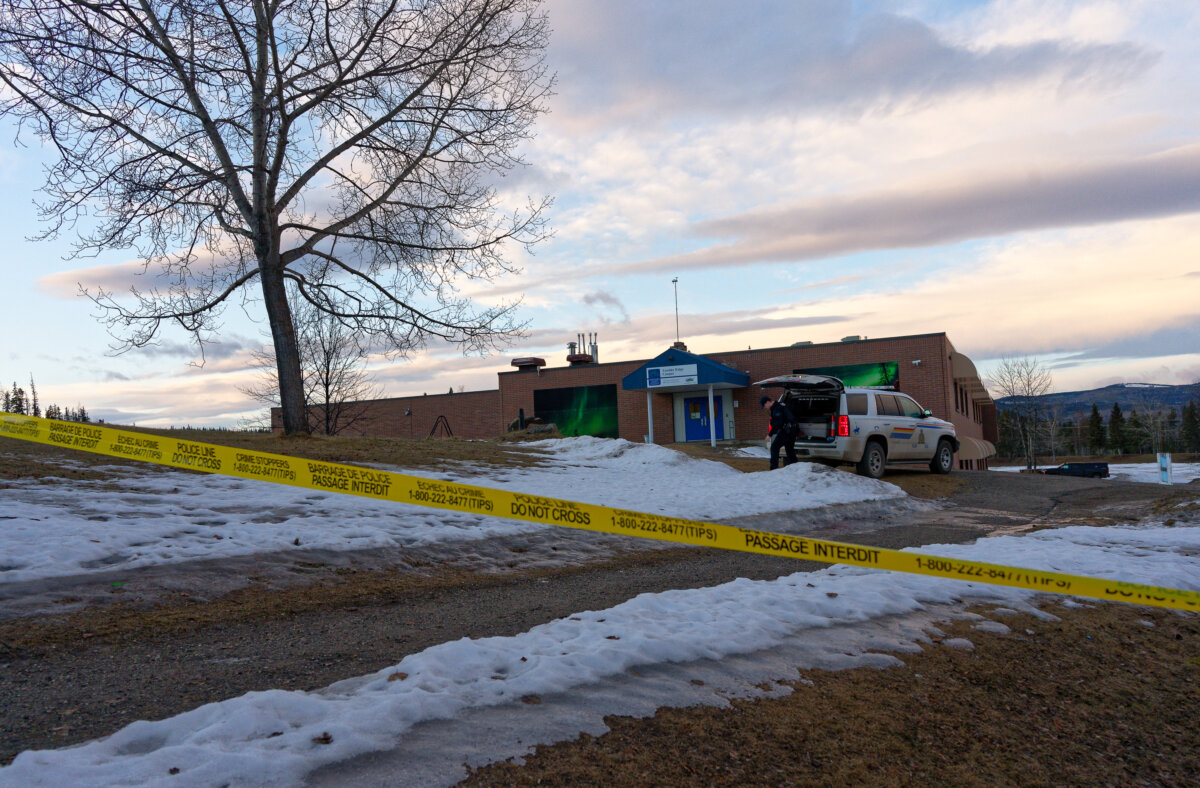

A family in Tumbler Ridge is suing a U.S. artificial intelligence firm after the Feb. 10 mass shooting in the small B.C. community left their 12-year-old daughter fighting for her life at BC Children’s Hospital.
Cia Edmonds, the mother of critically injured Grade 7 student Maya Gebala, is suing OpenAI, alleging the tech company was “aware of the shooter’s violent intentions,” but failed to alert authorities, according to the lawsuit filed March 9 in B.C. Supreme Court.
The claim against OpenAI names Edmonds and her daughters Maya and Dahlia Gebala as the plaintiffs. It alleges that OpenAI had “specific knowledge of the shooter using ChatGPT to plan a mass casualty event like the Tumbler Ridge mass shooting.”
OpenAI contacted police after 18-year-old Jesse Van Rootselaar killed eight people and injured 27 others on Feb. 10 before committing suicide. The firm said the killer’s ChatGPT account was deactivated last June, but noted that the shooter circumvented this restriction by opening a second account.
The account was not brought to the attention of the RCMP until after the shooting because the company did not identify “credible“ or ”imminent” planning for potential real-world violence when it banned the account last summer, OpenAI said in a Feb. 26 letter to Artificial Intelligence Minister Evan Solomon.
Van Rootselaar killed his mother and 11-year-old half-brother in their home before going to Tumbler Ridge Secondary School, where five students and a teacher’s aide were fatally shot, and Maya was critically wounded. The teen shooter was found dead at the scene with what the RCMP have described as a long gun and modified handgun, bringing the final death toll to nine.
Van Rootselaar, who was born a biological male and had begun transitioning to female in recent years, had a history of mental health issues.
The lawsuit says the shooter relied on ChatGPT for mental health support and counselling and treated the chatbot as a “mental health counsellor, advisor and/or pseudo-therapist” as well as a “trusted confidante, collaborator, ally, and friend.”
Van Rootselaar in 2025 described multiple scenarios involving gun violence to ChatGPT over the course of several days, according to the claim. Van Rootselaar was 17 at the time, younger than 18-year-old minimum age required to use ChatGPТ with parental consent.
The lawsuit says “approximately 12” OpenAI employees identified the posts as “indicating an imminent risk of serious harm to others” and recommended contacting police. It says the concerns were “escalated to leadership” but were “rebuffed.”
“Instead, the only step the OpenAI defendants took in response to the gun violence ChatGPT posts was to ban the shooter’s first OpenAI account,” the claim says.
The legal action also accuses the company of knowing ChatGPT had the ability to provide “detailed, actionable information” on violent topics such as how to carry out a mass casualty event. It says OpenAI did not take any steps to prevent ChatGPT from providing dangerous information and had no restrictions in place to keep users from finding such information.
“Possessing vast amounts of harmful information and the technical ability to distil it, ChatGPT equipped the shooter with information, guidance and assistance to plan a mass casualty event,” like the one carried out in Tumbler Ridge, the lawsuit says.
OpenAI has yet to respond to the claim and none of the allegations have been tested in court. The company previously called the Tumbler Ridge mass shooting an “unspeakable tragedy” in a media statement.
“Our thoughts remain with the victims, their families, and the entire community,” the company said in the statement. “OpenAI remains committed to working with government and law enforcement officials to make meaningful changes that help prevent tragedies like this in the future.”
Company CEO Sam Altman recently met virtually with B.C. Premier David Eby and Tumbler Ridge Mayor Darryl Krakowka, after a separate meeting with federal AI Minister Evan Solomon. Eby said OpenAI has also promised to work with the provincial government to present AI regulation recommendations.
Solomon met with Altman on March 4 to “demand immediate steps” to bolster safeguards and accountability in Canada for ChatGPT, according to a statement.
OpenAI has since said it has beefed up its protocols and OpenAI vice-president for global policy Ann O’Leary said in an open letter to Solomon the company is dedicated to improving its detection systems to more effectively thwart efforts to bypass its safeguards and to “prioritize identifying the highest-risk offenders.”
O’Leary said in her letter OpenAI remains committed to co-operating with the investigation into the Tumbler Ridge tragedy as well as establishing an ongoing partnership with federal and provincial governments.
“These immediate commitments are only the first step in the work we must do in partnership with the Canadian government to improve AI safety,” she said. “We seek continued dialogue and we would welcome working with the Canadian government to convene local stakeholders and industry to develop best practices for law enforcement referrals and AI model behavior in cases involving potential violence, including unique considerations for youth.”
‘Pain and Suffering’
Rice Parsons Leoni & Elliott LLP, the lawyers representing Edmonds and her daughters, said in a statement that the purpose of the lawsuit is “to learn the whole truth about how and why the Tumbler Ridge Mass Shooting happened, to impose accountability, to seek redress for harms and losses, and to help prevent another mass-shooting atrocity in Canada.”
The claim says Maya was shot three times at close range, with one bullet entering her head above her left eye, a second striking her neck, and the third grazing her cheek and earlobe.
Maya suffered a “catastrophic, traumatic brain injury” with “permanent cognitive and physical disability” and “scarring and physical deformities” as a result of her injuries, the lawsuit says.
The claim says Maya, her younger sister Dahlia, and their mother now suffer from depression, anxiety, and post-traumatic stress disorder as a result of the shooting. Both Dahlia and Edmonds are also dealing with sleep disturbances, it says.
The injuries listed in the claim have caused pain and suffering for all three of the plaintiffs, it says. It also claims “loss of enjoyment of life, permanent physical disability, loss of earnings, past and prospective, loss of income earning capacity, loss of opportunity to earn income and loss of housekeeping capacity, past and prospective” for Edmonds and her daughters.
Edmonds has kept the public up-to-date on Maya’s progress via social media since the shooting occurred. Edmonds said in a March 6 Facebook post that her daughter’s breathing tube has been removed “to see if she can breathe on her own.”
In a March 4 post she said Maya “with little control” can wiggle her toes, raise her arm, and “follow with her eyes.”
“Despite hemorrhaging, meningitis, pneumonia, and cerebral fluid leak, she continues to give it all she’s got,” she added.
The law firm’s statement said the family would not comment on the lawsuit while it remains before the court.
The Canadian Press contributed to this report.
 Friends Read Free
Copy
Facebook
Tweet
Friends Read Free
Copy
Facebook
Tweet