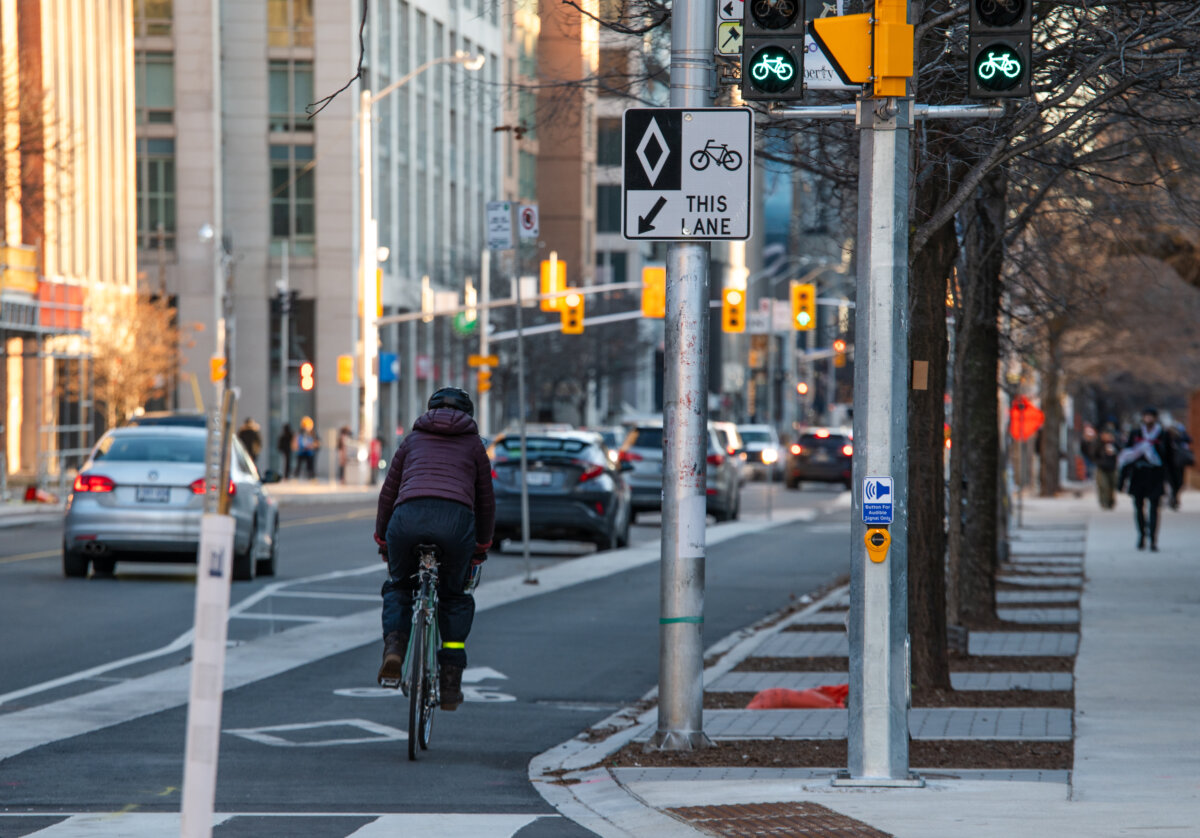

The Ontario government is seeking contractors to remove and redesign more than 19 kilometres of bike lanes in Toronto, following a win in the Ontario Court of Appeal last month that found their removal does not violate the Charter rights of cyclists.
On Aug. 14, the Ontario Court of Appeal overturned a lower court’s ruling in July 2025 that had prevented the province from getting rid of the bike lanes on constitutional grounds.
“Bike lanes are coming off Ontario’s busiest streets and going back onto side streets,” Ontario Premier Doug Ford said in a Sept. 1 post on social media. “We’re not wasting any time. We’re moving fast, starting this week to hire contractors so we can begin removing and reconfiguring bike lanes on several of Toronto’s busiest streets.”
The province plans to reconfigure or remove the affected bike lanes to allow vehicle traffic along Bloor Street, University Avenue, Queen’s Park Crescent, Avenue Road, and Yonge Street.
The province also plans to bring back a vehicle lane for approximately 600 metres of Bloor Street West near Clissold Road in Etobicoke, which is next to a roughly 500-metre lane of vehicle traffic that was restored between Kipling Avenue and Islington Avenue in October 2025.
Toronto Mayor Olivia Chow has opposed the province’s plan to remove the bike lanes, calling it “arbitrary” and not a good use of public funds. A 2024 estimate done by staff at the City of Toronto said that removing bike lanes on Bloor, University, and Yonge and replacing them with vehicle lanes could cost roughly $48 million.
She repeated her criticism on Sept. 1, saying the Ford government should instead “be laser focused on dealing with Trump and helping workers and families through these uncertain times, not picking endless political fights with the city of Toronto.”
The province says removing the lanes would help mitigate the city’s gridlock which Ontario’s Minister of Transportation Prabmeet Sarkaria says is costing the provincial economy $56 billion a year. He said the cost of the removal and reconfiguring of the bike lanes isn’t yet known.
“We’ll wait for the individuals who participate in that RFP [request for proposal] to bid on it,” Sarkaria said at a Sept. 1 press conference when asked about the timeline and cost of the project.
“These are some of the busiest streets in all of North America. We need to restore the vehicle lanes to stop the congestion,” he added.
Court Challenge
The disagreement over bike lanes goes back to 2024 when the Ford government tabled Bill 212, the “Reducing Gridlock, Saving You Time Act.”
The act, which received royal assent in November 2024, requires municipalities to get provincial approval before creating any bike lanes that take away a lane of vehicle traffic. It also directed the Minister of Transportation to remove bike lanes on Bloor Street, Yonge Street, and University Avenue.
Non-profit cycling advocacy organization Cycle Toronto and several individuals challenged the bike lane removals under the Charter, leading to an injunction granted by Ontario Superior Court Justice Paul Schabas in April 2025.
Schabas subsequently ruled in July 2025 that removal of the bike lanes in question would violate section 7 of the Canadian Charter of Rights and Freedoms by endangering cyclists.
However, in its Aug. 14, 2026, ruling, a three-judge panel of the Ontario Court of Appeal found that Schabas had overstepped the bounds of the court in ruling on the wisdom or safety of government policy rather than the strict question of whether the bike lanes were constitutional.
“There is no Charter right to bicycle lanes – neither specifically nor as inference from any of the rights specifically enumerated in the Charter,” Ontario Court of Appeal Justice Grant Huscroft wrote, adding that “policy is for politics.”
 Friends Read Free
Copy
Facebook
Tweet
Friends Read Free
Copy
Facebook
Tweet