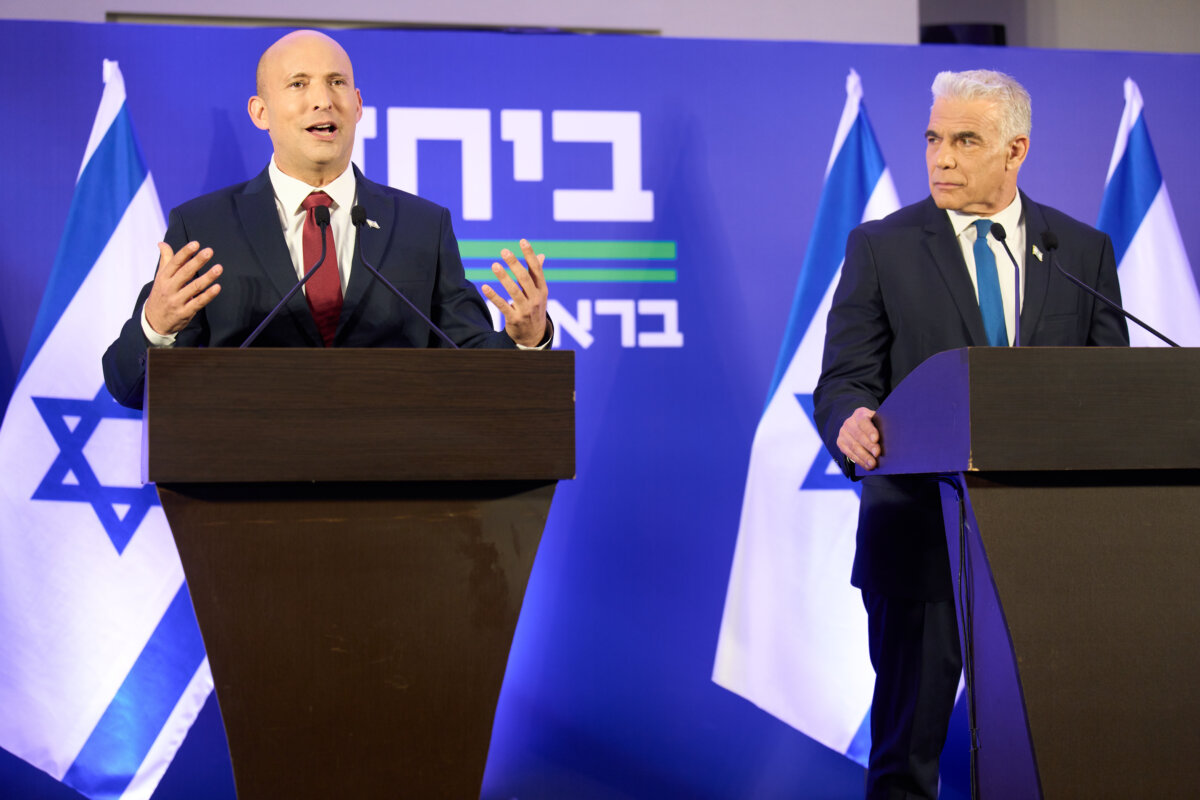

Two former Israeli prime ministers have announced they are joining forces to challenge Prime Minister Benjamin Netanyahu in elections later this year.
Yair Lapid, the current opposition leader, and Naftali Bennett said on April 26 that they are merging their parties, Yesh Atid and Bennett 2026.
At a joint press conference, Bennett said the newly formed “Together” party would run under his leadership and seek what he called “a great victory” in parliamentary elections currently scheduled for Oct. 27.
He described the alliance as “a big step toward fixing the state” and pledged that a government led by him would establish, on its first day in office, a state commission of inquiry into the Oct. 7, 2023, Hamas-led attack on Israel.
Lapid cast the merger as a strategic consolidation of the Israeli center and liberal right.
“This country needs a union as it needs air to breathe,” Lapid said, adding that “the entire Israeli center must stand behind Naftali Bennett.”
He also voiced support for Bennett’s bid for prime minister.
“Bennett is a typical man of the right, but a liberal right, decent, law-abiding right, who has not sold out his values, not to Haredi extortion and not to corruption,” Lapid said. “He was an excellent prime minister, and he will be an excellent prime minister. That is what we need now.”
The announcement marks a significant realignment of the opposition since Bennett and Lapid assembled the so-called “government of change” in 2021. The broad coalition, which ousted Netanyahu after 12 consecutive years in office, collapsed 18 months later under internal divisions.
Alliance Revival
In June 2021, Israel’s parliament approved its coalition by a 60–59 vote, ending Netanyahu’s tenure and bringing together an ideologically diverse alliance that included, for the first time, an Arab party, the United Arab List.
That government struggled to maintain cohesion amid disagreements over the Israeli–Palestinian conflict and domestic governance.
Its collapse contributed to another election in November 2022, when Netanyahu returned to power with a right-wing coalition that remains in office today.
In an April 26 post on Telegram, Netanyahu posted a 2021 photo of Bennett and Lapid with United Arab List leader Mansour Abbas, writing, “they’ll do it again,” in what appeared to be an effort to remind right-leaning voters of the prior coalition’s inclusion of an Arab party.
An April 23 poll by Israel’s N12 News suggested that the merger could strengthen the opposition’s electoral prospects.
The survey projected that Bennett’s party would win 21 seats in the 120-member Knesset, compared with 25 for Netanyahu’s Likud, and Lapid’s party was forecast to take seven seats, down sharply from its current 24.
The poll also indicated that Netanyahu’s bloc of right-wing and religious parties would secure about 50 seats, short of a majority, while a potential Bennett–Lapid-led coalition, together with smaller allied factions, could reach at least 60 seats, near the 61 needed to govern.
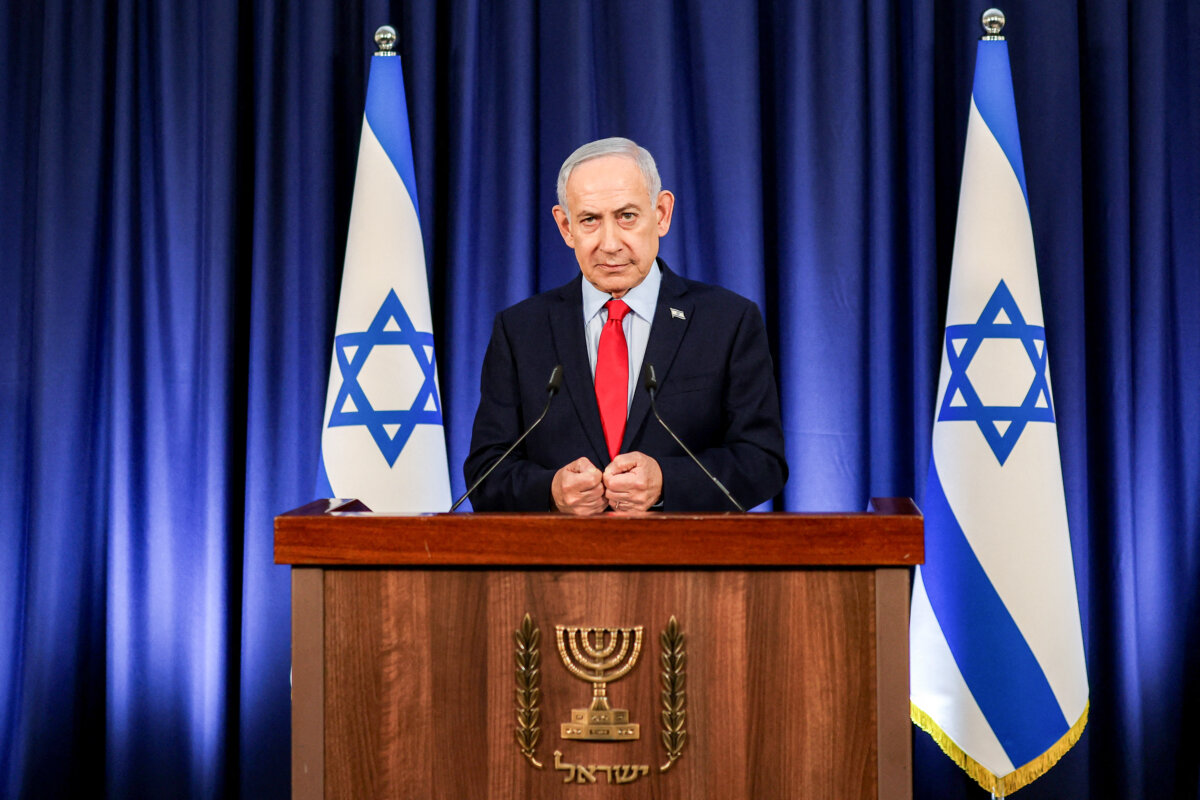
Between 2019 and 2022, Israel held five elections in less than four years, underscoring the instability produced by a parliamentary system in which no single party has ever won an outright majority. In three of those contests, Netanyahu failed to form a government despite Likud’s strength.
Bennett said in an April 26 post on X that the “era of division is over,” while Lapid, also writing on social media, called the alliance the “first step” in changing Israel’s direction and said the country needed unity like it “needs air to breathe.”
Netanyahu remains Israel’s longest-serving prime minister and a dominant political force despite corruption charges that he denies and repeated electoral challenges.
Reuters and The Associated Press contributed to this report.
 Friends Read Free
Copy
Facebook
Tweet
Friends Read Free
Copy
Facebook
Tweet