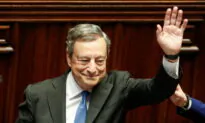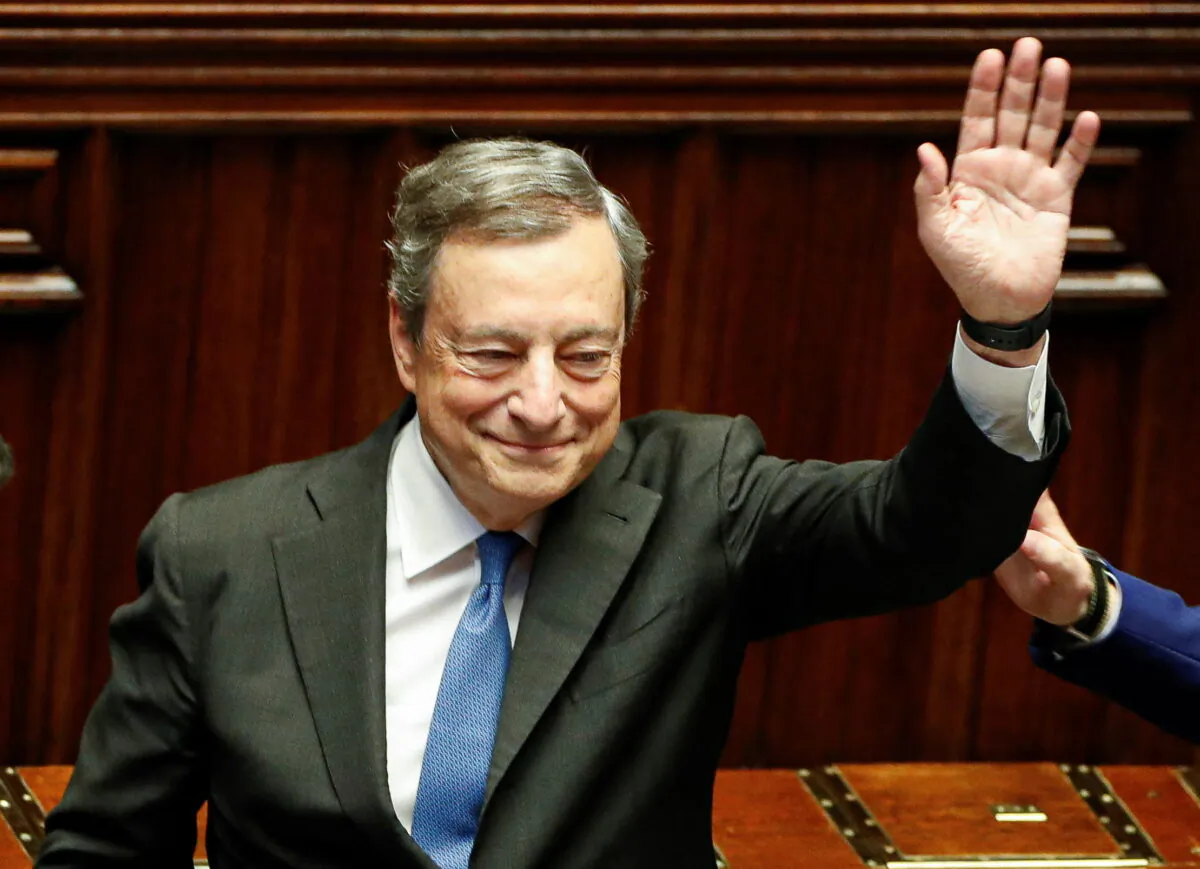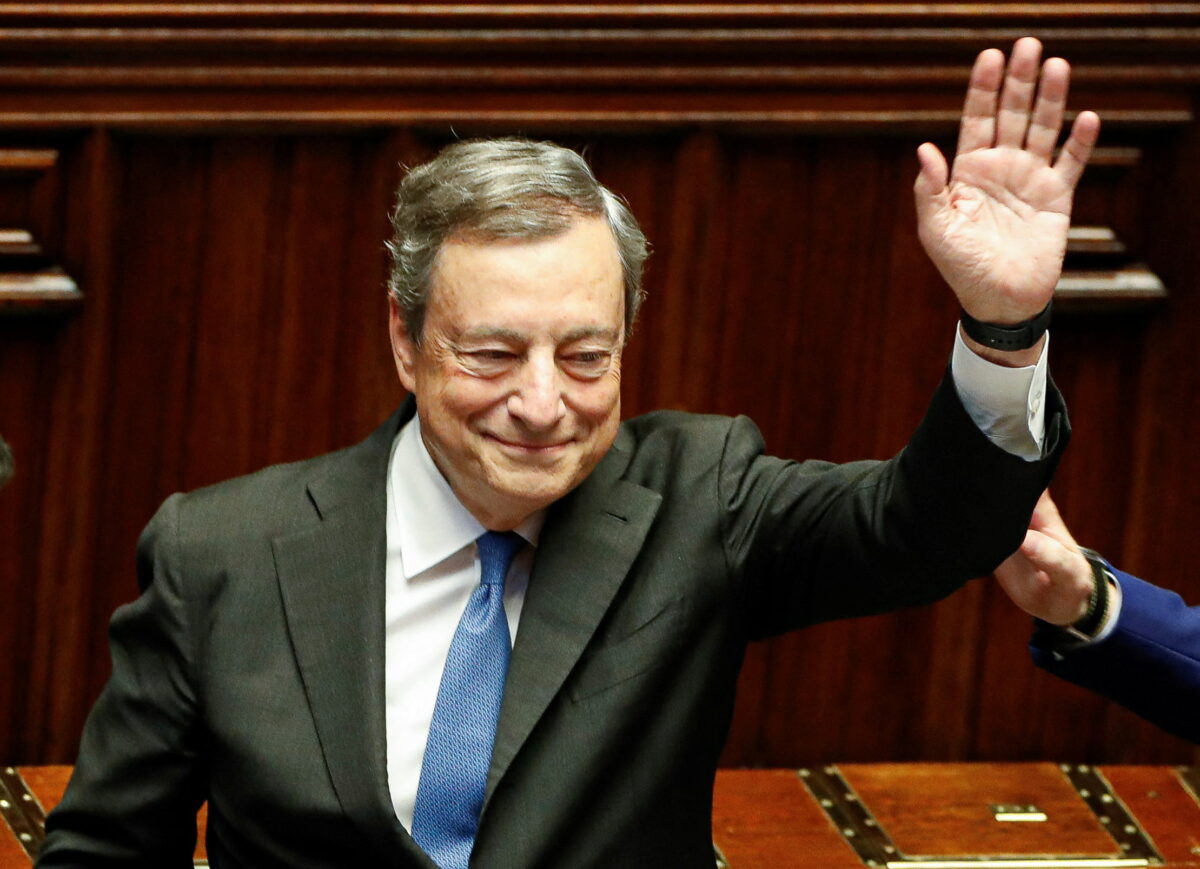
Former Italian Prime Minister Mario Draghi has called for the European Union to transform itself into a federal bloc, akin to the United States, to adapt to a new world order.
“Power requires Europe to move from confederation to federation,” Draghi said in a keynote speech at the University of Leuven in Belgium on Feb. 2.
Draghi, a 78-year-old economist, was Italy’s prime minister from February 2021 to October 2022, president of the European Central Bank from 2011 to 2019, and before that, chair of the Financial Stability Board.
“Of all those now caught between the United States and China, Europeans alone have the option to become a genuine power themselves,” he said.
“So we must decide, do we remain merely a large market subject to the priorities of others, or do we take the steps necessary to become one power?
“Grouping together small countries does not automatically produce a powerful bloc.
“This is the logic of confederation—the logic by which Europe still operates in defense, in foreign policy, in fiscal matters. This model does not produce power.”
He proposed creating a federation of states, adding that, currently, the EU was being treated as a “loose assembly of middle-sized states which can be divided.”
He said there were persuasive arguments that the 27-member bloc needed to become a single federal state to compete with the United States and China.
“We face a United States that, at least in its current posture, emphasizes the costs it has borne while ignoring the benefits it has reaped,” Draghi said, adding that the Trump administration was “imposing tariffs on Europe, threatening our territorial interests, and making clear, for the first time, that it sees European political fragmentation as serving its interests.”
Draghi: China Exploiting ‘Leverage’
“We face a China that controls critical nodes in global supply chains and is willing to exploit that leverage,” Draghi said.
“Flooding markets, withholding critical inputs, forcing others to bear the cost of its own imbalances.”
Caught between the United States and China, Draghi warned that Europe risked becoming subordinated, divided, and deindustrialized.
“The now defunct global order did not fail because it was built on illusion,” Draghi said, but because the rise of China threatened American hegemony.
Without naming China, Draghi said, “Some states pursued absolute advantage through mercantilist strategies, forcing de-industrialization onto others.”
He said this led to a “political backlash.”
Draghi emphasized the power of the EU’s economy, saying the bloc imports 3.6 trillion euros ($4.25 trillion) of products from the rest of the world, produces half the world’s planes, and makes the engines that power most of the world’s ships, and that European firms control 100 percent of ultraviolet lithography, the technology required to make the most advanced microchips.
The bloc that is now the EU was founded in 1957, as the European Economic Community, and originally included only France, West Germany, Italy, Belgium, Luxembourg, and the Netherlands.
Over the years, it expanded. In 1992, the Maastricht Treaty created a stronger political union with less room for national deviation. By 2016, it included 28 countries and was increasingly politically and economically integrated, prompting dissent in Britain and several other countries.
In June 2016, the UK narrowly voted to exit the EU, with Leave campaigners fearing they were being politically subsumed.
There remains a range of views across the 27 nations about whether they should integrate more.
Monday’s speech is not the first time Draghi has warned of the danger of the EU falling behind.
In 2024, he produced a 400-page report on competitiveness, which stated that the bloc needed to invest up to 800 billion euros ($945 billion) per year to digitize and decarbonize the economy and to increase defense capacity.
Draghi, one of Europe’s leading strategic thinkers, and Enrico Letta—who produced his own report on the future of the single market in 2024—have been invited to an informal meeting of EU heads of state at Alden Biesen, a former Teutonic Order castle in Belgium, on Feb. 12.
In his letter of invitation, Antonio Costa, the president of the European Council, said the 27 EU leaders would spend the morning discussing with Draghi “the impact of the new geopolitical and geoeconomic environment on the EU’s competitiveness.”
In the afternoon, they would hear from Letta on “how to leverage the potential of our single market in a fast-changing world,” and then discuss how to reinforce the EU’s competitiveness.
The Epoch Times has reached out to the European Commission but has not received a response.
 Friends Read Free
Copy
Facebook
Tweet
Friends Read Free
Copy
Facebook
Tweet