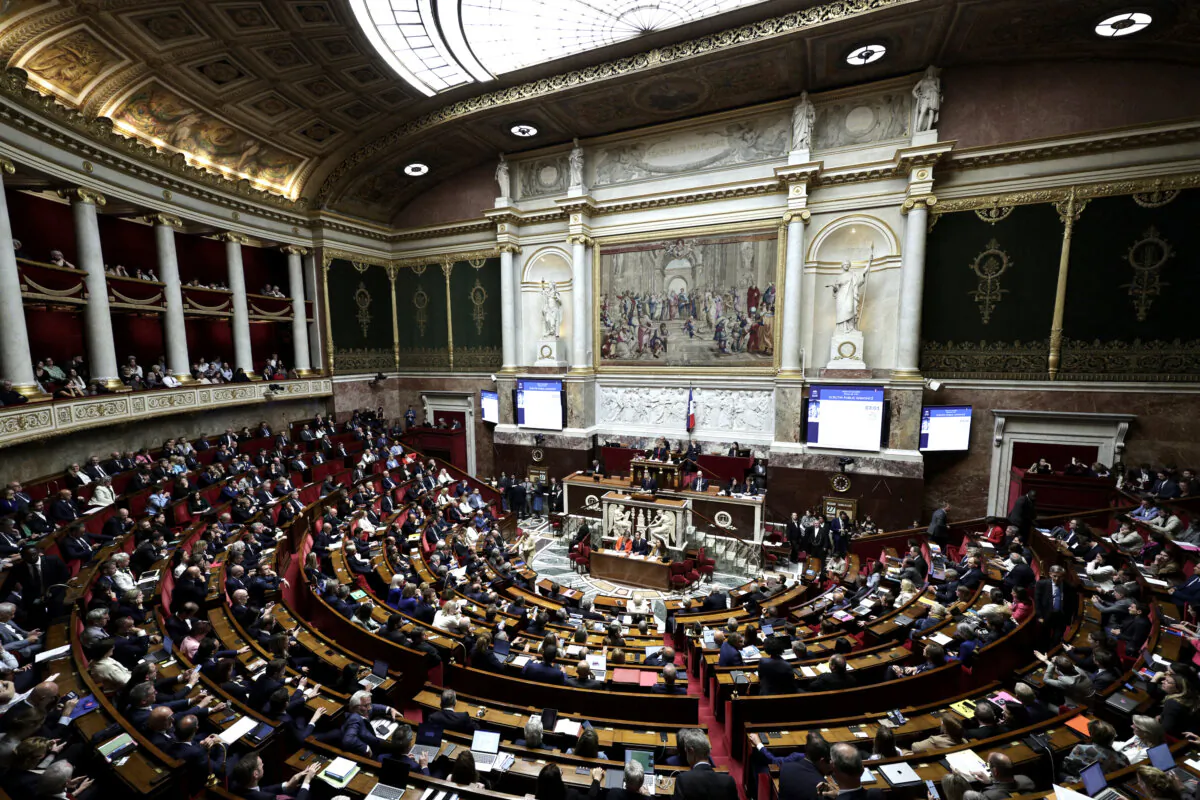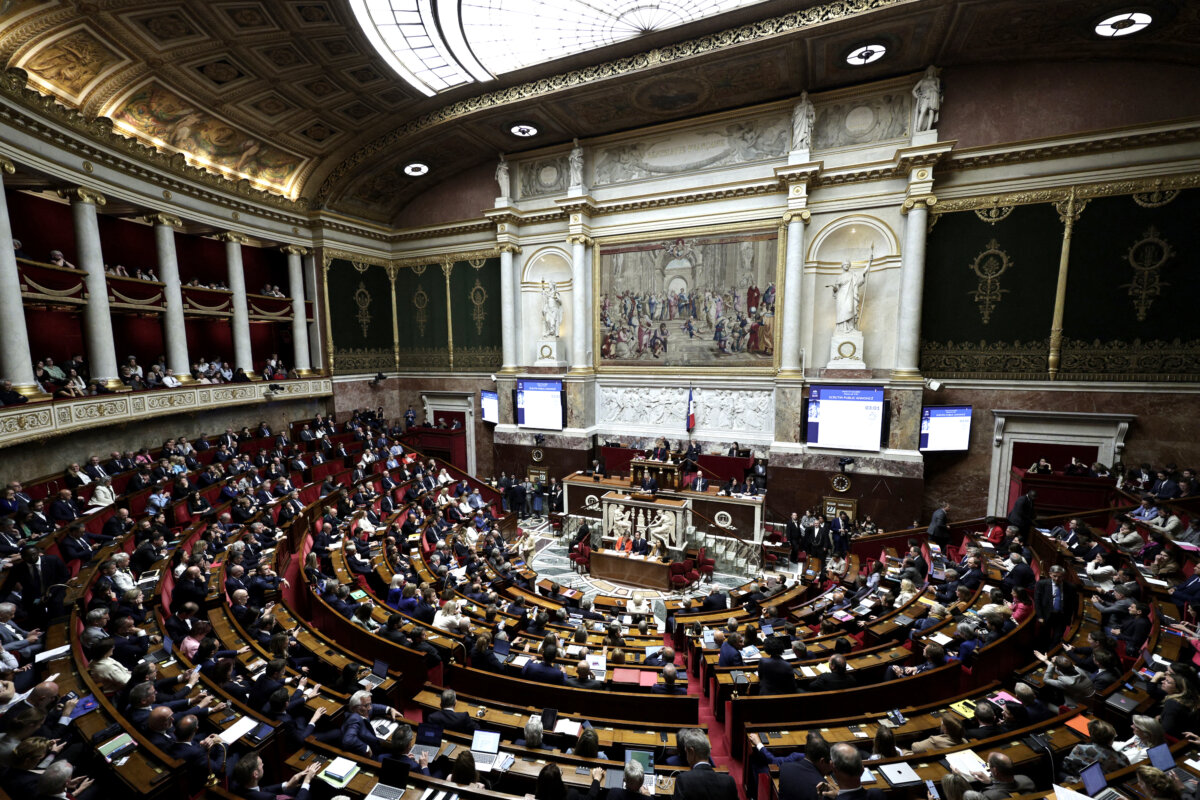

PARIS—The French Parliament gave final approval on July 21 to a bill barring children younger than 15 from social media, making France the first European Union member state to impose an outright age limit.
The Senate adopted the compromise text 243–2, and the National Assembly followed hours later, 279–81.
The ban covers new accounts from Sept. 1, while platforms have until Jan. 1, 2027, to close accounts already held by under-15s.
The law also extends the school cellphone ban to high schools and exempts online encyclopedias, educational repositories, and open-source development platforms. It carries no penalty for children or parents.
The measure is a signature reform of the final term of French President Emmanuel Macron, who ordered the bill to be fast-tracked to take effect from the new school year.
Following the law’s adoption, Macron hailed it as “a major advance” in a video posted on social media.
“France is leading the way in Europe in protecting our children and our teenagers,” he said.
Gabriel Attal, the former prime minister who leads Macron’s party in the National Assembly, wrote on X: “Faced with the health and educational catastrophe that social media threatens to become for our young people, France has chosen not to stand by. This is the culmination of a relentless fight.”
The law does not prescribe how platforms must check ages. Anne Le Hénanff, digital affairs minister, said all French users would have to prove their age during the four-month transition, while insisting that privacy is protected: No identifying data would be stored or shared with platforms.
She has also made the case for the law, arguing that early exposure to social media damages children’s mental health.
Free Speech Concerns
Opponents said they did not dispute the harm social media can inflict on children, but warned that the bill puts civil liberties at risk.
“From a legislative standpoint, the problem is twofold,” Alexandre Allegret-Pilot, a National Assembly member with the conservative Union of the Right for the Republic Party, who voted against the bill, told The Epoch Times.
“First, it was never truly debated in the National Assembly, leaving a vague and poorly constructed legal framework. Second, it offers no safeguards for fundamental freedoms and no guarantee that the state will refrain from policing online speech.
“Beyond the law, raising children is the responsibility of parents, not of the state.”
National Rally member of Parliament Laure Lavalette told the National Assembly: “We support the goal of banning access to social networks for minors under the age of 15. While your bill addresses the ‘why,’ it unfortunately does not, in its current form, answer the question of ‘how,’ and at this stage represents a potential infringement on the civil liberties to which we are deeply committed.”
Most National Rally lawmakers abstained instead of voting against the legislation.
“A legitimate cause, protecting children, risks being put to other ends,” Nicolas Conquer, cofounder of La Flamme de la Liberté, a French free speech advocacy group, told The Epoch Times.
“One need only look at the apparatus of speech control now taking shape: the Digital Services Act; the shutdown of C8, a conservative television channel judged too politically incorrect; the pressure now bearing down on CNews; and the repeated attacks on X, including the legal proceedings opened against Elon Musk’s platform in France.”
Criticism also came from the other end of the political spectrum.
Louis Boyard, of the hard-left France Unbowed Party, told the National Assembly that the text’s real purpose was to force the entire French population, whatever their age, to verify their identity before logging on. Bill author Laure Miller rejected the charge.
The law will be referred to the Constitutional Council, which has one month to rule on it.
The Council of State, France’s highest administrative court, cautioned during its review that the text must preserve the “freedom of expression” of the young.
Senators dropped an earlier blacklist mechanism over fears that it breached EU law. Catherine Morin-Desailly, who steered the bill through the upper house, conceded that constitutional censure was a risk.
Doubts Over Enforcement
Australia, which barred under-16s from social media in December 2025, offers the only precedent.
A survey of 1,050 Australians aged 12 to 15 conducted in March by the UK-based suicide prevention organization the Molly Rose Foundation found that more than 60 percent of those who held accounts before the ban still reached at least one platform, using borrowed logins, false birthdates, and workarounds to facial scans.
Brussels is moving in the same direction.
The European Commission unveiled an age verification app in April, and European Commission President Ursula von der Leyen has said minors should have “phased and gradual access” to social media.
Several government agencies, professional associations, and research institutes have raised concerns about children’s exposure to social media.
In the United States, Heat Initiative, a nonprofit focused on online child safety, has documented how routinely minors run into harmful material and unwanted contact online.
In a series of reports on Snapchat, the group found that children encountered sexually suggestive material, bullying, self-harm imagery, and drug-related content on the app. Many said the exposure left them anxious, depressed, uneasy, or numb to what they had seen, in some cases for days afterward.
Overall, the organization said that big platforms need to do much more to protect children from online harm.
 Friends Read Free
Copy
Facebook
Tweet
Friends Read Free
Copy
Facebook
Tweet