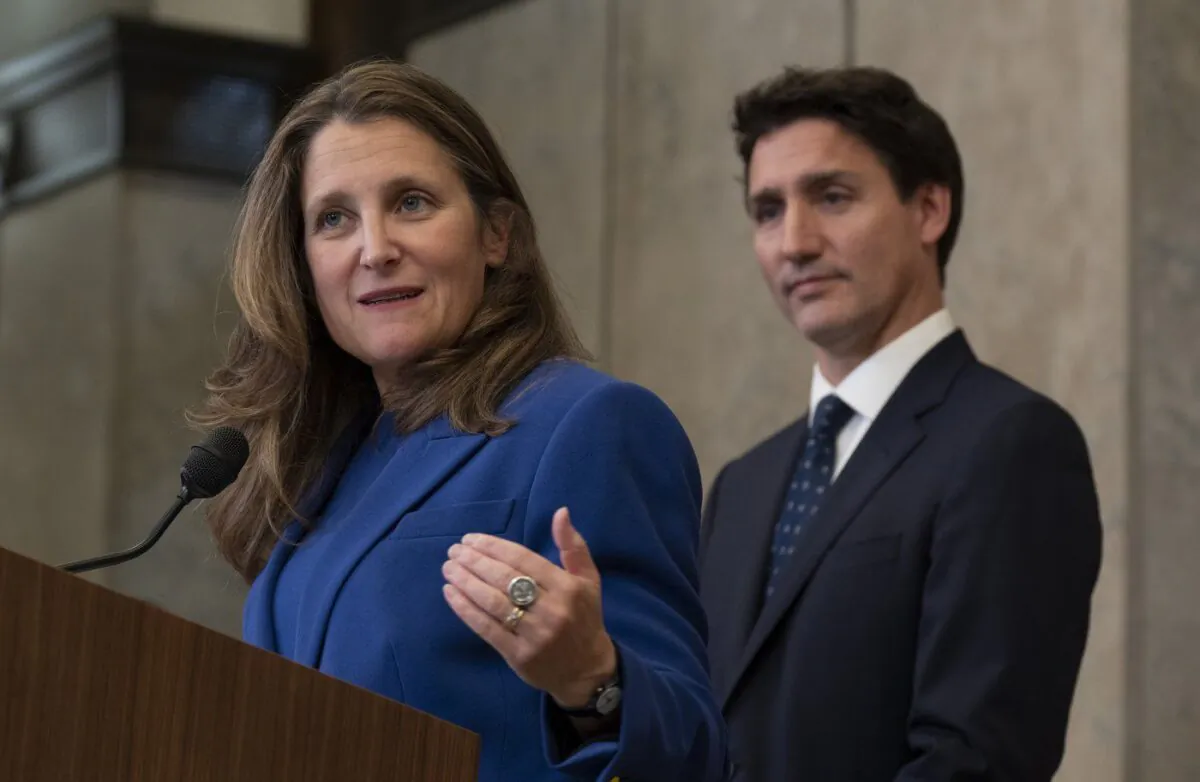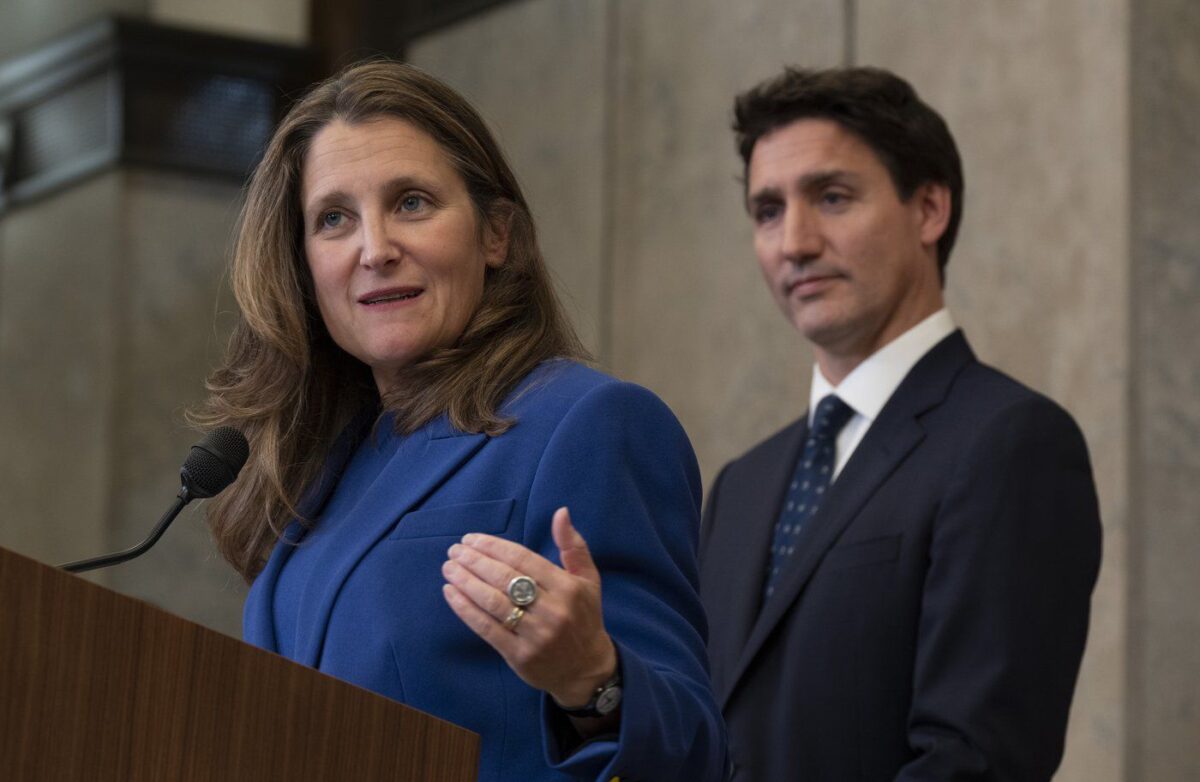

Chrystia Freeland says in her new book that she was encouraged by former Prime Minister Jean Chrétien to resign from Justin Trudeau’s cabinet, as the prime minister prepared to remove her as finance minister in late 2024.
In Freeland’s new book “Unreliable Boyfriend”—which details her time in Trudeau’s cabinet and dealing with trade negotiations with the United States—she also provides details on how her relationship with former Prime Minister Trudeau soured. The book’s title refers not to Trudeau, but to the United States under President Donald Trump.
The former deputy prime minister wrote that in November 2024, as rumours circulated on Parliament Hill that Trudeau was preparing to replace her with Mark Carney, she called Chrétien for advice. According to Freeland, Chrétien told her that her loyalty to Trudeau had reached its logical limit.
Chrétien warned that as long as she remained in cabinet and continued to publicly support Trudeau, he would stay on as prime minister and the Liberals would lose the next election to Conservative Leader Pierre Poilievre.
“And if that happens, it will be partly your fault,” Chrétien told her, according to Freeland.
Freeland wrote that before she was scheduled to deliver the fall economic statement on Dec. 16, 2024, she discovered Trudeau had removed more than $12 billion in spending cuts she had included. She said the economic statement was intended to tighten the government’s finances and prepare for trade tensions with the incoming Trump administration.
Freeland wrote that Trudeau had become focused solely on his political survival and that, “in his desperation, he was doing increasingly stupid things.”
On Dec. 13, 2024, Trudeau told Freeland during a Zoom call that she would be replaced as finance minister and offered her another cabinet position with responsibility for Canada-U.S. relations. Freeland resigned from cabinet on Dec. 16, 2024, the day she had been scheduled to deliver the fall economic statement, which was instead tabled by Government House Leader Karina Gould.
Freeland wrote that Chrétien called her after her resignation to congratulate her for doing the “right thing.” Freeland would go on to run for leadership of the Liberal Party after Trudeau announced his intention to resign as prime minister, but came in second place to Mark Carney.
Freeland wrote that she believed she could have won the 2025 election for the Liberal Party and go on to serve as an “effective” prime minister. Despite losing to Carney, she said he has been an “excellent” prime minister.
Freeland was appointed to be transport and internal trade minister by Carney in March 2025, but resigned the position in September 2025 to become special representative for the reconstruction of Ukraine. She resigned from that position four months later, and in July became CEO of the Rhodes Trust.
Trudeau and US Trade
In her book, Freeland also praises Trudeau, citing his role in securing trade deals with the United States, European Union, Pacific Rim countries, as well as rolling out a national daycare program and managing the COVID-19 pandemic.
She wrote that Trudeau played “hardball” in negotiations over the Trans-Pacific Partnership, angering the leaders of Australia and Japan, but said it demonstrated his leadership abilities.
However, Freeland wrote that as Trudeau’s time in power wore on, Canadians began to dislike his “self-righteous exhibitionism.”
“Crying was routine at cabinet meetings,” she wrote. “There were always boxes of Kleenex on hand, and really sad colleagues would sometimes get a hug from the PM.”
Trudeau was also known to humiliate members of his cabinet, police words he deemed offensive, and had a tendency to pick on those weaker than him, she said. Freeland wrote that she was bothered by Trudeau’s “lectures” that she said often accompanied behaviour that “seemed like bullying.”
Freeland wrote that Trudeau once publicly scolded a female colleague at length for describing something as “crazy,” which he said was a derogatory term that could insult people with mental health issues. He told the woman to instead use the term “bananas.”
The former finance minister also wrote that during negotiations with the United States over the North American Free Trade Agreement (NAFTA) in 2018, she had become so concerned that the deal would fall apart that she started writing a speech to be delivered to Canadians about its demise.
After several heated meetings with U.S. officials on NAFTA, Freeland said she would “take refuge” in the women’s bathroom, and in one “particularly dire moment” she “got down on my knees on the cold white tiles in front of the sinks and prayed.”
Freeland wrote that Canada only managed to save that agreement because it imposed retaliatory tariffs on the United States when Washington hit Canada with steel and aluminum tariffs. She said Trudeau’s bold approach was what ensured Canada returned to a “reciprocal relationship” with its southern neighbour.
During Trump’s second term, Washington has imposed tariffs on Canadian steel, aluminum, automobiles and lumber, among other products, prompting Ottawa to impose retaliatory tariffs of its own. Trump has also said the United States would be better off without the Canada-United States-Mexico Agreement (CUSMA), which replaced NAFTA in 2020, and has expressed reluctance to renew the deal.
Freeland wrote that Canadians are “living in a time of three big fights”—between democracies and authoritarian countries, between global alliances and “predatory isolationism,” and between “people and plutocrats.”
 Friends Read Free
Copy
Facebook
Tweet
Friends Read Free
Copy
Facebook
Tweet